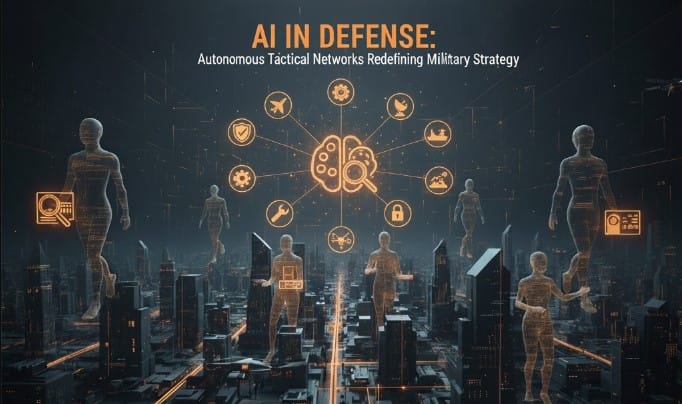
Introduction: A New Layer of Military Power
Artificial intelligence (AI) is shaping a profound shift in defense: the rise of autonomous tactical networks — distributed systems of sensors, platforms, and decision-making agents that operate with varying degrees of autonomy. In 2025 these networks are moving from experiments and prototypes into more integrated roles, augmenting human operators and changing how militaries sense, decide, and act across land, sea, air, space, and cyber domains.
This article explains what autonomous tactical networks are, what they can and cannot safely do, how they affect strategy and doctrine, the ethical and legal questions they raise, and the governance approaches needed to manage their risks.
1. What Are Autonomous Tactical Networks?
Autonomous tactical networks are interconnected collections of platforms and systems — such as drones, ground vehicles, sensors, communication nodes, and backend AI services — that share information and use algorithms to coordinate activities. They range from semi-autonomous sensor-fusion systems that support human decision-making to more autonomous swarms that can carry out limited tasks under defined rules.
Key characteristics:
- Distributed sensing: Multiple sensors share data to create a common operational picture.
- Adaptive autonomy: AI components adjust behavior in real time to changing conditions.
- Networked coordination: Systems collaborate, allocate tasks, and manage priorities across the network.
- Human-in-the-loop / on-the-loop modalities: Degrees of human oversight vary by mission and policy.
2. Core Technologies (High-Level)
To understand capabilities without veering into operational instruction, here are high-level technology building blocks:
- Sensor fusion & edge computing — combining data from multiple sources near the point of collection.
- Machine perception — object recognition, anomaly detection, tracking (kept at conceptual level).
- Autonomy frameworks — decision-support layers that recommend or select actions under constraints.
- Secure, resilient communications — low-latency, encrypted links and distributed architectures.
- Human–machine interfaces — dashboards, alerts, and controls for operators to supervise or intervene.
These technologies empower faster sensing and options generation, not unilateral human replacement when responsibly deployed.
3. Strategic and Doctrinal Impacts
Autonomous tactical networks influence strategy in several broad ways:
- Tempo and decision advantage: Faster data processing and pattern recognition compress the observe-orient-decide-act (OODA) loop, enabling quicker responses.
- Distributed operations: Smaller, networked units can operate more independently, complicating an adversary’s targeting and shaping tactics.
- Scalability: Networks enable scaling of surveillance and presence without proportionally increasing personnel risk.
- Persistence and reach: Continuous monitoring and extended presence in contested or denied areas become more feasible.
These changes encourage doctrines emphasizing multi-domain integration, resilience, and mission-focused autonomy, while also elevating the importance of command-and-control design.
4. Operational Risks and Limitations (Do Not Provide Tactics)
While promising, autonomous networks come with important limitations and risks that decision-makers must manage:
- Reliability under degraded conditions: Sensors and ML models can fail or degrade under adversarial conditions (jamming, spoofing, novel environments).
- Uncertainty & edge cases: AI systems can misinterpret novel situations; unpredictable behavior is particularly risky in high-stakes contexts.
- Escalation dynamics: Faster autonomous responses could inadvertently accelerate escalation if not carefully governed.
- Interoperability challenges: Integrating heterogeneous systems across services and partners is technically and organizationally complex.
Acknowledging these constraints is essential to responsible deployment and to avoid overreliance on automation.
5. Ethical, Legal, and Normative Considerations
Autonomous defense systems raise weighty ethical and legal questions. Responsible adoption requires attention to:
- Human accountability: Who is responsible for decisions made or enabled by autonomous systems? Command structures must preserve clear lines of accountability.
- Compliance with international humanitarian law (IHL): Distinction, proportionality, and precautions in attack must be respected; systems must be designed and used in ways that uphold legal obligations.
- Bias and fairness: ML models trained on incomplete or biased data may produce discriminatory or unsafe outputs; auditing and validation are necessary.
- Transparency and explainability: Decision-support systems should provide interpretable rationale so humans can assess and contest recommendations.
- Dual-use and proliferation: Civilian technologies can be repurposed; export controls, norms, and safeguards are important to reduce misuse.
Policymakers, militaries, and technologists must collaborate to translate ethical principles into operational rules and binding procedures.
6. Command, Control and Human Supervision
Design choices around human supervision shape risk profiles:
- Human-in-the-loop: Systems present options but require human approval before kinetic or consequential actions. This preserves direct human control.
- Human-on-the-loop: Systems can act autonomously but are monitored; humans can intervene or abort actions.
- Human-out-of-the-loop (limited, tightly controlled experiments): Generally discouraged for lethal outcomes and subject to strict legal and ethical scrutiny.
Best practice emphasizes meaningful human control for decisions with significant ethical or legal consequences, while allowing constrained autonomy for sensing, logistics, and low-risk tasks to increase operational effectiveness.
7. Resilience, Security, and Counter-AI Threats
Autonomous networks must be resilient to adversary actions and system faults:
- Adversarial threats: Attempts to deceive or manipulate models (e.g., spoofing) require robust detection and fallback behaviors.
- Cybersecurity: Secure software supply chains, authentication, and encryption are essential to protect integrity and availability.
- Graceful degradation: Systems should have safe fallback modes when communications fail or models detect anomalies.
- Red teaming and continuous testing: Ongoing evaluation under realistic conditions reduces surprise and improves robustness.
These measures reduce the risk that autonomy becomes a vulnerability under contestation.
8. Policy, Governance and International Norms
Managing military AI responsibly requires layered governance:
- National policies: Clear doctrines, legal guidance, and procurement standards that define acceptable uses and required oversight.
- Operational procedures: Checklists, human-review gates, and certification processes before deployment.
- Transparency and reporting: Where feasible, public reporting on policy commitments and safeguards builds trust.
- International cooperation: Dialogues, confidence‑building measures, and potential norms or treaties help limit destabilizing uses and proliferation.
Several governments and multilateral forums are already working on responsible AI principles; translating them into enforceable standards is the next step.
9. Societal and Workforce Implications
Autonomous defense systems will affect people and institutions:
- Workforce evolution: New roles (AI analysts, system integrators, ethics officers) will be in demand; training and reskilling are essential.
- Civil‑military interfaces: As AI blurs defense and civilian tech ecosystems, partnerships must manage dual‑use concerns while preserving oversight.
- Public trust: Keeping citizens informed about safeguards and oversight strengthens legitimacy for responsible deployments.
Investment in human capital and transparent governance helps societies adapt while reaping benefits.
10. Recommendations for Responsible Adoption
For defense leaders and policymakers pursuing autonomous tactical networks:
- Prioritize human-centered design: Ensure systems enhance, not replace, human ethical judgment.
- Adopt rigorous testing & validation: Simulations, live trials, and red-team assessments under diverse conditions.
- Enforce legal and ethical guardrails: Codify human-in-the-loop requirements for high-consequence actions.
- Invest in resilience & security: Harden systems to cyber and adversarial manipulation.
- Foster interoperability & standards: Use open standards and joint exercises to integrate multi-vendor systems safely.
- Engage internationally: Lead or participate in norm-building forums to shape responsible global practices.
These steps balance operational advantage with safety, legality, and public accountability.
Conclusion: A Strategic Technology — Not a Silver Bullet
Autonomous tactical networks are transforming the character of military operations by improving situational awareness, scaling capabilities, and enabling more agile responses. Yet they are not a substitute for sound strategy, accountable leadership, and robust governance. The most effective and legitimate uses of AI in defense will be those that pair technical capability with clear ethical commitments, rigorous testing, and sustained human oversight.
As nations integrate these technologies in 2025 and beyond, careful policy design, international cooperation, and investment in resilient systems and people will determine whether autonomous networks enhance security responsibly — or introduce unacceptable risks.
Bonus: Further Reading & Resources
(When writing for a public audience, include links to reputable policy reports, ethics frameworks, and defense whitepapers — avoid operational manuals or how-to guides.)