Introduction
In the age of digital finance, the speed and complexity of transactions have reached unprecedented levels. Traditional rule-based fraud detection systems — once sufficient — are now too slow and too rigid to keep up.
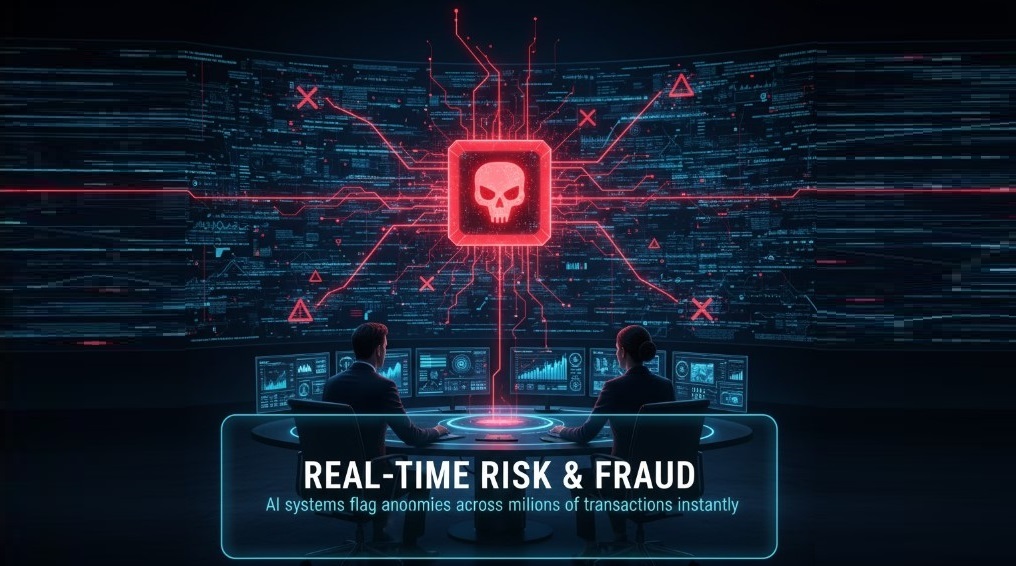
Enter AI-powered risk and fraud detection. Using advanced machine learning and real-time analytics, modern financial systems can now scan millions of transactions per second, identify anomalies, and flag suspicious behavior instantly — all without disrupting legitimate customer activity.
The result? A new era of proactive, intelligent fraud prevention that protects consumers, businesses, and the global financial ecosystem.
Why Real-Time Fraud Detection Matters
Every second, digital payment platforms, banks, and eCommerce systems process enormous volumes of transactions.
This scale has made fraud faster, more sophisticated, and more automated than ever before.
According to industry reports, global fraud losses exceeded $400 billion in 2024, with cybercriminals exploiting weaknesses in legacy detection systems.
To fight back, financial institutions now rely on AI-driven real-time monitoring to:
- Detect suspicious activities before funds are transferred.
- Adapt dynamically to new fraud patterns.
- Reduce false positives to improve customer experience.
How AI Detects Fraud in Real Time
🧠 1. Machine Learning for Pattern Recognition
AI models learn from historical data — both legitimate and fraudulent — to identify complex behavioral patterns that human analysts might miss.
Once trained, they can recognize subtle deviations in:
- Spending habits
- Transaction frequency
- Device location
- IP addresses and authentication methods
These deviations trigger instant alerts for further review or automatic blocking.
⚡ 2. Anomaly Detection at Scale
AI excels at detecting the “needle in the haystack.”
Advanced algorithms like unsupervised learning and neural networks can analyze billions of data points to isolate transactions that don’t fit normal statistical patterns — often within milliseconds.
This enables continuous surveillance without manual intervention.
🔄 3. Real-Time Decision Engines
Modern AI risk systems use streaming analytics platforms such as Apache Kafka, Spark, or TensorFlow Extended (TFX) to process live transaction data.
Each transaction is evaluated instantly using multiple models:
- Risk scoring models
- Behavioral analytics models
- Geolocation anomaly filters
If a transaction exceeds a risk threshold, it’s flagged, delayed, or declined automatically — reducing response time from minutes to microseconds.
🕵️ 4. Natural Language Processing (NLP) for Document and Chat Analysis
AI now monitors communications and documentation to detect hidden fraud signals — such as falsified invoices, phishing content, or insider threats.
For example:
- NLP systems read transaction memos or emails to identify suspicious wording.
- Chatbots powered by AI analyze tone and context to catch social engineering attempts in real time.
Benefits of AI-Driven Fraud Prevention
| Benefit | Description |
|---|---|
| Speed | Detects suspicious activity within milliseconds. |
| Accuracy | Reduces false positives by learning genuine user behavior. |
| Scalability | Handles millions of transactions per second across global networks. |
| Adaptability | Continuously updates to new fraud patterns. |
| Compliance | Automatically logs and explains decisions for regulators. |
AI transforms fraud detection from reactive defense to predictive protection.
Real-World Use Cases
🏦 Banking and Payments
- JPMorgan Chase uses AI to analyze billions of daily transactions, cutting fraud-related losses by over 50%.
- Mastercard’s Decision Intelligence applies machine learning to authenticate transactions in milliseconds, improving approval accuracy.
💳 eCommerce and Retail
- AI identifies fraudulent purchase behaviors, such as unusual cart values or mismatched billing data.
- Systems like Stripe Radar and PayPal Fraud Protection leverage AI to balance fraud prevention with smooth checkout experiences.
🧾 Insurance and Lending
AI systems analyze claim documents and credit applications to detect synthetic identities or falsified information before approval.
The Role of Explainable AI (XAI)
While AI systems are powerful, regulators require transparency in decision-making — especially in finance.
Explainable AI (XAI) ensures that when an AI flags a transaction, the reasoning is clear and auditable.
For instance, an AI might explain:
“Transaction flagged due to location mismatch and unusual spending pattern exceeding normal daily average by 230%.”
This level of interpretability builds trust between financial institutions, customers, and regulators.
Challenges and Risks
Despite its benefits, AI-powered fraud detection isn’t without challenges:
- Bias in training data can cause unfair flagging of certain users.
- Overfitting may reduce model performance over time.
- Data privacy concerns arise when sensitive financial data is used for training.
- Adversarial AI — fraudsters using AI to outsmart detection systems — is an emerging threat.
Continuous monitoring, retraining, and ethical oversight are essential for reliability.
The Future of AI in Risk and Fraud Detection
By 2030, we’ll see autonomous fraud prevention ecosystems where AI systems:
- Share anonymized data across institutions to detect global fraud networks.
- Use federated learning to train models without exposing sensitive data.
- Employ graph neural networks (GNNs) to uncover complex relationships between fraudulent entities.
- Integrate blockchain analytics for immutable risk tracking.
The future of finance is self-defending, data-driven, and instant.
✅ Conclusion
AI has revolutionized how organizations manage financial risk and fraud. With the ability to analyze millions of transactions in real time, these systems protect businesses and consumers at a scale once thought impossible.
As the global economy becomes more digital, the institutions that adopt AI-powered risk management today will be best equipped to stay ahead of evolving threats tomorrow.
Real-time AI fraud detection isn’t just a technological advantage — it’s the new foundation of financial trust.