💡 Introduction
In 2025, mobile apps are no longer just convenient tools — they are repositories of sensitive data, financial information, and personal interactions. This growing reliance on apps has made security and trust critical priorities.
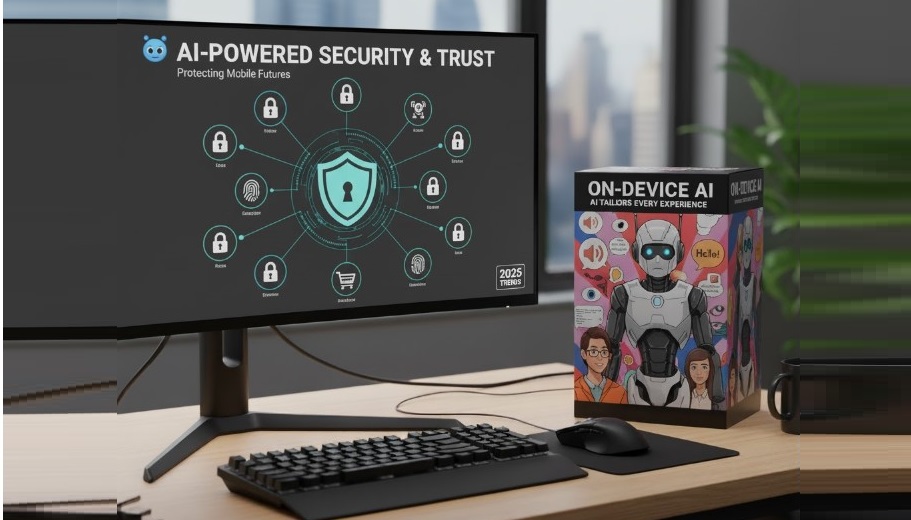
Enter AI-powered security: intelligent systems that detect anomalies, prevent fraud, strengthen authentication, and secure apps in real time. Unlike traditional rule-based security, AI learns patterns, adapts dynamically, and reacts instantly to threats, ensuring a safer mobile ecosystem.
⚙️ What is AI-Powered Mobile Security?
AI-Powered Mobile Security refers to using machine learning, behavioral analytics, and anomaly detection to secure apps and devices. Key functions include:
- Anomaly Detection: Identifying unusual behavior, such as suspicious logins or abnormal transaction patterns.
- Fraud Prevention: Monitoring payments, accounts, and user interactions to stop fraud in real time.
- Enhanced Authentication: Using AI-driven biometrics like facial recognition, voice analysis, and behavioral patterns.
- Threat Prediction: Proactively identifying potential vulnerabilities before they are exploited.
🌟 Benefits of AI in Mobile Security
1. Real-Time Threat Detection
AI can analyze millions of events per second, detecting potential security breaches before they escalate.
2. Adaptive Security Measures
Unlike static security rules, AI systems adapt to evolving threats, learning from patterns and anomalies continuously.
3. Fraud Prevention at Scale
AI identifies fraudulent transactions in real time, even in high-volume environments like banking or e-commerce apps.
4. Enhanced User Trust
When users know their data is protected with advanced AI security, app retention and engagement increase.
5. Reduced Operational Costs
Automating threat detection and response with AI reduces the need for large security teams while improving accuracy.
🧠 Real-World Examples
1. Banking Apps
Apps like Chase, Revolut, and Monzo use AI to detect fraudulent transactions, unusual login locations, or unusual spending patterns, often alerting users instantly.
2. Payment Platforms
PayPal and Stripe employ AI to monitor billions of transactions, detecting anomalies like chargebacks, bot attacks, or account takeover attempts.
3. Mobile Authentication
Apple’s Face ID and Samsung’s biometric behavioral analytics use AI to ensure only authorized users access the device or apps.
4. Enterprise Security Apps
Solutions like CrowdStrike and Lookout Mobile Security leverage AI to detect malware, phishing attempts, and suspicious app behavior across devices in real time.
⚡ How AI-Powered Security Works
- Data Collection: AI systems monitor user activity, app interactions, device metrics, and network traffic.
- Pattern Analysis: Machine learning models identify normal vs. abnormal behavior.
- Anomaly Detection: Any deviations trigger alerts, automated actions, or additional authentication.
- Automated Response: AI can block malicious activity, freeze accounts, or request multi-factor authentication instantly.
- Continuous Learning: AI models evolve to detect new attack methods without manual updates.
🔍 Challenges & Considerations
- False Positives: Over-sensitive AI models may flag legitimate user activity as suspicious.
- Data Privacy: Collecting behavioral and biometric data requires strong compliance with GDPR, CCPA, and other regulations.
- Resource Intensive: AI-powered security can be demanding on device processing or cloud infrastructure.
- Model Bias: AI models must be trained to recognize diverse user behaviors to prevent discriminatory blocking or authentication issues.
🛠️ Best Practices for Developers
- Integrate AI Early: Incorporate AI-powered security from the design phase, not as an afterthought.
- Balance Security & UX: Avoid friction — too many alerts or checks can frustrate users.
- Regular Model Updates: Continuously update AI models to stay ahead of evolving threats.
- Privacy-First Approach: Minimize sensitive data collection and provide transparency to users.
- Hybrid Security: Combine AI with traditional rule-based systems for layered defense.
🌍 The Future of AI-Powered Mobile Security
By 2026, AI-driven security will be a standard feature in mobile apps, from finance and health to social networking. Key trends include:
- On-device AI security for faster detection and privacy protection
- Behavioral biometrics for seamless authentication
- Predictive threat modeling to prevent attacks before they happen
- Generative AI for threat simulation, allowing developers to test security in realistic attack scenarios
“AI doesn’t just react to threats — it predicts, adapts, and defends. In 2025, trust and security will be inseparable from AI intelligence.”