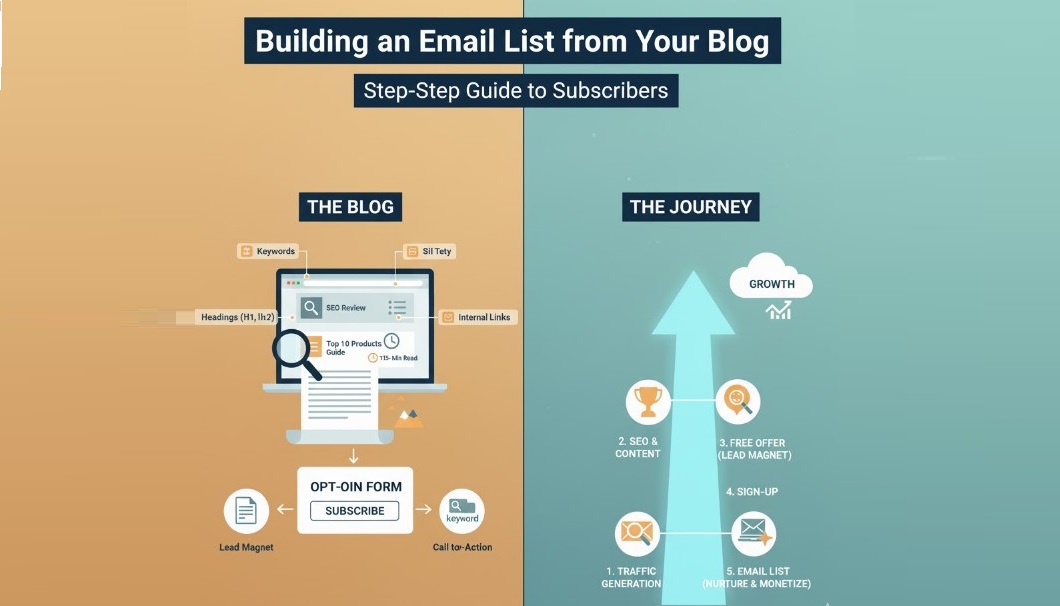
Introduction: Why an Email List Matters
An email list remains the most valuable asset for bloggers in 2025. Unlike social media, where algorithms change unpredictably, an email list gives you direct access to your audience.
“Your blog may get traffic, but your email list is what converts readers into loyal followers and paying customers,” says Nina Roberts, a digital marketing strategist.
This guide walks you through step-by-step strategies to build a robust email list, even if your blog is new.
1. Choose the Right Email Marketing Platform
Start by selecting a platform that suits your needs:
- Mailchimp: Beginner-friendly, free tier available
- ConvertKit: Excellent for creators, automation-friendly
- MailerLite: Affordable, easy to use
- ActiveCampaign: Advanced automation for professional bloggers
Human example:
Leo, a tech blogger, started with Mailchimp for simplicity, then migrated to ConvertKit once his subscriber base grew beyond 1,000.
2. Create a Valuable Lead Magnet
A lead magnet is a free resource offered in exchange for an email address.
Popular types:
- Ebooks or guides
- Checklists and templates
- Mini-courses via email
- Resource libraries or swipe files
Human example:
Emma, a finance blogger, created a “30-Day Budget Challenge” PDF. Within a month, she gained over 200 subscribers — even before her blog had significant traffic.
Tip: Make your lead magnet highly relevant to your audience’s pain points.
3. Optimize Your Blog for Conversions
Your blog must encourage visitors to subscribe:
- Pop-ups: Use timed or scroll-triggered pop-ups
- Inline forms: Embed forms within posts
- Sidebar forms: Keep subscription options visible
- Exit-intent pop-ups: Capture users before they leave
Pro tip: Avoid overwhelming readers with multiple pop-ups — focus on quality over quantity.
4. Craft an Effective Opt-In Form
Key elements for a high-converting form:
- Clear, benefit-driven headline (“Get Your Free 30-Day Budget Challenge”)
- Short description explaining the value
- Minimal fields (name and email work best)
- Strong call-to-action (CTA) button (“Download Now” or “Join the Challenge”)
Human insight:
Sophia, a health blogger, A/B tested form designs. A simple two-field form with a bright CTA button increased subscriptions by 27%.
5. Write a Compelling Welcome Email
Your first email sets the tone for your relationship:
- Thank subscribers for signing up
- Deliver the promised lead magnet immediately
- Introduce yourself and your blog’s value
- Include a subtle CTA (read a popular post, join a webinar, or check out a product)
Human example:
David, a SaaS blogger, saw 15% higher engagement when he personalized welcome emails with subscriber names and links to popular content.
6. Promote Your Lead Magnet Strategically
Even with minimal traffic, you can grow your list:
- Social media: Share your lead magnet on LinkedIn, X/Twitter, Instagram, and Pinterest
- Guest posts: Include an opt-in link in your author bio
- Content upgrades: Offer exclusive resources within blog posts
- Communities and forums: Share value without spamming
Tip: Focus on audience-relevant channels, not just traffic volume.
7. Automate Email Sequences
Automation helps nurture subscribers:
- Welcome series: Introduce your blog, mission, and resources
- Educational series: Deliver value related to your niche
- Promotional emails: Introduce products, affiliate offers, or courses
Human insight:
Amira, a lifestyle blogger, set up a 5-email welcome series. Engagement rates doubled compared to single, manual emails.
8. Segment Your Audience
Segmentation allows for personalized communication:
- Beginner vs. advanced readers
- Interests or topics (fitness, finance, productivity)
- Engagement levels or purchase history
Benefit: Personalized emails improve open rates, click-through rates, and conversions.
9. Analyze and Optimize
Regularly track metrics:
- Open rate
- Click-through rate (CTR)
- Subscriber growth
- Conversion rate
Pro tip: Use the data to tweak subject lines, content, and CTA buttons. Small improvements compound over time.
10. Human Experiences: Lessons Learned
- Consistency pays off: Leo added subscription forms to every post consistently. Growth was gradual but steady.
- Quality beats quantity: Emma focused on highly valuable lead magnets rather than multiple generic offers.
- Personalization matters: Sophia personalized emails based on audience segments — engagement improved dramatically.
Key Takeaways
- Choose the right email platform for your scale and goals
- Offer a high-value lead magnet relevant to your audience
- Optimize your blog with visible opt-in forms and conversion-focused CTAs
- Craft a welcoming, engaging first email
- Promote your lead magnet across social media, communities, and guest posts
- Automate and segment emails for better engagement
- Track metrics and iterate to grow efficiently
“Your email list is the backbone of your blog’s growth,” says Nina Roberts.
“Traffic is temporary; an engaged list is permanent.”