Introduction
For over a decade, social media has been dominated by a few centralized giants — Facebook, Twitter/X, Instagram, and TikTok. While these platforms offer convenience, they control user data, monetisation, and content visibility, often prioritizing profits over users.
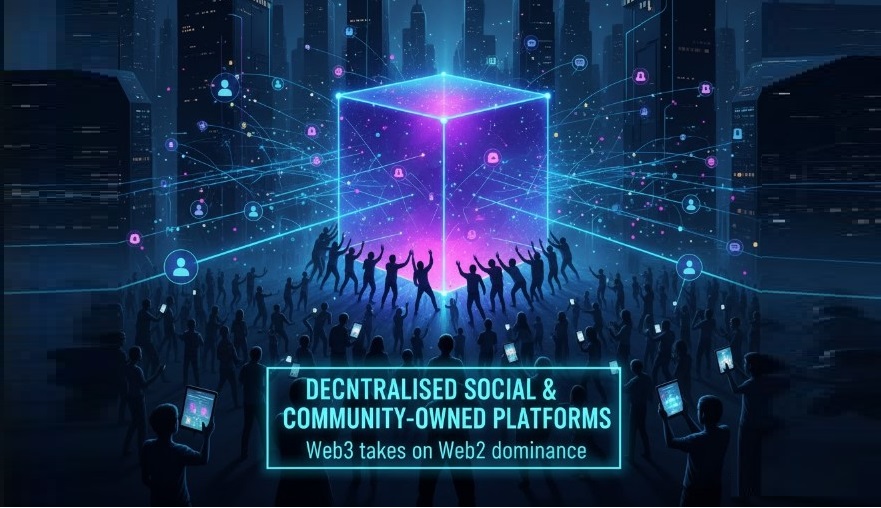
Web3 is changing the game. Decentralised and community-owned platforms are empowering users to own their data, participate in governance, and monetise contributions, challenging traditional Web2 dominance.
By combining blockchain transparency, token-based incentives, and governance models, Web3 social networks promise a more equitable digital social experience.
Why Decentralised Social Platforms Matter
Web2 social platforms face growing criticism for:
- Exploitative monetisation of user data
- Centralised content moderation
- Lack of transparency in algorithms
- Limited revenue sharing with creators
Decentralised social networks tackle these issues by:
- Putting users in control of personal data
- Allowing community governance over content policies
- Enabling monetisation through tokens or NFTs
- Ensuring transparency via blockchain record-keeping
These platforms transform users from passive participants into active stakeholders.
Core Features of Web3 Social Platforms
🧩 1. User-Owned Data
- Personal data is stored on-chain or in decentralized storage systems like IPFS or Arweave.
- Users control permissions and decide who accesses their content, reducing dependency on centralized platforms.
💰 2. Token-Based Incentives
- Platforms reward content creation, curation, and engagement with native tokens or NFTs.
- Example: Lens Protocol allows creators to monetize directly, bypassing traditional ad-driven models.
🗳️ 3. Community Governance
- DAOs (Decentralised Autonomous Organizations) enable users to vote on platform policies, moderation rules, and feature upgrades.
- This ensures democratic participation, reducing arbitrary control by a single company.
🌐 4. Interoperability
- Web3 social networks can integrate with other blockchain apps, DeFi protocols, or NFT marketplaces.
- Cross-platform identity and content portability empower users to maintain influence beyond a single network.
🛡️ 5. Censorship Resistance
- Decentralised architecture ensures no single entity can remove content arbitrarily.
- Ideal for free expression while maintaining community-driven moderation policies.
Examples of Decentralised Social & Community-Owned Platforms
- Lens Protocol: A composable Web3 social graph allowing creators to own profiles, content, and monetisation rights.
- Mastodon: Open-source federated social media network enabling user-driven moderation.
- BitClout / DeSo: Blockchain-based social platforms where users can buy creator coins and participate in governance.
- Mirror.xyz: Decentralised publishing and social engagement platform using Web3 for content monetisation.
These platforms demonstrate the shift from passive content consumption to active participation and ownership.
Benefits of Web3 Social & Community Ownership
| Benefit | Description |
|---|---|
| Ownership & Control | Users own content, data, and digital identity. |
| Fair Monetisation | Creators earn directly through tokens, NFTs, or microtransactions. |
| Transparency | Blockchain records provide verifiable proof of transactions, content, and governance. |
| Censorship Resistance | Community-based moderation ensures balanced enforcement. |
| Interoperability | Users and content can move across Web3 ecosystems seamlessly. |
This approach reshapes social media economics, putting value creation back into the hands of the users.
Challenges & Considerations
- UX & Onboarding: Blockchain wallets, token management, and decentralized identity can be complex for mainstream users.
- Regulatory & Compliance Risks: Token incentives and governance models may fall under financial regulation.
- Moderation & Abuse: Ensuring safe spaces while maintaining decentralisation is challenging.
- Network Effects: Competing with established Web2 giants requires large user bases for meaningful engagement.
- Scalability: Blockchain infrastructure must handle high-volume social interactions efficiently.
Solutions involve layer-2 scaling, simplified wallets, and hybrid models combining decentralisation with usability.
The Future of Decentralised Social Platforms
By 2030, decentralised social and community-owned platforms are expected to:
- Attract mass adoption as usability improves
- Enable cross-platform social identity, where profiles and content migrate across networks
- Integrate AI and predictive analytics for personalized experiences without compromising privacy
- Power token economies, NFTs, and creator DAOs at scale
- Foster global digital communities independent of geographic or corporate control
The ultimate vision is a Web3 social ecosystem where users are empowered, creators are rewarded fairly, and communities govern themselves democratically.
✅ Conclusion
Decentralised social and community-owned platforms are Web3’s direct challenge to Web2 dominance. By giving users ownership, monetisation rights, and governance powers, these platforms create equitable, transparent, and sustainable social networks.
The future of social media is not controlled by a handful of corporations — it’s community-owned, token-enabled, and user-first, marking a radical evolution in how humans connect online.