💼 Introduction
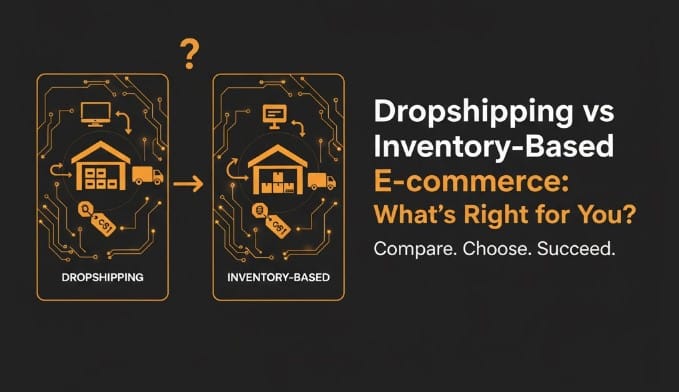
When starting an online store, one of the biggest decisions you’ll make is choosing between dropshipping and inventory-based e-commerce.
Both models have proven successful for thousands of entrepreneurs, but they work very differently. The right choice depends on your budget, goals, and risk tolerance.
This guide breaks down how each model operates, their pros and cons, and how to decide which one fits your business best.
🚚 1. What Is Dropshipping?
Dropshipping is an e-commerce model where you don’t keep products in stock. Instead, when a customer places an order, you forward it to a supplier, who ships the product directly to the buyer.
In short, you sell the product, but someone else handles storage and delivery.
How it works:
- A customer orders from your website.
- You forward the order to your supplier.
- The supplier packages and ships the product directly to your customer.
Popular dropshipping platforms: Shopify, AliExpress, SaleHoo, and Spocket.
🏬 2. What Is Inventory-Based E-commerce?
Inventory-based e-commerce means you buy and store your products before selling them. You manage stock levels, packaging, and shipping (or hire a fulfillment center to do it).
How it works:
- You purchase products in bulk from manufacturers or wholesalers.
- You store them in your own facility or warehouse.
- When an order comes in, you pack and ship it yourself.
Examples: Amazon FBA sellers, boutique store owners, and DTC (Direct-to-Consumer) brands like Gymshark and Allbirds.
⚖️ 3. Dropshipping vs. Inventory-Based: Side-by-Side Comparison
| Aspect | Dropshipping | Inventory-Based |
|---|---|---|
| Startup Cost | Low | High |
| Profit Margin | Low–Medium | Medium–High |
| Inventory Risk | None | High |
| Shipping Speed | Slower (supplier-controlled) | Faster (self-controlled) |
| Branding Control | Limited | Full control |
| Customer Experience | Inconsistent | Consistent |
| Scalability | Easy to scale | Requires storage and logistics |
| Time Investment | Low upfront, but dependent on suppliers | High upfront, more control |
💸 4. The Pros and Cons of Dropshipping
✅ Advantages
- Low risk & cost: No need to buy inventory upfront.
- Easy setup: Launch your store quickly with minimal investment.
- Scalable: Add new products without worrying about stock levels.
- Flexible: Run your business from anywhere.
❌ Disadvantages
- Lower profit margins: Suppliers take a cut of every sale.
- Limited control: Shipping delays or quality issues can hurt your brand.
- High competition: Many dropshippers sell identical products.
- Supplier reliability: Your business depends heavily on third parties.
📦 5. The Pros and Cons of Inventory-Based E-commerce
✅ Advantages
- Higher profit margins: Buying in bulk reduces per-unit cost.
- Brand control: You manage packaging, unboxing, and delivery.
- Better customer experience: Faster shipping and consistent quality.
- Opportunity for branding: Custom packaging and exclusive products.
❌ Disadvantages
- High upfront investment: Buying and storing inventory costs money.
- Storage and logistics: You’ll need space or a warehouse.
- Risk of unsold products: Overestimating demand can lead to losses.
- More time-consuming: Managing stock, packing, and shipping requires effort.
🔍 6. Which Model Is Right for You?
It depends on your goals, experience level, and available capital.
💡 Choose Dropshipping If:
- You’re a beginner with limited funds.
- You want to test multiple products quickly.
- You prefer a hands-off business model.
- You don’t want to deal with warehousing or logistics.
💪 Choose Inventory-Based If:
- You want to build a long-term brand.
- You can afford upfront investment.
- You value product quality control and fast shipping.
- You’re focused on customer satisfaction and retention.
🧠 7. Hybrid Model: The Best of Both Worlds
Many successful e-commerce entrepreneurs combine both strategies.
They start with dropshipping to test which products sell best, then transition to inventory-based for those top performers.
This hybrid model lets you:
- Minimize risk early on
- Scale with confidence
- Optimize margins once you identify your best sellers
💬 8. Key Takeaways
| Scenario | Best Option |
|---|---|
| Low budget & testing phase | Dropshipping |
| Building a strong brand | Inventory-based |
| Prioritizing speed & experience | Inventory-based |
| Flexibility & scalability | Dropshipping |
| Long-term growth | Hybrid approach |
Ultimately, both models can lead to success. Your decision should reflect your resources, risk appetite, and long-term business vision.
🧾 Conclusion
Both dropshipping and inventory-based e-commerce have their place in the digital economy.
If you’re just starting out, dropshipping offers a low-risk path to learn and experiment. But if your goal is to build a lasting brand with loyal customers, managing your own inventory can provide greater control and profitability.
The smartest entrepreneurs often use both — testing with dropshipping and scaling with owned inventory once they find what truly sells.
In e-commerce, success isn’t about choosing one path — it’s about adapting the right model at the right time.