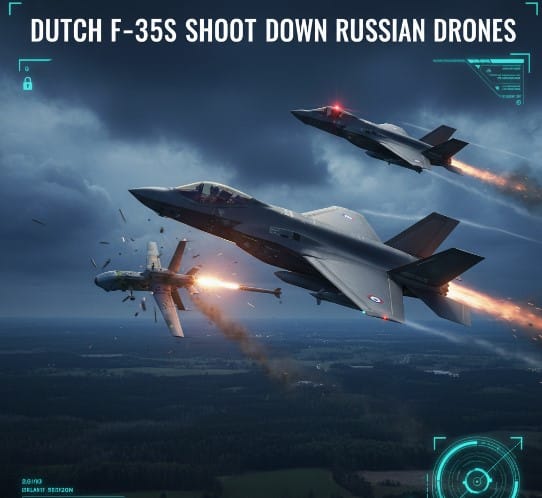
What Happened: The Verified Facts
- Incursion Date & Location
Around the night of 9–10 September 2025, multiple Russian drones crossed into Polish airspace. The event triggered a NATO air response. Defence Industry Europe+4NL Times+4Wikipedia+4 - Dutch F-35 Involvement
Royal Netherlands Air Force F-35A jets were deployed in Poland as part of a NATO air policing rotation (since early September). They reportedly participated in shooting down some of the drones that posed a threat. Defence Industry Europe+3DutchNews.nl+3DutchNews.nl+3 - First Confirmed Drone “Kill Mark”
The Dutch Ministry of Defence released photographs of one F-35A (tail number F-027, 313 Squadron) bearing a “drone kill mark” below the canopy — a symbol of successfully downing a drone during that mission. NL Times+3The Aviationist+3UNITED24 Media+3 - Broader NATO Response
The event led to heightened alert levels. Poland invoked Article 4 of NATO’s treaty (which calls for consultations when member territory is threatened). Other NATO members voiced concern, and air defense systems received reinforcement. AP News+2DutchNews.nl+2
Key Uncertainties & What We Don’t (Yet) Know
- Exact count of drones destroyed by Dutch F-35s
Reports vary. Several drones were shot down, but how many by Dutch jets vs. Polish or other NATO assets remains less clear. NL Times+2DutchNews.nl+2 - Damage on the ground
Minimal. One home was reported damaged in Poland, but no casualties have been confirmed. AP News+1 - Intent & whether drone incursion was deliberate
Poland and NATO officials call it a provocation; Russia denies responsibility or claims drones veered off course. Attribution is contested. DutchNews.nl+2Wikipedia+2 - Weapon systems used & operational details
It’s not yet confirmed exactly what armament was used for each drone engagement. (Though the photographs show kill markings, they don’t give full technical detail in publicly available sources.) The Aviationist+2Defense Mirror+2
Why This Matters: Implications & Context
- First Confirmed Aerial “Kill” Over NATO Territory by Dutch F-35
For the Netherlands, this marks a milestone — F-35s hadn’t before been documented to shoot down adversary drones in NATO-controlled skies. It’s a symbolic and operational precedent. UNITED24 Media+2The Aviationist+2 - Escalation of Drone Usage and Countermeasures
The incident underscores how unmanned aerial vehicles (UAVs) are now active tools in hybrid warfare. NATO and its members are increasing readiness and enhancing air defense, including anti-drone capabilities. Army Recognition+2AP News+2 - NATO’s Eastern Flank & Deterrence Message
The response signals NATO’s commitment to defending its airspace and responding to violations. It also may serve as a deterrent: showing that incursions will be met with force when needed. AP News+3DutchNews.nl+3NL Times+3 - Strategic and Technical Signals
- Using advanced platforms (F-35A) against drones — often cheaper and more expendable systems — raises cost-effectiveness debates.
- The “kill mark” also has symbolic importance: boosting morale, signaling operational successes.
What to Watch Next: What to Expect Going Forward
- Further public statements and more precise after-action reports (number of drones, damage assessments, weapon types).
- Expansion of NATO’s counter-drone capability — more patrols, more rapid response assets, better detection systems.
- Possible increased diplomatic tension, especially if evidence emerges of deliberate cross-border escalation.
- Impact on defense spending / policies in NATO nations, particularly along the eastern border (Poland, Baltics, etc.).
Conclusion
The shooting down of Russian drones by Dutch F-35 jets over Poland is more than a headline — it’s a turning point. It reflects growing urgency about aerial security over NATO territories, the operational use of high-end fighters in unmanned threat scenarios, and the symbolic weight of defending sovereign airspace.
While many questions remain unanswered, what is clear: NATO’s deterrence and readiness posture is evolving, and Europe’s eastern border is no longer a quiet frontline.
🔑 Interactive Question: How do you think NATO should balance the cost of deploying advanced fighters like F-35s to counter drones versus investing in cheaper, dedicated anti-drone systems?