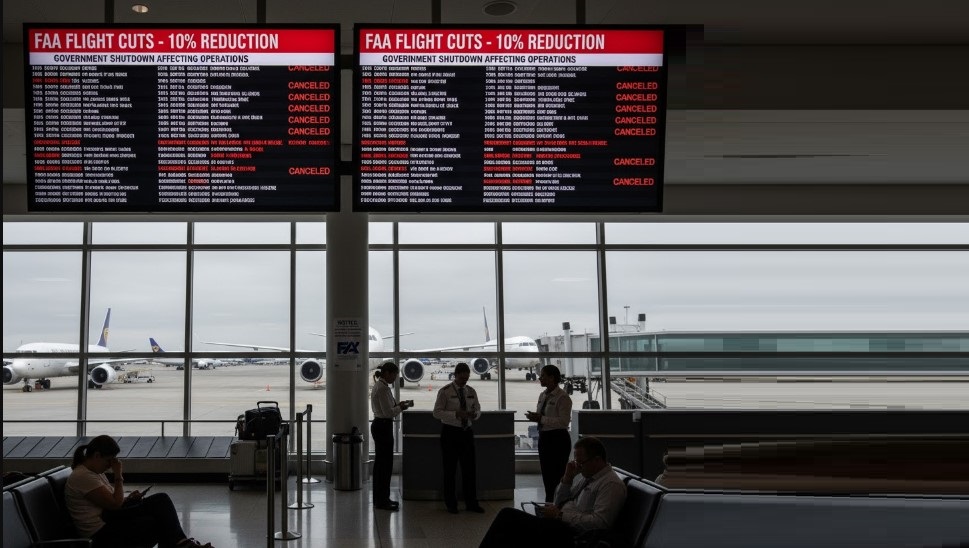
The Federal Aviation Administration (FAA) has announced an unprecedented move: beginning this Friday, the agency will reduce air traffic by up to 10 percent across approximately 40 high-volume U.S. airports as the federal government shutdown drags on. People.com+3AP News+3Reuters+3
What’s driving the action
The decision comes as the shutdown, now the longest in U.S. history, enters its 36th – 37th day. Hundreds of thousands of federal workers are either furloughed or working without pay — including air traffic controllers who are deemed essential. Utah News Dispatch+2Reuters+2
According to the FAA and the U.S. Department of Transportation, staffing shortages and mounting fatigue among controllers are creating a safety risk in the National Airspace System. FAA Administrator Bryan Bedford said the agency could not wait for a crisis to act. Federal News Network
Scale & timing of the cutbacks
- The cuts will begin this Friday, gradually ramping from approximately 4 percent on day one to a full 10 percent shortly thereafter if the shutdown remains unresolved. The Guardian+1
- The reduction will apply to flights across the identified markets and cover passenger, cargo and private operations — though international flights are initially excluded from the earliest phase. Reuters+1
- Estimates suggest that as many as 1,800 flights and 268,000 airline seats could be impacted daily in the affected airports. Reuters+1
Airports and markets likely affected
While the FAA has not publicly released the final list of all 40 airports, sources say most of the nation’s busiest hubs will be included. These likely include:
- Hartsfield‑Jackson Atlanta International Airport (Atlanta)
- Los Angeles International Airport (L.A.)
- Chicago O’Hare International Airport (Chicago)
- Dallas/Fort Worth International Airport (Dallas)
- Denver International Airport (Denver)
- All three of New York’s major airports The Guardian+1
Some airports — such as Kansas City International Airport — reportedly are not on the list of 40, offering a possible route for travelers seeking lower-risk hubs. KMBC
Travel-industry consequences
- Airlines like American Airlines, United Airlines and Southwest Airlines are already adjusting flight schedules, offering flexible change/refund options, and trying to mitigate customer disruption. AP News
- Passenger delays have already surged in recent weeks: more than 5,900 flights were delayed on a recent Saturday, as controller-shortage incidents climbed. Reuters+1
- Because the cuts target the busiest airports and peak hours (6 a.m.–10 p.m. local), ripple effects are likely on connecting flights, regional routes, and cargo operations. The Guardian+1
Safety and regulatory implications
Although the FAA and aviation experts emphasize that air travel remains safe, they warn the system’s buffers are shrinking. CBS News
The reduction in capacity is framed as a pre-emptive measure to reduce risk, not a sign of immediate collapse. As Administrator Bedford stated:
“We’re in new territory in terms of government shutdowns. Our sole role is to make sure we keep this airspace as safe as possible.” The Guardian+1
Why the shutdown is amplifying the issue
- The federal shutdown started October 1, 2025, and has prevented the hiring, training and onboarding of new controllers and other essential personnel. Wikipedia+1
- Many air traffic controllers are working without pay, under mandatory overtime and reduced rest periods — factors known to increase error risk. The Guardian+1
- The FAA already faced a shortage of about 3,500 controllers before the shutdown; the current conditions have worsened those gaps. Utah News Dispatch
What travellers should know
- If you’re flying to or from a major U.S. hub in the coming days, anticipate higher chances of cancellation or delay.
- Check your airline’s website/app and subscribe to flight alerts.
- Consider flying through a smaller airport if feasible, or choosing off-peak times.
- Airlines are reporting that they will provide flexibility — including full refunds — if your flight is cancelled due to the capacity cuts. People.com
- Monitor the news: The cuts are conditional and could be reversed if the government reopens. Reuters+1
Political & operational fallout
The announcement further raises stakes in the budget impasse in Congress. Transportation Secretary Sean Duffy said the cuts would be reversed only if lawmakers agreed to reopen the government. Reuters
Industry groups are also warning of long-term damage to airline reliability and public trust if the shutdown drags on. The Guardian
Looking ahead
- The cuts are scheduled to begin this weekend and will escalate if the shutdown persists.
- Thanksgiving travel — typically one of the busiest periods of the year — could face significant disruption if nothing changes.
- The FAA has not ruled out further reductions or even more sweeping steps if staffing deteriorates further. AP News
Bottom line: The FAA’s decision to slash flight capacity at dozens of major U.S. airports signals how deeply the government shutdown is affecting critical infrastructure — and how quickly ripple effects can hit everyday travellers. If you’re flying in the U.S. within the next week, it’s wise to plan for possible changes and keep flexibility.
Recent FAA / shutdown flight‑cut news


US to cut airline traffic by 10% at 40 airports amid shutdown, Trump transport chief says

FAA reducing air traffic by 10% across 40 ‘high-volume’ markets during government shutdown


US orders 10% flights cut at major US airports due to shutdown