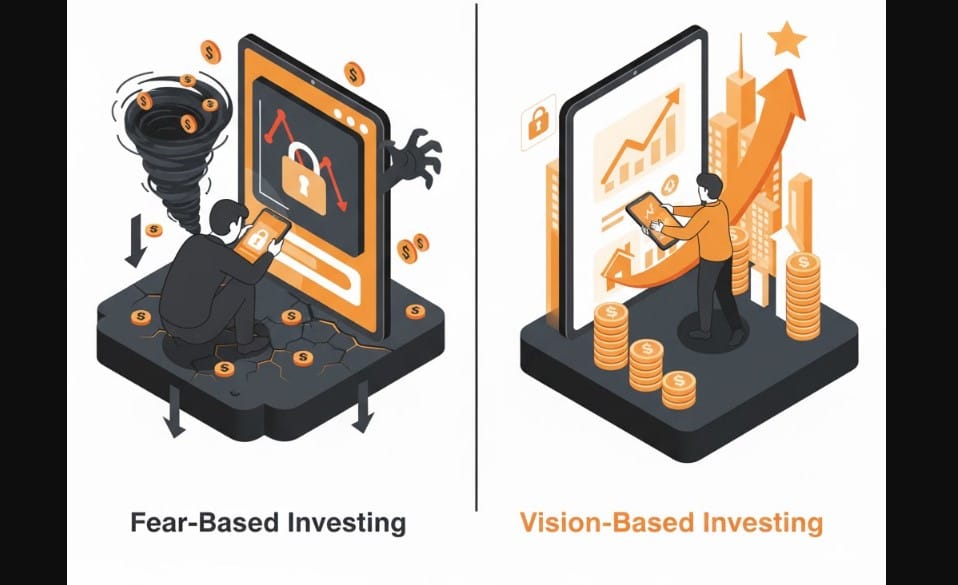
Most people believe investing success depends on market knowledge — but in truth, it depends on mindset.
The way you think and feel about money determines how you invest, when you act, and whether you grow or stagnate financially.
There are two dominant mindsets investors fall into:
- Fear-Based Investing – reactive, emotional, and scarcity-driven.
- Vision-Based Investing – intentional, confident, and purpose-driven.
Understanding which mindset you operate from can completely transform your financial outcomes.
1. What Is Fear-Based Investing?
Fear-based investing is driven by anxiety and scarcity.
It’s the mindset of constantly trying to avoid loss — not to build growth.
Common behaviors include:
- Panic-selling when markets drop
- Hoarding cash without investing
- Following “hot tips” out of fear of missing out (FOMO)
- Overreacting to news or social media trends
- Distrusting long-term strategies
It’s a survival mentality: “I don’t want to lose.”
But ironically, that fear often leads to missed opportunities and smaller returns.
2. The Emotional Roots of Fear-Based Investing
Fear-driven investors are often influenced by past experiences — financial instability, loss, or even cultural beliefs about money.
This mindset creates a feedback loop:
Fear → Inaction → Missed Opportunity → Regret → More Fear
It keeps investors trapped in short-term thinking, unable to benefit from compound growth or strategic patience.
3. What Is Vision-Based Investing?
Vision-based investing starts with clarity and purpose — not fear.
It’s about aligning investments with your values, goals, and long-term future.
Vision-based investors:
- Focus on long-term growth, not short-term volatility
- Invest in what they understand and believe in
- Diversify with patience and planning
- Ignore emotional noise and market panic
- View downturns as buying opportunities
Their mantra isn’t “I hope I don’t lose” — it’s “I’m building something that matters.”
4. The Core Difference: Reaction vs. Intention
| Mindset | Fear-Based Investing | Vision-Based Investing |
|---|---|---|
| Emotion | Fear, scarcity | Confidence, purpose |
| Focus | Short-term safety | Long-term growth |
| Behavior | Reactive | Strategic |
| Outcome | Missed gains | Sustainable wealth |
| Example | Panic selling during dip | Buying strategically in dip |
The difference isn’t knowledge — it’s emotional discipline.
5. How to Transition from Fear to Vision
Shifting from fear-based to vision-based investing is about emotional mastery and strategic clarity.
Step 1: Define Your “Why”
What’s the real reason you want to invest?
Retirement? Freedom? Family security? When you have a clear “why,” fear loses its grip.
Step 2: Build a Simple, Aligned Strategy
Don’t chase trends.
Choose investments that align with your goals and values — whether it’s ethical funds, tech innovation, or stable index ETFs.
Step 3: Learn Emotional Regulation
Market volatility triggers anxiety — but practice grounding yourself.
Meditation, journaling, or even automating investments can help remove emotional noise.
Step 4: Set Time Horizons
Vision-based investors think in decades, not days.
Remind yourself: “I’m not investing for today — I’m investing for 2035.”
Step 5: Celebrate Consistency Over Perfection
You don’t need to time the market — you need to stay in the market.
The real success lies in emotional stability and steady growth.
6. Why This Matters More Than Ever
In an age of crypto hype, social media investing tips, and economic uncertainty, emotional intelligence is more valuable than any financial course.
A vision-driven investor doesn’t chase trends — they create a roadmap.
They use fear as information, not a barrier.
Building wealth isn’t just about choosing assets — it’s about choosing the right mindset.
Conclusion
Fear-based investing keeps you stuck in survival mode. Vision-based investing sets you free to grow.
When you invest with purpose instead of panic, every decision — from saving to portfolio management — becomes part of a bigger picture.
Wealth, after all, is not only about how much you earn — it’s about how confidently you grow it.
The goal isn’t to escape fear.
It’s to build a vision so strong that fear no longer drives the strategy.