Introduction: Creativity Meets AI
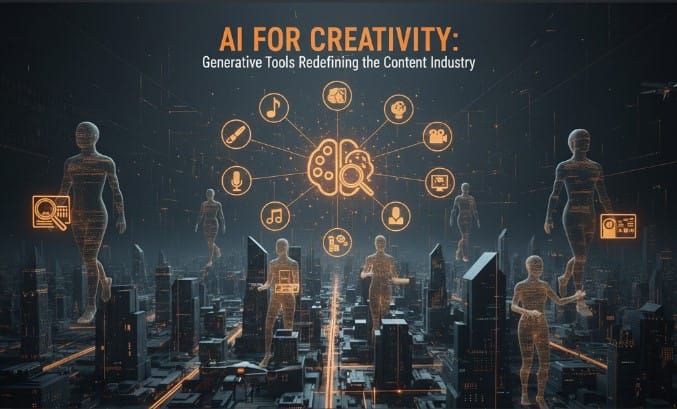
The content industry is undergoing a radical transformation. From writing and graphic design to video production and music composition, AI generative tools are becoming indispensable for creative professionals.
In 2025, AI is not just an assistant — it’s a collaborator, enabling faster production, innovative ideas, and scalable content strategies.
This article explores:
- What generative AI tools are
- How they enhance creativity
- Real-world applications across industries
- Challenges and best practices for content creators
1. What Are Generative AI Tools?
Generative AI refers to artificial intelligence systems capable of creating original content based on input data. These tools use machine learning models, often leveraging large language models (LLMs) or generative adversarial networks (GANs), to produce:
- Text: Articles, stories, scripts, ad copy
- Images & Graphics: Illustrations, designs, concept art
- Video & Animation: Short-form videos, motion graphics
- Audio & Music: Background tracks, sound effects, voiceovers
💡 Example: AI tools like ChatGPT, MidJourney, DALL·E, and Runway generate content that rivals human creativity in both speed and quality.
2. How AI Enhances Creativity
Contrary to the misconception that AI replaces human creativity, generative AI augments it:
- Idea Generation: Brainstorm concepts faster than traditional methods.
- Content Drafting: Generate high-quality drafts for writers, reducing time spent on repetitive tasks.
- Visual Inspiration: AI generates design variations, helping designers explore possibilities.
- Experimentation at Scale: Test multiple concepts quickly without resource-heavy production.
💡 Tip: Treat AI as a creative partner, not a replacement. Combine human intuition with AI-generated outputs for the best results.
3. Applications in the Content Industry
A. Writing and Publishing
- AI-assisted blogs, articles, and newsletters
- Scriptwriting for video and podcasts
- SEO-focused content optimization
- Personalized marketing copy
B. Design and Visual Arts
- Logo creation and branding materials
- Digital illustrations and concept art
- Social media graphics and templates
- Web and UI design mockups
C. Video and Animation
- AI-generated short-form social media videos
- Motion graphics and animation prototypes
- Automated video editing and captioning
- AI voiceovers and dubbing
D. Music and Audio
- Composing background tracks for ads or videos
- Sound effects generation for games and media
- AI-assisted audio mastering
💡 Example: A marketing team can generate ad copy, design visuals, and create short promotional videos within hours, tasks that traditionally took days or weeks.
4. Benefits for Content Creators
- Increased Efficiency: Produce high-quality content faster and at scale.
- Cost-Effective Production: Reduce dependency on multiple human specialists for repetitive tasks.
- Enhanced Creativity: Explore new ideas and variations that may not have been considered.
- Personalization: Tailor content to different audiences using AI-driven insights.
- Global Collaboration: AI tools are accessible across geographies, enabling remote creative workflows.
5. Challenges and Considerations
While generative AI offers transformative potential, content creators must navigate challenges:
- Quality Control: AI outputs may require human editing to maintain authenticity and accuracy.
- Copyright & Ownership: Determining ownership of AI-generated content can be legally complex.
- Bias in Content: AI may replicate biases present in training data, affecting fairness and inclusivity.
- Ethical Use: Misuse of AI-generated content for misinformation or plagiarism is a growing concern.
💡 Best Practice: Use AI to assist, not replace, and always review outputs for quality, originality, and compliance.
6. The Future of AI-Driven Creativity
In 2025 and beyond, generative AI will:
- Become fully integrated into creative software tools
- Support collaborative workflows between humans and AI agents
- Enable real-time content generation, personalized for individual users
- Drive new forms of media, such as interactive storytelling, AI-powered games, and immersive experiences
Trend: The line between human-created and AI-generated content will blur, making hybrid creativity the new standard.
7. Maximizing the Impact of AI Tools
Content professionals can leverage AI effectively by:
- Choosing the Right Tool: Pick AI solutions tailored to your niche (writing, design, video, audio).
- Setting Clear Objectives: Use AI to achieve specific creative goals rather than open-ended outputs.
- Iterating with Human Input: Refine AI outputs to ensure alignment with brand voice, accuracy, and style.
- Tracking Performance: Measure engagement and ROI of AI-generated content.
- Staying Updated: AI tools evolve rapidly — continuous learning is crucial.
Conclusion: A New Era of Creative Collaboration
Generative AI is redefining the content industry, transforming how creators write, design, and produce media.
Far from replacing humans, these tools amplify creativity, enhance efficiency, and unlock new possibilities.
The future of content creation in 2025 is collaborative, AI-augmented, and limitless. Those who embrace AI creatively will lead the next wave of innovation in media, marketing, and entertainment.
Bonus Tip
Experiment with hybrid workflows:
- Draft copy using AI
- Design visuals with AI tools
- Finalize with human review and customization
This approach maximizes speed, creativity, and quality, giving you a competitive edge in the evolving content landscape.