Introduction
At the heart of every cryptocurrency — from Bitcoin to Ethereum — lies the blockchain, a revolutionary system that records and secures every transaction without the need for banks or intermediaries.
But what exactly happens when you send or receive crypto? How does your transaction get verified, recorded, and made tamper-proof?
In this guide, we’ll break down how cryptocurrency transactions work on the blockchain, step-by-step, in a way that’s clear, practical, and beginner-friendly.
1. What Is the Blockchain?
The blockchain is a decentralized digital ledger that stores all cryptocurrency transactions across a network of computers (called nodes).
Each new set of transactions is grouped into a block, which is then linked (or “chained”) to the previous one — hence the name blockchain.
Because the ledger is distributed, no single entity controls it. Every participant in the network can view, verify, and confirm transactions, making the system transparent and secure.
2. What Happens When You Send Cryptocurrency?
Let’s use an example: you’re sending 0.1 Bitcoin to a friend.
Here’s what happens behind the scenes:
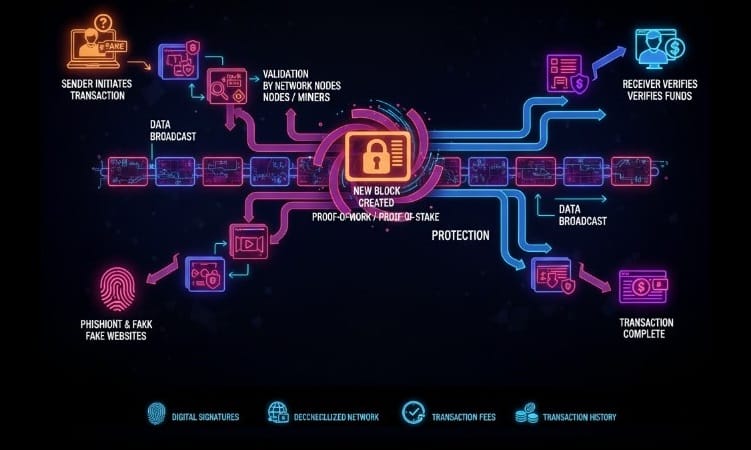
Step 1: You Initiate a Transaction
You open your crypto wallet, enter your friend’s wallet address, and specify the amount you want to send.
When you click “Send,” your wallet creates a transaction request that includes:
- The amount being transferred
- The sender’s public key (address)
- The recipient’s public key (address)
- A digital signature (generated using your private key)
This digital signature proves that you are the rightful owner of the funds and authorizes the transfer.
Step 2: The Transaction Is Broadcast to the Network
Once created, your transaction is broadcast to the blockchain’s peer-to-peer network.
Thousands of computers (called nodes) receive this information simultaneously and start verifying it.
They check:
- Whether the sender’s address actually holds the funds.
- Whether the digital signature is valid.
- Whether the same coins have already been spent elsewhere (double-spending check).
Step 3: Transaction Validation (Mining or Staking)
After your transaction passes the initial checks, it must be validated and added to the blockchain.
Depending on the blockchain, this is done through one of two main methods:
🧩 a. Proof of Work (PoW) – Mining
Used by Bitcoin and similar networks.
Miners compete to solve complex mathematical puzzles using computational power.
The first miner to solve it adds the block of transactions to the blockchain and earns a block reward (newly minted coins + transaction fees).
🌱 b. Proof of Stake (PoS) – Staking
Used by Ethereum (post-Merge), Cardano, Solana, and others.
Validators “stake” their coins as collateral to be randomly chosen to confirm transactions.
They earn staking rewards for honest participation — and risk losing coins if they act maliciously.
Step 4: The Block Is Added to the Blockchain
Once verified, your transaction is grouped into a new block alongside many others.
This block is cryptographically linked to the previous block using a hash function — a unique digital fingerprint that ensures data integrity.
Because each block references the previous one, altering or deleting past transactions becomes virtually impossible.
Step 5: Confirmation and Finalization
Your transaction isn’t officially complete until it receives several confirmations — meaning other blocks have been added after it, further securing the chain.
- On Bitcoin, 6 confirmations are considered fully secure (about 1 hour).
- On Ethereum, 12 confirmations typically suffice (a few minutes).
Once confirmed, the recipient’s wallet will show the transferred amount as available.
3. Key Components That Make Blockchain Transactions Work
🔑 1. Public and Private Keys
Every crypto wallet has two cryptographic keys:
- Public Key: Acts like your account number (safe to share).
- Private Key: Acts like your password (must remain secret).
You sign transactions with your private key, which proves ownership without revealing it.
🧱 2. Hashing
Every block uses a cryptographic hash function to ensure its contents haven’t been altered.
If even one letter in a transaction changes, the hash becomes completely different — instantly exposing tampering.
🌐 3. Consensus Mechanisms
Blockchains rely on consensus algorithms to agree on the true state of the ledger.
This ensures that all participants share one consistent version of the blockchain.
Main types include:
- Proof of Work (PoW)
- Proof of Stake (PoS)
- Delegated Proof of Stake (DPoS)
- Proof of Authority (PoA)
Each has its own way of validating transactions and preventing fraud.
4. Transaction Fees and Network Speed
Each transaction includes a network fee, which goes to miners or validators as compensation.
Fees depend on:
- Network congestion (busy networks cost more).
- Transaction size (in bytes, not amount).
- Chosen speed (faster confirmations usually require higher fees).
For example:
- Bitcoin fees can range from $0.50 to $5 depending on demand.
- Ethereum’s gas fees vary by network usage and smart contract complexity.
5. Why Blockchain Transactions Are Secure
Blockchain security is built on several powerful principles:
- Decentralization: No central authority to manipulate data.
- Transparency: Every transaction is public and verifiable.
- Immutability: Once recorded, transactions cannot be altered.
- Cryptography: Advanced encryption ensures ownership and privacy.
Together, these elements make blockchain transactions highly resistant to hacking, censorship, or fraud.
6. The Future of Blockchain Transactions
As blockchain technology evolves, transactions are becoming faster, cheaper, and more efficient thanks to innovations like:
- Layer-2 solutions (e.g., Lightning Network, Arbitrum)
- Zero-knowledge proofs for enhanced privacy
- Cross-chain bridges for interoperability between networks
- AI-powered fraud detection and security tools
By 2025, many experts predict blockchain transactions will rival — and even surpass — traditional banking in both speed and reliability.
Conclusion
Understanding how cryptocurrency transactions work on the blockchain helps you grasp the true power of decentralized finance.
Every time you send crypto, you’re not just moving money — you’re participating in a transparent, secure, and borderless digital economy.
In blockchain, trust isn’t given — it’s built through code, consensus, and cryptography.