🚀 Introduction: The AI Search Revolution
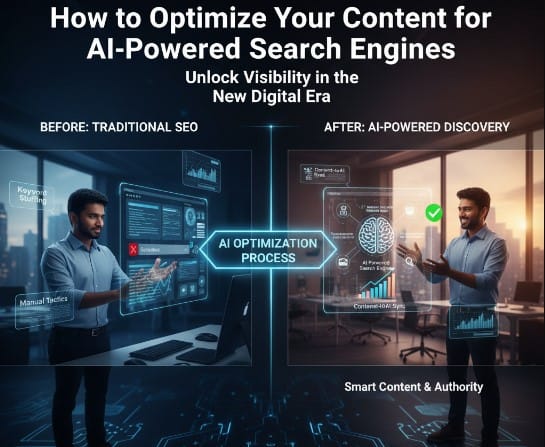
Search engines are no longer just matching keywords — in 2025, AI-powered search engines like Google MUM, Bard, and AI-driven knowledge graphs interpret user intent, context, and semantics.
This means that the old SEO tricks — keyword stuffing or backlinks alone — are no longer enough.
The future belongs to content that is AI-friendly, contextually relevant, and structured for machine comprehension.
Let’s explore actionable strategies to make your content visible, discoverable, and profitable in this AI-driven search landscape.
💡 H2: Understand AI Search Behavior
1. Semantic Understanding
AI searches analyze meaning, not just keywords.
- Focus on topics and concepts, not just phrases.
- Include related keywords, synonyms, and variations naturally.
Example: Instead of writing “best SEO tools,” create content that covers “AI SEO tools, content optimization tools, semantic search strategies, and AI-driven keyword research.”
2. Intent-Based Optimization
AI tries to satisfy user intent:
- Informational: “What is AI SEO?” → create detailed guides.
- Transactional: “Buy AI writing tools” → review/comparison content.
- Navigational: “ChatGPT SEO guide” → clear brand/website-specific content.
Action Tip: Identify user intent for every major keyword and tailor content accordingly.
3. Structured & Readable Content
AI algorithms prefer structured content for better indexing.
- Use H2/H3 headings with clear hierarchy.
- Break text into short paragraphs and bullet points.
- Include tables, lists, and charts for clarity.
⚙️ H2: Technical Strategies for AI SEO
🔹 Schema Markup & Rich Snippets
- Use structured data (JSON-LD) for articles, products, reviews.
- Helps AI understand your content type and context.
🔹 Optimize for Voice Search
- AI searches increasingly integrate voice assistants.
- Use conversational phrasing and FAQs.
🔹 Internal Linking & Semantic Networks
- Link related content with descriptive anchor text.
- Builds topical authority recognized by AI algorithms.
🛠 H2: Tools to Optimize Content for AI
- SurferSEO / NeuronWriter – AI-driven content optimization with semantic analysis.
- ChatGPT / Jasper AI – Generate topic clusters, FAQs, and drafts aligned with AI search.
- Frase.io – Create AI-friendly outlines and check content relevancy.
- Clearscope / WriterZen – Semantic keyword research and content scoring.
Pro Tip: Combine multiple tools — use AI for research, content drafting, and optimization scoring.
🌱 H2: Human Touch Matters
Even with AI-friendly SEO, humans are still the final decision-makers.
- Add personal anecdotes or case studies.
- Include real examples, images, and charts.
- Maintain authentic tone — AI can read structure, but humans engage with emotion.
This combination ensures your content satisfies both AI algorithms and human readers.
🔮 H2: Future-Proof Your AI SEO Strategy
- Focus on E-A-T: Expertise, Authority, and Trust are AI ranking factors.
- Content Depth & Updates: AI favors comprehensive, updated content.
- AI + Analytics: Monitor engagement metrics with AI analytics tools and adjust strategy.
Remember: AI SEO isn’t about tricking the system; it’s about aligning content with intelligence-driven search intent.
🔑 Conclusion: Optimize Today, Dominate Tomorrow
AI-powered search engines reward well-structured, semantic, and valuable content.
Start thinking beyond keywords — focus on user intent, context, and clarity, and your content will thrive in 2025 and beyond.
🔑 Question for You:
Which part of your content strategy would you optimize first for AI-powered search — structure, intent, or topic depth?
CTA:
If this guide helped, share it with your network and start applying AI-friendly SEO strategies today to future-proof your content.