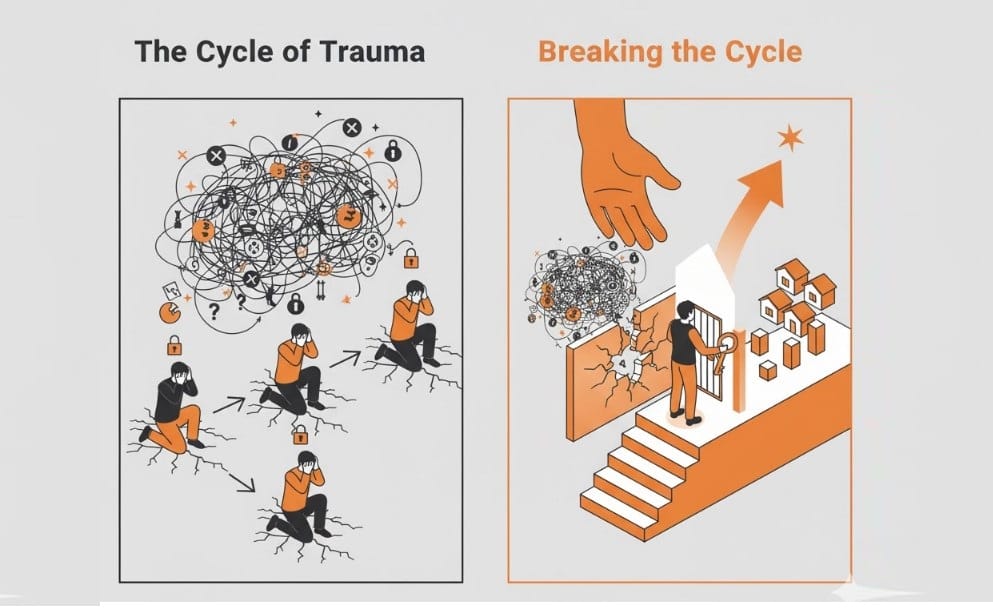
Money is rarely just about numbers—it’s a deeply emotional and psychological force. Behind every financial decision lie beliefs, fears, and memories, many of which didn’t start with us.
Financial trauma—stress or pain caused by financial instability, scarcity, or loss—can silently shape generations. It influences how families think, talk, and behave around money.
The truth is, money trauma is often inherited, not chosen.
1. Understanding Financial Trauma
Financial trauma occurs when money experiences cause chronic stress or fear that affects future financial behaviors.
Common roots include:
- Growing up in poverty or instability
- Experiencing job loss or debt
- Witnessing financial conflict in the household
- Living through economic crises or displacement
Unlike one-time stress, financial trauma embeds in a person’s nervous system. It shapes how we feel about security, spending, and success, even decades later.
2. The Inheritance of Fear and Scarcity
Children learn about money not from textbooks, but from observation. When parents constantly express worry—“We can’t afford that” or “Money doesn’t grow on trees”—these phrases become core beliefs.
Such messages can crystallize into a scarcity mindset, where the subconscious tells you:
- “There’s never enough.”
- “Money is hard to get.”
- “I don’t deserve wealth.”
Over time, this mindset limits ambition, fosters guilt around earning, and sustains financial avoidance—a hidden emotional inheritance.
3. Emotional Contagion: How Stress Transfers
Neuroscience shows that children internalize the emotional states of their caregivers. When parents are anxious or fearful about money, children absorb that emotional tone—even without explicit conversations.
This creates a cycle where:
- Financial instability → emotional stress → inherited anxiety → self-limiting behavior.
As adults, these individuals may:
- Hoard money out of fear
- Overspend for comfort
- Avoid financial planning altogether
Thus, unresolved emotional wounds become behavioral patterns passed through generations.
4. The Silence Around Money
Many families treat money as taboo. Parents hide financial struggles, creating confusion and shame. Without open dialogue, children fill the silence with assumptions:
- “We must be bad with money.”
- “Talking about money is rude or stressful.”
- “Financial success isn’t for people like us.”
This silence prevents financial education, self-trust, and emotional resilience. The next generation inherits both the fear and the lack of literacy.
5. Intergenerational Patterns in Action
Some common manifestations of inherited financial trauma include:
| Generation | Emotional Legacy | Behavioral Pattern |
|---|---|---|
| Grandparents (War/Instability Era) | Fear of loss | Hoarding, distrust of banks |
| Parents (Economic Recovery Era) | Pressure to achieve | Overworking, money anxiety |
| Children (Modern Economy) | Fear of failure | Avoidance, inconsistent financial behavior |
Each generation reacts to the last—trying to correct it—but without awareness, the emotional foundation remains unchanged.
6. How Financial Trauma Affects Identity
Money beliefs influence self-worth and identity. People with inherited financial trauma often equate:
- Wealth with morality (“Rich people are greedy.”)
- Scarcity with virtue (“Struggling means I’m hardworking.”)
This emotional coding affects career choices, risk tolerance, and even relationships. It keeps people emotionally loyal to struggle, even when they crave freedom.
7. Breaking the Cycle: Awareness First
The first step to ending generational financial trauma is awareness without judgment. Ask yourself:
- What messages did I absorb about money growing up?
- How did my family react to financial stress?
- What emotions arise when I think about saving or spending?
Bringing these unconscious patterns to light helps rewire emotional responses from fear to empowerment.
8. Reparenting Your Financial Self
Financial healing often requires reparenting—becoming the stable, calm guide your younger self never had.
Steps include:
- Emotional regulation: Recognize financial triggers and pause before reacting.
- Financial education: Replace inherited fear with knowledge and clarity.
- Self-compassion: Acknowledge past mistakes without shame.
- Boundaries: Break family patterns of financial enabling or dependency.
This process transforms survival-based money behavior into intentional financial living.
9. Building a New Family Narrative
Breaking financial trauma isn’t just personal—it’s generational work. Create a new story for your family:
- Talk openly about money, goals, and mistakes.
- Teach children emotional literacy around spending and saving.
- Celebrate progress, not perfection.
Transparency normalizes money conversations and replaces secrecy with trust. This is how emotional and financial resilience are passed forward.
10. Healing Is Financial Freedom
Healing financial trauma is more than budgeting—it’s emotional liberation. When you stop reliving the fears of your ancestors, you unlock a new kind of wealth:
The ability to make financial decisions from clarity, not fear.
True financial freedom isn’t just about assets—it’s about peace.
Conclusion
Financial trauma doesn’t vanish with wealth—it must be understood, named, and healed. By recognizing the inherited beliefs and emotional wounds that shape your relationship with money, you can stop the cycle of fear and scarcity.
Each time you choose awareness over avoidance, or calm over panic, you’re rewriting your financial lineage.
You are not your family’s money story—you are its evolution.