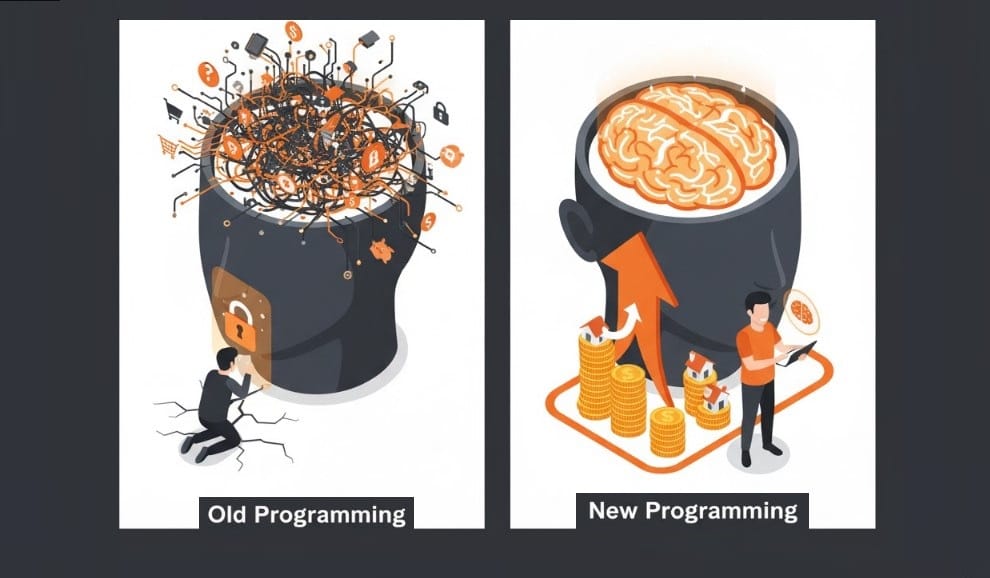
Your financial reality is not just built on numbers — it’s built on neural patterns.
The way you think about money determines how you earn, spend, and save it.
If you’ve ever wondered why some people seem to attract opportunities while others stay stuck in scarcity, the answer isn’t luck — it’s mental wiring.
The good news? You can retrain your brain for wealth.
Financial success isn’t just about strategy; it’s about psychology.
1. Your Brain Wasn’t Designed for Modern Wealth
Our brains evolved to keep us safe, not successful.
In ancient times, survival depended on short-term rewards: food, safety, shelter.
That same brain now manages long-term financial goals like investing, saving, and planning — and it often resists them.
This is why you might:
- Feel anxious saving money instead of spending it
- Avoid checking your bank account
- Self-sabotage right before financial breakthroughs
It’s not weakness — it’s wiring.
Your brain is trying to protect you from perceived “threats” like risk, failure, or change.
2. The Subconscious Money Programming You Inherited
Before age 7, your subconscious mind absorbs beliefs like a sponge.
These early money messages — from parents, culture, or past experiences — shape your financial behavior for life.
You may have internalized:
- “Money is hard to earn.”
- “Rich people are greedy.”
- “I’m not good with money.”
- “There’s never enough.”
These aren’t just ideas — they’re neural pathways.
Your brain reinforces them automatically until you consciously rewrite them.
What you believe about money determines how you behave with money.
3. Awareness: The First Step to Rewiring
You can’t change what you can’t see.
Begin by identifying your limiting money beliefs.
Ask yourself:
- What emotions arise when I think about wealth?
- Do I feel guilt or fear around success?
- What did my parents teach me about money (directly or indirectly)?
Write these beliefs down.
Awareness activates the prefrontal cortex — the decision-making center — and weakens the emotional grip of old patterns.
4. Replace Fear-Based Thoughts with Empowering Narratives
Your subconscious accepts repetition as truth.
To reprogram it, you must replace fear-based narratives with empowering ones.
Try reframing your thoughts:
- From “I’m bad with money” → “I’m learning to manage my money intelligently.”
- From “Money is scarce” → “Money is energy that flows and grows.”
- From “Rich people are selfish” → “Wealth can amplify positive impact.”
Repeat these daily — not as fake affirmations, but as mental rewiring exercises.
Over time, your brain will begin to build new neural pathways that support financial success.
5. The Science Behind Reprogramming: Neuroplasticity
Neuroplasticity is your brain’s ability to reorganize itself by forming new connections.
Every time you think, feel, or act differently around money, you’re literally reshaping your neural network.
Practical ways to leverage neuroplasticity:
- Visualization: Imagine yourself handling money with calm and confidence.
- Journaling: Track emotions connected to financial actions.
- Small wins: Reinforce positive behavior with micro-successes (e.g., saving $20 weekly).
- Consistency: Your brain needs repetition more than intensity.
The more emotionally charged and consistent the new pattern, the faster it replaces the old one.
6. Emotional Regulation: The Missing Key to Wealth
Financial intelligence isn’t just about knowledge — it’s about emotional control.
Fear, guilt, and shame are powerful blockers of wealth creation.
When you feel anxious about money, your brain releases cortisol, shutting down logical reasoning.
This leads to impulsive spending, avoidance, or self-sabotage.
To calm the nervous system before making financial decisions:
- Take deep, slow breaths
- Step away from the situation for a few minutes
- Ask: “Am I reacting from fear or from clarity?”
A regulated mind makes smarter money moves.
7. Building New Habits Through Identity Shifts
Long-term financial change doesn’t come from willpower — it comes from identity.
Stop saying:
- “I’m trying to be better with money.”
Start saying:
- “I’m the kind of person who manages money consciously.”
When you attach financial success to your identity, your brain aligns your behavior automatically.
You’re no longer “forcing discipline” — you’re living from a new self-concept.
8. The Wealth Mindset in Practice
Here are daily practices to help reprogram your financial brain:
- Morning Visualization:
Picture yourself handling wealth with confidence and peace. - Money Gratitude Journal:
Write three things money allows you to experience today. - Wealth Exposure:
Surround yourself with financially empowered people and content. - Reinforcement Loop:
Celebrate small progress — your brain associates success with reward. - Limit Negative Input:
Avoid media or people that normalize scarcity or fear.
9. From Financial Anxiety to Financial Flow
Once you begin shifting your mental patterns, money starts feeling less like a battle and more like a flow.
You stop chasing — and start creating.
You stop fearing loss — and start trusting your capacity to rebuild.
You stop comparing — and start aligning.
This is what true financial success looks like: peace, purpose, and prosperity working together.
10. Final Thought: Your Mind Is Your Greatest Asset
No strategy can outperform a mindset that’s programmed for scarcity.
But once you rewire your brain for abundance and emotional clarity, wealth creation becomes natural.
Your financial success doesn’t start in your wallet.
It starts in your mind.