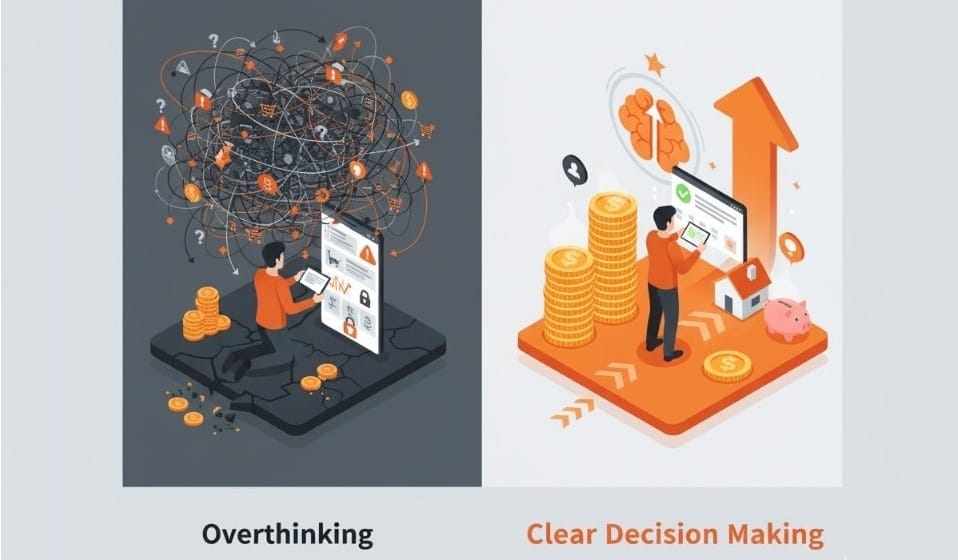
Money decisions can feel heavy. Whether it’s investing, saving, or even making a simple purchase, many of us fall into analysis paralysis—the cycle of thinking, doubting, and second-guessing every financial move.
At first, overthinking feels like responsibility—it’s an attempt to “get it right.” But beneath the logic lies emotion: fear, uncertainty, and a lack of self-trust.
The problem isn’t that you care too much about your money—it’s that you don’t yet trust yourself with it.
Here’s how to stop overthinking and start building financial clarity and confidence.
1. Why We Overthink Money
Money triggers both logic and emotion. It’s tied to survival, success, and self-worth, so financial choices feel deeply personal.
Common causes of money overthinking include:
- Fear of making a mistake (“What if I regret this?”)
- Information overload (too many conflicting opinions)
- Perfectionism (“I’ll act when I’m 100% sure”)
- Past financial trauma (loss, debt, or poor advice)
Overthinking becomes a coping mechanism—a way to feel safe in uncertainty. But in reality, it often delays progress and feeds financial anxiety.
2. The Psychology of Financial Paralysis
Behavioral psychologists call this decision fatigue—the mental exhaustion that comes from too many choices. When it comes to money, every option feels high-stakes, so your brain freezes.
The deeper truth: Overthinking is a symptom of fear, not lack of intelligence. It’s your nervous system protecting you from perceived danger.
Recognize these emotional signs:
- Constantly re-checking your bank balance
- Delaying purchases for weeks
- Feeling anxious when comparing financial options
- Regretting decisions right after making them
You’re not bad with money—you’re emotionally overstimulated by it.
3. How Money Stories Shape Decision Anxiety
Your relationship with money was formed early. If you grew up hearing:
- “Money is tight,” you may equate spending with danger.
- “You have to be smart with money,” you may equate mistakes with failure.
- “Money changes people,” you may fear success or abundance.
These subconscious narratives shape how you think—and overthink—today’s financial choices.
Breaking the cycle begins with rewriting the story:
“I can make thoughtful financial decisions, even if they’re not perfect.”
4. The Overthinking Loop: Control vs. Trust
Overthinkers crave control. They research endlessly, compare endlessly, and plan endlessly—hoping that more information will bring peace.
But the truth is, clarity comes from action, not endless analysis.
When you make small, confident financial choices, you build trust in yourself. That trust becomes the antidote to overthinking.
Ask yourself:
- “Am I researching to learn—or to avoid deciding?”
- “Is this about the numbers, or my fear of being wrong?”
The moment you notice control slipping into anxiety, you’re already gaining awareness.
5. Emotional Triggers That Keep You Stuck
Here are some of the hidden emotional triggers behind money overthinking:
| Trigger | Thought Pattern | Behavioral Outcome |
|---|---|---|
| Fear of loss | “If I spend, I’ll regret it.” | Hoarding or under-investing |
| Guilt | “I don’t deserve to enjoy this.” | Avoiding pleasure spending |
| Shame | “I’m bad with money.” | Avoiding financial planning |
| Comparison | “Others are smarter investors.” | Copying trends without clarity |
| Perfectionism | “I must make the best choice.” | Never acting at all |
Recognizing your dominant trigger gives you the emotional distance to choose differently.
6. The Power of “Good Enough” Decisions
Perfectionism kills financial growth. The truth is, there is no perfect financial decision—only informed ones.
Try replacing “Is this the best choice?” with “Is this a good enough choice for now?”
Examples:
- Instead of finding the perfect investment, start with a diversified index fund.
- Instead of over-analyzing budget apps, pick one and learn by doing.
- Instead of waiting to earn more to save, start small and build consistency.
Progress, not perfection, compounds into financial confidence.
7. Reframing Financial Mistakes
Fear of making a mistake fuels overthinking. But every financially confident person has made wrong calls—it’s part of building literacy and resilience.
Shift your mindset:
- Mistakes are data, not disasters.
- A wrong decision today builds a wiser decision tomorrow.
- You can recover from losses, but not from inaction.
Self-forgiveness is an essential skill in long-term wealth creation.
8. Simplify Your Decision Framework
To quiet overthinking, create decision rules that reduce emotional load:
- The 24-hour rule: Wait one day before large purchases.
- The 1% rule: Invest or save at least 1% more each month.
- The “no drama” rule: If a decision causes stress for over a week, simplify it.
- The alignment rule: Choose what aligns with your values, not trends.
These small frameworks protect your energy and reduce decision fatigue.
9. Building Financial Self-Trust
The ultimate goal isn’t perfect money management—it’s emotional regulation.
To build self-trust:
- Review your past smart money choices.
- Track your spending without judgment.
- Learn continuously but avoid endless comparison.
- Celebrate decisions made with clarity, even small ones.
Confidence is built through consistent, self-aligned decisions—not luck or wealth.
10. The Calm Mind Makes the Smartest Choices
When emotions calm, logic returns. Meditation, journaling, and grounding exercises help regulate your nervous system before financial choices.
You make your best money decisions not when you’re informed—but when you’re centered.
Pause, breathe, and ask:
- “What decision feels aligned, not pressured?”
- “Does this choice create peace or tension?”
You’ll find that your intuition, once quieted by fear, often knows the right next step.
Conclusion
Overthinking money decisions is not a flaw—it’s a signal. It means you care, but your emotions and fears are louder than your trust.
By slowing down, simplifying, and grounding yourself emotionally, you can transform financial decision-making into a confident, intuitive process.
Financial peace doesn’t come from knowing everything—it comes from trusting yourself to handle anything.