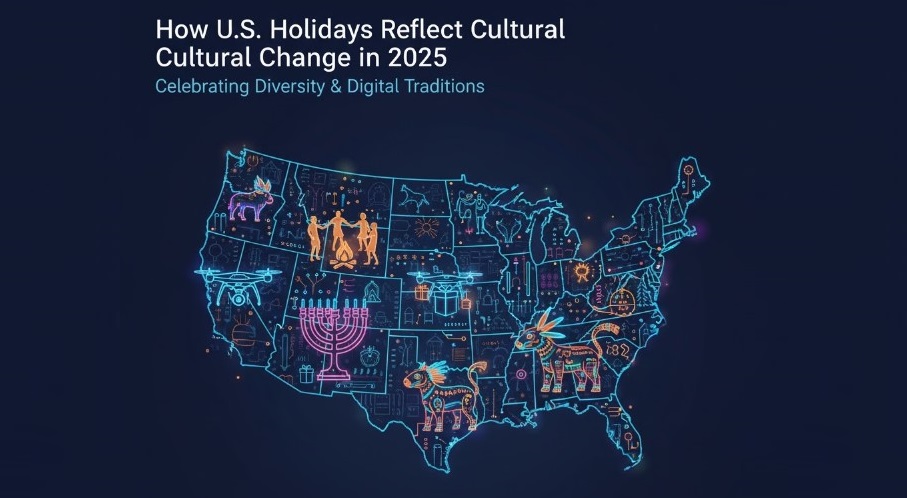
🏙️ Introduction: The Calendar Is More Than Dates — It’s a Cultural Mirror
A country’s holiday calendar tells a story.
Not just about the past, but about who we are becoming.
In the United States, holidays have always carried meaning — sometimes patriotic, sometimes religious, sometimes commercial. But in 2025, those meanings have grown more layered and more reflective of the nation’s evolving identity.
What used to be a predictable lineup of national days — Thanksgiving, the Fourth of July, Labor Day — has gradually expanded into a more inclusive landscape that acknowledges a wider range of histories, cultures, and perspectives. Juneteenth, Indigenous Peoples’ Day, Pride Month, Veterans Day, and environmental observances like Earth Day now occupy a central place in public conversation.
Today, American holidays aren’t just days off or shopping events.
They’re touchpoints for national memory.
They’re emotional flashpoints.
They’re reflections of what we choose to honor — and what we’re finally learning to confront.
Understanding these shifts offers a glimpse into the changing heart of America.
🇺🇸 1. A Changing National Narrative: Whose Stories Does the Calendar Tell?
For most of the 20th century, America’s holiday schedule changed very little. The calendar centered around independence, harvest, faith, and labor. But as the country diversified and conversations around identity and justice entered the mainstream, new observances emerged to challenge old narratives.
The Rise of Juneteenth: Recognition, Repair, and Celebration
Juneteenth became a federal holiday in 2021, but its national significance has only grown with each passing year.
By 2025, it has transformed into one of the most vibrant celebrations in the U.S., marked by:
- Community parades
- Educational programs
- Cultural festivals
- Conversations about legacy, justice, and progress
The holiday’s rise reflects a collective desire to acknowledge stories that were overlooked for generations. It also shows how Americans are re-evaluating their relationship with history — not to divide, but to understand it fully.
Indigenous Peoples’ Day vs. Columbus Day: A Dialogue, Not a Replacement
Indigenous Peoples’ Day has spread across states, schools, and institutions.
What started as a small movement now serves as a counter-narrative to the traditional Columbus Day story.
Rather than erasing history, the coexistence of both observances has created a national dialogue:
- Who gets to define discovery?
- How should a nation acknowledge complex histories?
- Can two perspectives coexist without one invalidating the other?
The dual celebration is a sign that America is becoming more willing to face uncomfortable truths — and more capable of holding multiple narratives at once.
💼 2. The Digital Age and the Rise of Hybrid Holidays
Holidays in 2025 are no longer limited to physical gatherings.
The digital world has reshaped how people participate, communicate, and create meaning.
Social Media as a Cultural Amplifier
Platforms like TikTok, Instagram, and YouTube now influence how Americans experience holidays:
- Earth Day: viral climate challenges
- Veterans Day: storytelling campaigns led by active service members
- Pride Month: livestream events, digital parades, and creative digital art
- Memorial Day: documentary-style videos honoring stories that don’t make the news
For many young Americans, the internet is the gathering place — a space where traditions are interpreted through memes, short videos, and community-led activism.
The New Role of Brands and Influencers
Companies once saw holidays mainly as marketing opportunities. Today, audiences demand more substance. Campaigns that highlight diversity, social causes, or authentic personal stories tend to resonate more than generic greetings.
Influencers, too, play a role in shaping holiday perception.
Their content doesn’t just entertain — it sets expectations for how people should celebrate, learn, or reflect.
This merging of physical and digital spaces has created a new type of American holiday: one that is experienced simultaneously in living rooms and online communities.
🌎 3. The Globalization of U.S. Holidays: Culture, Influence, and Consumerism
American holidays have long crossed borders, but in 2025 the globalization is faster and more digital than ever.
Halloween: A Worldwide Spectacle
Thanks to streaming platforms, global creators, and AI-driven creativity, Halloween has become a global cultural event. From digital costume contests to virtual trick-or-treat experiences, the holiday has grown beyond its American roots into a worldwide creative festival.
Black Friday and Cyber Monday: International Shopping Seasons
What once began as a single-day post-Thanksgiving sale has evolved into a global phenomenon. Countries across Europe, Africa, Asia, and Latin America now participate in:
- Week-long sales
- Digital wallet promotions
- Influencer-led product drops
- AI-personalized shopping experiences
However, this expansion raises important questions:
Are American holidays being shared globally as cultural experiences —
or as commercial exports?
The answer lies somewhere in between.
💬 4. The Politics of Celebration: When Holidays Become Statements
Holidays are no longer neutral. They reflect national debates and cultural tensions — sometimes quietly, sometimes loudly.
Earth Day and Climate Awareness
Earth Day now serves as a barometer for national climate conversations.
Politicians, scientists, and activists use it to push for environmental reforms, while businesses showcase sustainability initiatives.
Memorial Day’s Evolving Story
While still rooted in honoring fallen soldiers, Memorial Day increasingly includes:
- Discussions about mental health
- Support for veterans’ families
- Efforts to bring awareness to PTSD and long-term care gaps
The holiday is slowly shifting from commemoration alone to a call for systemic support.
Pride Month: Beyond Visibility
Pride Month has expanded from protest marches to a celebration of visibility, rights, and community resilience. Cities host festivals, corporations adopt inclusive messages, and public institutions use the time as an opportunity to highlight progress and gaps in equality.
The political dimension doesn’t diminish these holidays — it strengthens their significance.
❤️ 5. Why This Matters: Holidays as Cultural Clues
The transformation of America’s holiday calendar reveals several truths about the nation’s evolution:
1. A More Inclusive National Identity
Different histories are gaining recognition, and more people see themselves reflected in national celebrations.
2. A Willingness to Reevaluate Tradition
America is growing more comfortable with revisiting historical narratives and updating them as collective understanding grows.
3. A Blending of Digital and Physical Culture
Celebrations now live in both worlds, shaping how younger generations relate to tradition.
4. A Shift Toward Values-Based Observances
More holidays foreground themes like justice, sustainability, equality, and mental health.
In short, the calendar is becoming more democratic — shaped not only by policymakers but by the people who celebrate, critique, and reinterpret it.
✨ Conclusion: Celebrating Forward
The U.S. holiday calendar of 2025 is a living document, constantly evolving alongside the nation itself. When a new holiday is embraced or an old tradition is rethought, it signals a cultural shift — one that often begins quietly and becomes louder as more voices join in.
Holidays remind us that history is not fixed.
It’s something we participate in, shape, debate, and pass on.
As America continues to diversify and redefine itself, the calendar will keep changing — reflecting who we are today and hinting at the country we may become tomorrow.
🔑 Engagement Question
Which U.S. holiday do you think best reflects America’s changing identity — and how would you reinvent it for the next generation?
💬 Light CTA
If this piece helped you see the calendar in a new way, feel free to share it.
And if you enjoy exploring how culture, technology, and society are shifting in real time, consider joining our newsletter for deeper insights each week.
Next Read: How Technology Is Shaping Cultural Identity in the Digital Age.