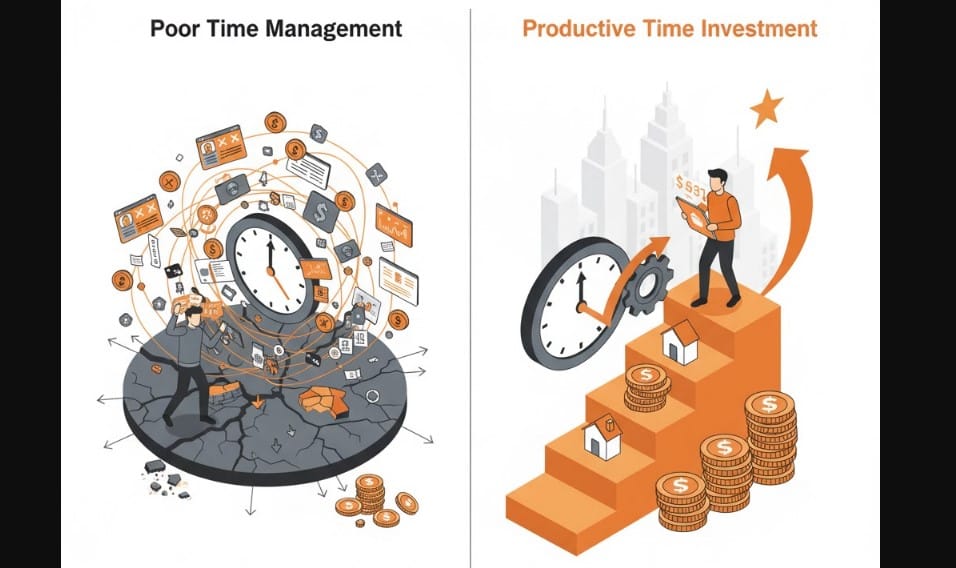
Time and money are the two most limited resources in life — and they are deeply intertwined.
How you perceive and use time often dictates your financial outcomes, yet most people overlook this connection.
Do you spend your hours mindfully or reactively?
Do you trade time for money consciously or unconsciously?
Your relationship with time shapes:
- How much you earn
- How much you save
- How much you invest
- How you experience financial freedom
1. Time as a Reflection of Your Money Mindset
The way you value your time reflects your beliefs about money.
- If you constantly overwork without strategy, you may subconsciously equate effort with worth.
- If you procrastinate on financial tasks, it might reflect fear or avoidance of money.
- If you delegate wisely, automate, and focus on high-value tasks, you’re practicing a growth-oriented money mindset.
Time is money — but not every hour is equal. Understanding which hours generate real value is key.
2. The Cost of Misaligned Time Management
When your time and money aren’t aligned, common issues appear:
- You trade hours for income without considering opportunity cost
- Financial planning and investments are delayed
- Debt accumulates because long-term planning is neglected
- Stress and burnout reduce your efficiency and earning potential
The hidden cost of poor time management is financial leakage — lost opportunity that could have grown into wealth.
3. Scarcity vs. Abundance Mindset Around Time
Just like money, your mindset around time shapes outcomes:
| Scarcity Mindset | Abundance Mindset |
|---|---|
| “I never have enough time.” | “I can prioritize and leverage time.” |
| Overcommits, burns out | Delegates, automates, and focuses on high-value tasks |
| Reacts to urgency | Acts with intentionality |
| Short-term focus | Long-term planning and investments |
When time is treated as abundant and strategic, your money flows more efficiently too.
4. Strategies to Align Time and Money
1. Track Your Hours
Understand where your time goes — not just for work, but for money-related tasks.
Small shifts can free hours for investing, learning, or building income streams.
2. Prioritize High-Value Activities
Ask:
“Does this task move me closer to financial freedom?”
Focus on activities that create long-term value, not just urgent work.
3. Automate and Delegate
Time spent on repetitive or low-value tasks costs money.
Automation and outsourcing free up your hours for strategy and growth.
4. Set Time-Based Financial Goals
Instead of only monetary targets, set deadlines and milestones:
- Emergency fund by month X
- Debt paid by quarter Y
- Investment plan implemented by year Z
Time-bound goals create accountability and reduce procrastination.
5. Reflect on Emotional Time Habits
Your emotions shape how you use time:
- Anxiety → Avoidance → Missed opportunities
- Guilt → Overworking → Burnout
- Confidence → Prioritization → Consistent progress
Emotional awareness ensures your time is spent intentionally.
5. The Compounding Effect of Time and Money
Time and money compound together:
- Early investments in skills yield higher earning potential over decades
- Consistent financial planning, even in small increments, compounds wealth
- Strategic use of time for career growth multiplies income potential
Ignoring the time-money relationship is like planting seeds but never watering them — growth is delayed, and potential is lost.
6. The Mindset Shift: From Trading Hours to Leveraging Time
Many people see time purely as a trade for money:
“I work X hours, therefore I earn Y.”
A better mindset:
- Time is leverage — not only for earning, but for creating systems, learning skills, and building assets
- Money is freedom — a tool to buy back time
- Investing in time-efficient strategies multiplies both freedom and wealth
The ultimate goal is alignment: your hours, money, and goals all support each other.
Conclusion
Your financial health is a direct reflection of your relationship with time.
When you treat time as valuable, plan strategically, and act with emotional awareness, money begins to work with you, not against you.
Mastering time is mastering your financial destiny.
Align your hours with your values — and wealth, freedom, and peace will follow.