Introduction
With the rollout of advanced mobile networks and increasingly capable hardware, mobile applications are entering a new era of immersive interaction. The combination of 5G connectivity with augmented reality (AR) and virtual reality (VR) is redefining what “mobile” means — not just apps on a phone, but full-bodied experiences that respond in real time, blend digital and physical worlds, and invite deeper user engagement.
In this article we explore how 5G + AR/VR are unlocking immersive mobile experiences, the technical enablers, real-world use cases, challenges ahead, and what this means for developers and users alike.
What Does “Immersive” Really Mean?
Immersive mobile experiences go beyond simply displaying content. They encompass:
- Low-latency responsiveness — where user gestures, movement or voice trigger near-instant feedback in the virtual/augmented environment.
- High-fidelity visuals & audio — where 3D graphics, sound, and perhaps haptics converge to create presence.
- Contextual awareness and interactivity — environments adapt to user location, motion, device sensors or shared experiences.
- Seamless blending of physical and digital worlds — from AR overlays in the real world to fully virtual spaces for VR, all reachable on mobile or wearable devices.
When mobile apps achieve these properties, users don’t just use a screen — they feel part of a different space. And 5G is the network technology enabling that leap.
The Role of 5G in Enabling Immersive Mobile AR/VR
1. Ultra-Low Latency & Real-Time Interaction
Immersive AR/VR demands that the time between a user’s action (head turn, gesture, move) and the visual/aural update be extremely short — otherwise motion sickness, loss of immersion, or lag break the experience. 5G dramatically reduces latency compared to prior networks. InApp+25G+2
For example, latency dropping into single-digit milliseconds makes real-time object tracking and overlay feasible. MoldStud+1
2. High Bandwidth & Rich Content Delivery
Immersive AR/VR often requires large volumes of data — high-resolution textures, 360°/3D video, multi-user synchronization. 5G’s higher throughput enables this content to stream or update without long waiting times or buffering. Toxigon
For example, mobile AR environments that once required pre-downloaded assets can now stream dynamically via 5G. MoldStud
3. Edge Computing & Network Slicing
5G networks enable edge computing (processing closer to the device) and network slicing (dedicated virtual network lanes) which are essential for immersive services. Processing heavy graphics or multi-user synchronization at the edge helps keep latency low and ensures quality. ericsson.com+1
The industry is preparing for what’s termed “extended reality (XR)” — including AR, VR and mixed reality — supported by 5G-Advanced and edge architectures. Nokia Corporation | Nokia+1
Real-World Use Cases & Emerging Scenarios
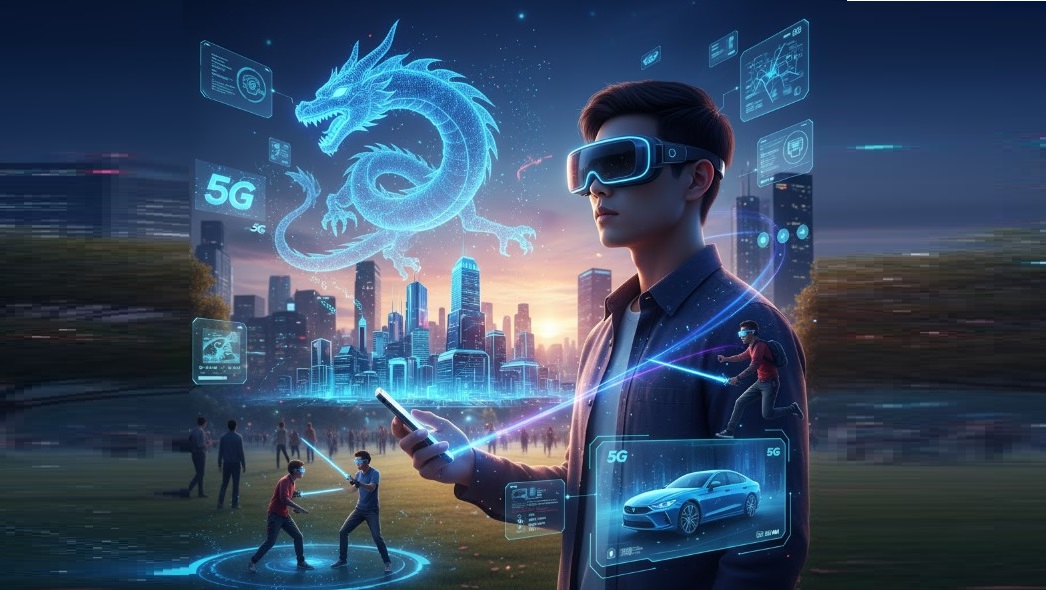
- Mobile AR in everyday life: Imagine a smartphone or wearable AR device, connected via 5G, overlaying directions, contextual information, or multiplayer game elements onto the real world — without lag or interruption.
- Mobile VR experiences on the go: With 5G and edge support, users can stream high-fidelity VR content on mobile headsets without tethering to a PC or local hardware. 5G
- Remote collaboration and training: Technicians, trainers or learners can connect via immersive AR/VR over 5G to interact with remote equipment, simulate scenarios, or receive real-time guidance as though they were physically present. Nokia Corporation | Nokia+1
- Entertainment and events: Sports, concerts or social events can integrate AR/VR mobile experiences delivered over 5G — for example, virtual/augmented overlays in large crowds, multi-user immersive spectatorship, or in-vehicle AR/VR journeys. MoldStud+1
Benefits for Mobile Interaction and End Users
- Deeper engagement: Immersive interfaces allow users to feel more “in” the experience rather than just tapping a screen.
- New modes of interaction: Gesture, gaze, motion become integral, not just taps and swipes.
- Anywhere, anytime immersion: With mobile 5G and wearable AR/VR, immersive experiences untether from the living-room or PC.
- Cross-device fluidity: Mobile devices, wearables and cloud/edge renderers combine to deliver seamless experiences across form factors.
- Innovation in services and monetization: Developers and businesses can craft entirely new app categories (location-based AR experiences, mobile immersive gaming, remote VR services) made viable by 5G.
Challenges and Considerations
- Coverage and consistency: 5G rollout is still incomplete in many regions. Immersion depends on stable high-quality connectivity.
- Device hardware constraints: Mobile AR/VR still demands powerful sensors, GPUs, and battery life; until hardware becomes fully optimized, trade-offs remain.
- Content and UX design: Immersive experiences must be designed for motion comfort, efficient streaming, and seamless interaction — poor design breaks the illusion.
- Privacy and safety: Immersive mobile interaction may involve camera, motion sensors, location data and shared spaces — safeguarding user data and ensuring safe UX becomes critical.
- Cost and infrastructure: Edge compute, network slicing, high-fidelity content production all add cost; adoption depends on ecosystem maturity and business models.
What This Means for Developers and Businesses
- Prioritise 5G-enabled features: When designing a mobile AR/VR app, consider how lower latency and higher bandwidth can enhance user interaction (e.g., real-time multiplayer AR, live VR streaming).
- Leverage edge compute and stream models: Off-loading heavy rendering or using split-render architectures helps deliver quality with lighter devices. ericsson.com
- Design for mobile form-factors and context: Mobile immersive apps must consider factors like device motion, network variability, battery life, and user comfort.
- Plan for scalability and multi-user realism: With 5G’s support for high density and concurrency (e.g., many simultaneous XR users), apps can scale beyond solo experiences. GSMA
- Monitor emerging standards (5G-Advanced, XR hardware): The ecosystem is evolving rapidly — early movers can gain advantage with next-gen AR/VR mobile interaction.
Future Outlook
As 5G networks mature (and evolve toward 5G‑Advanced and beyond), and as hardware (mobile devices, wearables, AR/VR headsets) becomes more capable and compact, the boundary between mobile apps and immersive experiences will fade. Mobile interaction won’t just be about tapping icons — it will be about stepping into alternate realities, interacting spatially, co-creating with others, and doing so from anywhere.
For users and developers alike, this era marks a shift from “apps on a screen” to “experiences in space”. And with 5G as the connectivity backbone, the possibilities are vast.
Conclusion
Immersive mobile experiences — built on the synergy of 5G connectivity and AR/VR technologies — are redefining how we interact with mobile devices, each other, and the digital world. For anyone designing or using mobile apps, the message is clear: the future of mobile is immersive. Developers who harness the capabilities of low-latency, high-bandwidth networks and design for spatial, interactive experiences will lead the next wave of mobile innovation.
Mobile interaction is no longer just about touching and swiping — it’s about being immersed.