
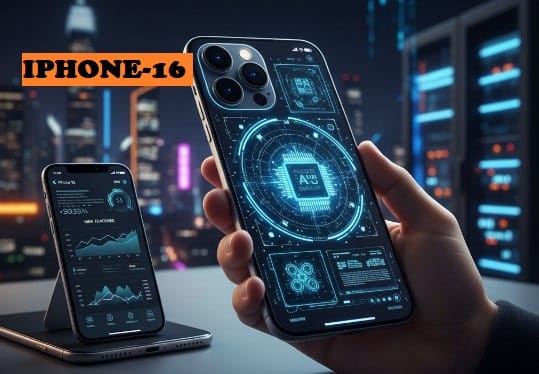
💡 Introduction
If you’re watching the smartphone world in 2025, the iPhone 16 is one of the most talked‑about releases. With Apple pushing forward in AI integration, imaging, and usability, many are wondering: What’s truly new? Which upgrades matter? And should you upgrade now?
In this article, we’ll dive into:
- Key new features and changes
- What’s meaningful to real users
- The trade-offs and limitations
- Whether upgrading makes sense for you
Let’s get into it.
⚙️ What’s New in iPhone 16 (vs iPhone 15 & earlier)
Below is a breakdown of the standout new features, backed by sources and leaks:
A18 Chip & AI Focus
- The iPhone 16 lineup is powered by the A18 system-on-chip. It’s designed with Apple Intelligence and on-device AI in mind. Wikipedia+2Laptop Mag+2
- The Neural Engine is notably faster, enabling smarter features like generative image editing, intelligent suggestions, and more efficient processing of heavy tasks. Wikipedia
- Some sources note that the logic board and thermal design have been reworked to sustain higher performance and reduce throttling. Wikipedia
Camera & Imaging Advances
- A 48MP “Fusion” camera remains the flagship sensor, now better leveraged for optical 2× “telephoto” cropping. Apple+1
- The ultra-wide camera sees improvements too: autofocus support, wider aperture, and better low-light capture. MacRumors+1
- A new Camera Control button is added on the side (below the power button), enabling quick photo/video actions. MacRumors+2Wikipedia+2
- The iPhone 16 supports spatial photos and videos (for Vision Pro/AR use), macro modes, and better computational imaging pipelines. Wikipedia+2Apple+2
Display, Design & Build
- The general design is similar to the iPhone 15: flat edges, aluminum frame, frosted matte glass back. MacRumors
- The iPhone 16 ships with Dynamic Island and a next-generation Ceramic Shield front glass, claimed to be tougher. MacRumors
- New color options: teal, pink, ultramarine, along with classic black and white. MacRumors+1
Charging, Battery & Connectivity
- The iPhone 16 supports faster MagSafe charging (22 W for standard, 25 W for Plus) with a new MagSafe charger required for full speeds. MacRumors+1
- Qi2 wireless charging is also supported. MacRumors
- Battery life is improved: up to 22 hours of video playback on the base, and up to 27 hours on the 16 Plus. T-Mobile+1
- The USB‑C port is introduced (replacing Lightning), but data transfer remains capped to USB 2.0 (480 Mbps) — same speed as before. MacRumors+1
- For wireless and network connections: Wi-Fi 7, Bluetooth 5.3, full 5G support, and enhanced Ultra-Wideband operations. MacRumors+1
- In the US, Apple continues with eSIM only, no physical SIM slot. MacRumors
🔍 What Matters to Real Users
It’s one thing to list upgrades; it’s another to see which changes users will actually feel:
1. Camera Usability & Flexibility
If you snap a lot of photos or do content creation, the Camera Control button + improved sensors are meaningful. The “dual in one” use of the 48MP sensor for both wide and 2× zoom is a smart optimization.
2. AI & Smart Features
As features like generative editing, intelligent photo suggestions, and smart automations rely on processing power and Neural Engine speed, the A18 + design improvements give room for future capabilities.
3. Battery Life & Charging Speed
Longer battery performance is always welcome. The faster MagSafe is helpful — but only if you adopt the newer charger.
4. Port & Connectivity Changes
Switching to USB‑C is a notable shift. Even though data speed remains USB 2.0, having universal cable compatibility is more convenient.
Wi-Fi 7 and better connectivity also mean future-proofing for faster networks.
5. Longevity & Future Features
Apple tends to support iPhones for many years. The hardware upgrades — especially stronger Neural Engine, better thermal design, connectivity — ensure that the iPhone 16 will remain relevant for longer.
⚠️ Trade-offs, Limitations & What Didn’t Change
- The base iPhone 16 model has a 60 Hz refresh rate (non-Pro models), which feels less smooth compared to 120 Hz phones. TECHi+1
- Some critical features are limited to higher-end models (or may appear in iPhone 16 Pro) — e.g. high refresh rate display, better camera systems.
- The USB-C’s continued limitation to USB 2.0 speeds is disappointing. MacRumors+1
- Upgrading from iPhone 15 to 16 may feel incremental if your current device is recent. Some reviewers advise waiting. Yahoo Tech
- The newer iPhone 16e (budget model) lacks some premium features: no MagSafe, no Camera Control button, no Dynamic Island (in some markets) — but keeps A18 and many core capabilities. The Verge+2Apple+2
🤔 Is It Worth Upgrading?
It depends on where you stand today and how you use your phone.
✅ Upgrade If You:
- Use your phone for content creation (photos, short videos, social)
- Want better battery life and future-proof connectivity
- Are interested in Apple’s evolving AI and imaging features
- Have an older iPhone (iPhone 13 or before)
⏳ Wait If You:
- Already own an iPhone 15 Pro or 15 — the leap is more incremental
- Prefer high refresh rate displays (would be better to wait for 120 Hz across all models)
- Don’t rely heavily on photography or AI-heavy features
💡 Tip:
Watch for price cuts and promotions — Apple often discounts the iPhone 16 when new models launch. Forbes

iPhone 16