Introduction: When Tech Meets the Workplace ⚡
For years, AI has been hyped as a productivity booster, a digital assistant, and even a creative partner. But alongside the opportunities, there’s always been an undercurrent of fear: Will AI take my job?
In 2025, Microsoft released new insights into which jobs are most vulnerable to automation. The findings aren’t just statistics — they reveal how AI is quietly reshaping entire industries.
Let’s break down what Microsoft’s research uncovered, why certain roles are at risk, and what workers can do to future-proof their careers.
Microsoft’s Revelation: The AI Impact Report
According to Microsoft’s analysis, jobs with repetitive, rules-based, or easily digitized tasks are at the highest risk of being replaced by AI. But the report also highlights opportunities for workers who adapt and learn how to work alongside intelligent systems.
👉 Key takeaway: It’s not just about losing jobs — it’s about jobs changing.
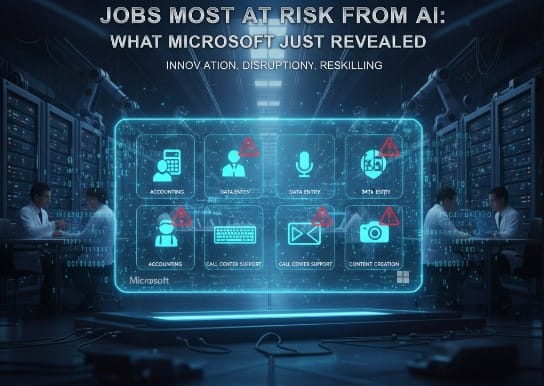
Jobs Most at Risk from AI
1. Administrative and Clerical Roles 🗂️
- Data entry, scheduling, and transcription are highly automatable.
- AI assistants can handle emails, calendars, and even document preparation.
👉 Example: A law firm replaced manual paralegal document review with AI, cutting processing time from 10 hours to 30 minutes.
2. Customer Support Agents 📞
- AI chatbots and virtual assistants now resolve basic queries 24/7.
- Human agents remain essential for complex, emotional, or sensitive cases.
3. Routine Accounting & Bookkeeping 📊
- AI can automatically reconcile transactions, generate reports, and flag errors.
- Accountants who focus on strategic advisory remain in high demand.
4. Basic Content Production ✍️
- AI can draft product descriptions, blog posts, and marketing emails at scale.
- Creative strategy and storytelling still need human direction.
👉 Case study: A mid-sized e-commerce company saved thousands by automating product listings — but hired copywriters to refine brand voice.
5. Manufacturing & Warehouse Roles ⚙️
- Robotics and AI logistics systems handle packaging, assembly, and inventory.
- Human workers are shifting to oversight and machine maintenance.
Which Jobs Are Safer (for Now)?
Microsoft’s findings suggest that roles emphasizing creativity, emotional intelligence, leadership, and complex problem-solving are less likely to be automated. These include:
- Strategic management.
- Healthcare professionals (with human empathy).
- Skilled trades (electricians, plumbers).
- Research and design.
What Workers Can Do to Adapt
- Upskill with AI Tools – Learn to use AI instead of competing with it.
- Focus on Human Strengths – Creativity, empathy, and judgment can’t be automated.
- Build Tech Literacy – Understanding how AI works boosts employability in nearly every sector.
- Shift to Hybrid Roles – Pair domain expertise (finance, law, healthcare) with AI-enabled workflows.
👉 Tip: Microsoft’s report emphasizes that workers who adopt AI early often become more valuable, not less.
Conclusion: A Future of Transformation, Not Just Replacement
The truth is, AI isn’t here to wipe out entire job markets overnight. Instead, it’s reshaping work, automating repetitive tasks, and pushing humans into higher-value roles.
The winners of the AI era won’t necessarily be the biggest companies or the most technical experts — they’ll be the workers who adapt fastest.
🔑 Which part of your job do you think AI could automate today — and which part will always need the human touch?
✅ Light CTA: Want to stay ahead of workplace trends? Subscribe to our AI & Work Newsletter for weekly insights, tools, and strategies to future-proof your career.