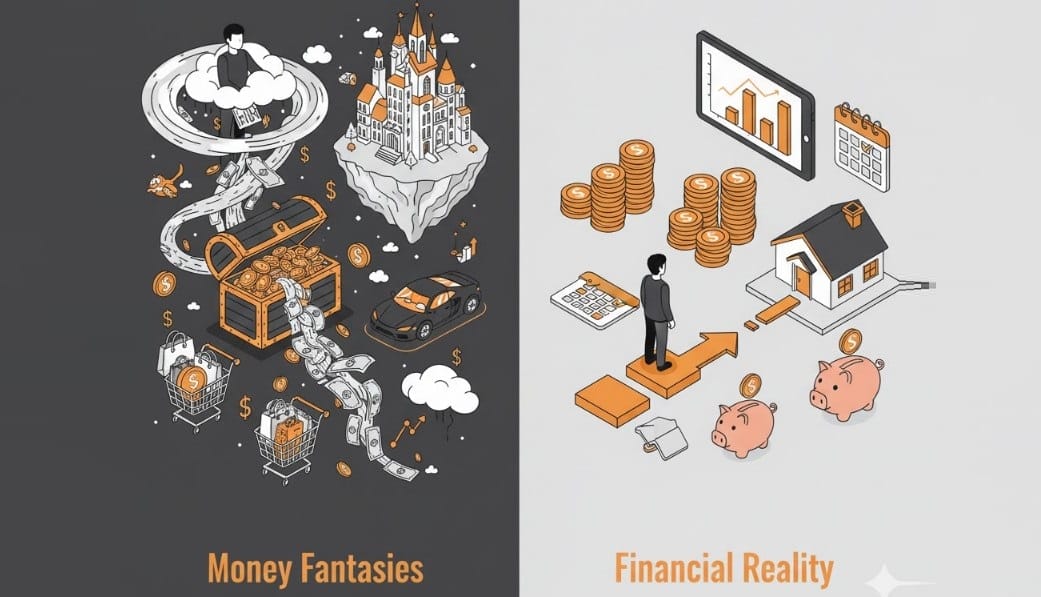
Everyone has a money fantasy.
For some, it’s waking up in a beachfront villa; for others, it’s quitting their job, traveling the world, or never worrying about bills again.
These fantasies can be motivating — but when they replace financial reality, they become traps.
Money fantasies make us feel powerful in the imagination but powerless in action.
To create true financial progress, we must separate the dream of wealth from the practice of financial stability.
1. What Are Money Fantasies?
A money fantasy is an idealized vision of financial success — the version of life where money solves every problem and buys emotional peace.
Common fantasies include:
- “Once I earn six figures, I’ll finally be happy.”
- “If I had more money, I’d never feel stressed again.”
- “When I invest in X, everything will change.”
Money fantasies often carry emotional promises — love, confidence, freedom, control — that money itself can’t deliver.
2. The Psychology Behind Financial Idealism
Money fantasies are not irrational — they’re emotional coping mechanisms.
They emerge from:
- Scarcity upbringing — where money symbolized safety or worth.
- Cultural conditioning — messages that “success = happiness.”
- Unhealed financial trauma — turning wealth into redemption.
Our brains create these fantasies to escape present discomfort — not because we’re greedy, but because we’re human.
But when fantasy replaces effort, it becomes a form of emotional avoidance.
3. How Money Fantasies Distort Financial Reality
Money fantasies distort our sense of time and effort.
They make success feel like a single breakthrough instead of a gradual process.
This distortion shows up as:
- All-or-nothing thinking: “If I can’t make a lot, why bother saving?”
- Overconfidence: “I’ll take this risk — I’ll be rich soon anyway.”
- Procrastination: “I’ll start managing my money once I earn more.”
- Chronic dissatisfaction: Always chasing the next level, never feeling secure.
In reality, wealth is built through small, consistent behaviors — not single, grand moments.
4. The Emotional High of Financial Fantasy
Money fantasies trigger dopamine — the brain’s reward chemical.
Thinking about wealth gives us the feeling of progress, even if we haven’t taken real steps.
This creates a cycle:
- Imagine financial success → feel inspired.
- Avoid current discomfort → feel relief.
- Return to the same habits → feel stuck.
- Fantasize again → temporary emotional reward.
Financial fantasy feels productive — but it’s emotional entertainment.
Breaking the cycle requires turning inspiration into structure.
5. When Dreams Become Distractions
Dreaming about money isn’t bad. The danger is using dreams to avoid reality.
For example:
- Reading about investments without actually saving
- Visualizing success but avoiding budgets
- Blaming external forces (“the system,” “the market”) instead of personal behavior
It’s not the dream that hurts — it’s what you postpone because of it.
6. The Reality Gap: Why Action Feels Uncomfortable
Financial reality requires discomfort — tracking expenses, saying no, delaying gratification.
Fantasies, in contrast, offer emotional comfort and instant control.
Reality feels vulnerable.
That’s why many people stay in the “planning” or “manifesting” phase indefinitely — it feels safer than confronting their current financial truth.
But awareness is freedom.
Once you look honestly at your finances, you stop imagining control and start creating it.
7. Signs You’re Living in a Money Fantasy
Ask yourself:
- Do I often say “When I make more money, I’ll finally…”?
- Do I avoid looking at my current financial numbers?
- Do I consume money content (videos, books, courses) more than I take action?
- Do I think financial success will fix my emotional struggles?
If so, you may be stuck in a fantasy loop — where dreaming feels safer than doing.
8. How to Ground Your Money Fantasies in Reality
You don’t need to kill your dreams — you need to anchor them.
1. Define the “Why” Behind the Fantasy
Ask: What feeling am I actually chasing? Freedom? Validation? Security?
You can often find healthier, immediate ways to meet that need.
2. Audit Your Financial Reality
List your income, expenses, debts, and goals.
Face the numbers — they are information, not judgment.
3. Set Micro-Goals
Instead of “be rich,” aim for “save $200 this month” or “invest 10% of income.”
Reality grows from repetition, not imagination.
4. Limit Comparison Culture
Unfollow unrealistic influencers or content that fuels fantasy.
Replace with practical education and grounded inspiration.
5. Revisit Your Vision Regularly
Dreams evolve — refine them as you grow.
Ground them in what’s meaningful, not just what’s marketable.
9. The Emotional Shift: From Fantasy to Fulfillment
When you bridge fantasy and reality, you experience emotional maturity around money.
You stop seeing money as magic and start seeing it as movement — a flow of choices, energy, and alignment.
The fantasy says, “One day I’ll feel free.”
Reality says, “I can start feeling free by managing what I have now.”
This mindset shift transforms your relationship with wealth from wishful to intentional.
10. The Power of Realistic Imagination
Grounded dreaming — or practical visualization — is powerful.
Visualize your ideal financial life with context:
- What daily habits support it?
- What behaviors sustain it?
- What emotions accompany it?
That vision becomes a compass, not an escape.
Fantasies float. Real visions walk.
Conclusion
Money fantasies give us hope, but unchecked, they can trap us in emotional paralysis.
Financial reality, though uncomfortable, gives us control and peace.
You don’t need to stop dreaming — you just need to stop waiting.
The bridge between money fantasy and financial reality is action informed by awareness.
It’s where self-trust grows, wealth stabilizes, and freedom becomes tangible.
Dream big — but budget wisely.
Imagine wealth — but live consciously.
That’s how fantasy becomes freedom.