Introduction
Why do some people thrive financially while others stay stuck — even when they earn the same income?
The answer often isn’t in spreadsheets or salaries. It’s in mindset.
Your money mindset — the set of beliefs and emotions you hold about wealth — shapes every financial decision you make. Whether you invest, save, spend, or avoid money altogether, your mindset determines your trajectory.
In this article, we’ll break down the difference between a fixed and a growth money mindset, explore how each affects your financial life, and show you how to shift your beliefs to unlock true financial growth and confidence.
1. What Is a Money Mindset?
A money mindset is your emotional and psychological relationship with money. It’s shaped by your upbringing, experiences, and beliefs — often long before you start earning.
Example:
If you grew up hearing “money doesn’t grow on trees,” you might subconsciously associate wealth with struggle or scarcity.
If you heard “money flows easily to people who create value,” you might naturally seek opportunities and growth.
Actionable Tip:
Take a few minutes to write down your top three money beliefs. Then ask:
- Are these beliefs helping or limiting me?
- Where did they come from — my family, culture, or personal experiences?
Awareness is the first step toward change.
2. Understanding the Fixed Money Mindset
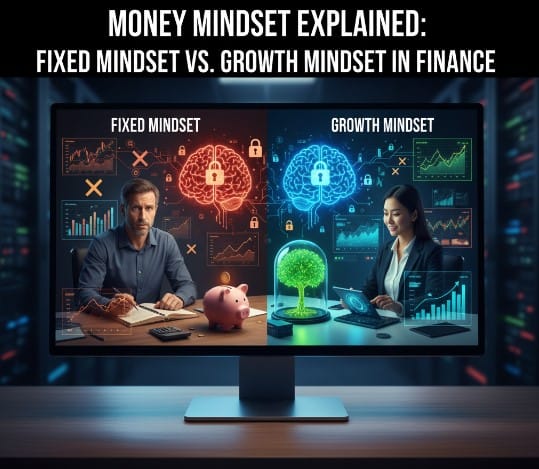
People with a fixed money mindset believe that their financial ability is limited — that they’re either “good” or “bad” with money, and nothing can change that.
Typical Beliefs of a Fixed Money Mindset:
- “I’ll never be rich; it’s just not for people like me.”
- “Investing is too risky — I’d probably lose everything.”
- “I’m just not good with numbers.”
This mindset keeps people in a cycle of fear, avoidance, and stagnation. They avoid new financial challenges and often sabotage progress out of subconscious doubt.
Example:
A freelancer might avoid raising rates, believing “clients won’t pay more.” In reality, that’s not a fact — it’s a fixed belief.
Actionable Tip:
Challenge one limiting belief this week. For example, instead of “I can’t save,” reframe it as “I’m learning how to manage money better.” Small shifts create big results over time.
3. What Is a Growth Money Mindset?
A growth money mindset views money skills as learnable and wealth as expandable.
People with this mindset believe they can improve their financial situation through learning, experimentation, and persistence.
Typical Beliefs of a Growth Money Mindset:
- “I can learn to manage and grow my money.”
- “Mistakes teach me how to make smarter decisions.”
- “Opportunities are everywhere when I’m willing to adapt.”
Example:
An entrepreneur who loses money in a failed launch studies what went wrong, refines the strategy, and succeeds next time. They see financial growth as a skill — not luck.
Actionable Tip:
Read one finance or mindset book per month. Start with “Mindset” by Carol Dweck or “You Are a Badass at Making Money” by Jen Sincero. Learning feeds confidence, and confidence fuels action.
4. How Fixed vs. Growth Mindset Impacts Financial Habits
| Financial Behavior | Fixed Mindset | Growth Mindset |
|---|---|---|
| Saving & Budgeting | “I’ll never save enough, so why try?” | “I can build saving habits one step at a time.” |
| Investing | “Investing is too risky.” | “I can start small, learn, and improve over time.” |
| Income Growth | “My income depends on luck or my boss.” | “I can create new income streams through skill-building.” |
| Financial Mistakes | “I failed; I’m not good with money.” | “That was a lesson — I’ll make better choices next time.” |
A fixed mindset keeps you reacting to money.
A growth mindset puts you in charge.
5. Shifting from Fixed to Growth Money Mindset
Transforming your money mindset isn’t about pretending everything is easy — it’s about training your thoughts to see potential instead of limitation.
Actionable Framework:
- Identify Limiting Beliefs
Write down any negative statements you catch yourself thinking about money. - Reframe Them into Growth Beliefs
- “I’m bad with money” → “I’m improving my financial skills every month.”
- “I’ll never afford that” → “I’m learning how to earn and manage enough to afford it.”
- Take Micro-Actions
Each small financial win (saving $50, investing $100, negotiating a rate) rewires your brain to trust growth. - Surround Yourself with Growth-Minded People
Join communities, masterminds, or mentors who encourage progress, not fear.
6. Emotional Intelligence and Money Confidence
Emotional awareness is crucial in financial growth. Many people make emotional money decisions — panic selling, guilt spending, or avoiding finances altogether.
Actionable Tip:
Before any big financial decision, pause and ask:
- “Is this fear or fact?”
- “Am I reacting emotionally or thinking strategically?”
Growth-minded people use emotion as data, not direction.
7. The Long-Term Benefits of a Growth Money Mindset
A growth mindset transforms not just your bank account but your entire relationship with success.
You’ll notice:
- Reduced financial anxiety
- More creative income ideas
- Improved decision-making
- Stronger resilience during economic shifts
In 2025 and beyond, adaptability will be the new currency — and growth thinkers will thrive.
Conclusion
Money is more than numbers — it’s a mirror of mindset.
A fixed money mindset keeps you trapped in scarcity and fear. A growth money mindset frees you to learn, evolve, and build lasting wealth through confidence and intention.
Remember: you can’t out-earn your mindset — but you can upgrade it.
🔑 Interactive Question:
Which belief about money are you ready to reframe today to step into a growth mindset?