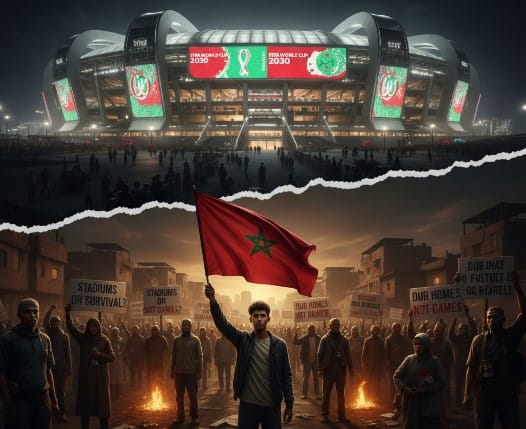
Introduction: The Billion-Dollar Question
Morocco is pouring billions of dollars into stadiums, hotels, and mega-projects in preparation for the 2030 FIFA World Cup. Yet outside those glossy blueprints, ordinary Moroccans are struggling with soaring food prices, a collapsing healthcare system, and record youth unemployment.
For critics, the question is unavoidable: is this progress—or a form of predatory capitalism that sacrifices the poor to satisfy elites and international prestige?
Billion-Dollar Investments vs. Daily Struggles
According to local estimates, Morocco is allocating over $8 billion to upgrade stadiums, build transport links, and boost tourism ahead of 2030. These investments are marketed as “nation-building” projects.
But at the same time:
- Hospitals lack basic supplies.
- Schools are overcrowded.
- Youth unemployment hovers around 37%.
- Inflation has left basic goods out of reach for many families.
To Morocco’s Gen Z, who are already leading mass protests, this is not progress—it’s betrayal.
Who Really Benefits?
While the government frames the World Cup as a “national project,” the distribution of benefits tells a different story. Construction companies with ties to political elites win billion-dollar contracts. Luxury hotels spring up in tourist zones, catering to wealthy visitors.
Meanwhile, the majority of Moroccans see little improvement in their daily lives. The pattern mirrors what critics call “wild capitalism”: profits privatized by elites, while costs and sacrifices are borne by the public.
Global Prestige, Local Pain
For Morocco’s rulers, the World Cup is a chance to impress the world, attract foreign investors, and polish the kingdom’s international image. But for the people on the ground, it’s a bitter irony: billions for stadiums, nothing for survival.
This contrast has fueled an increasingly viral slogan among young protesters: “We don’t need stadiums, we need hospitals.”
A Systemic Problem
The issue goes beyond sports. It reveals a broader governance crisis:
- Corruption siphons resources away from public services.
- Prestige projects are prioritized over social programs.
- Citizens are treated as an afterthought, rather than the core beneficiaries of development.
This is not unique to Morocco—many World Cup hosts, from Brazil to South Africa, faced similar criticism. But in Morocco, where poverty and inequality remain acute, the stakes feel even higher.
Conclusion: Stadiums or Justice?
As Morocco races toward 2030, the divide between shiny stadiums and struggling citizens grows sharper. The kingdom’s leaders present the World Cup as a symbol of national pride. But for millions of Moroccans, it symbolizes something else entirely: a system that values spectacle over dignity, and capital over citizens.
The question remains: will the World Cup leave Morocco stronger—or will it be remembered as the ultimate expression of a ruthless capitalism that served the few and abandoned the many?
🔑 Key Question for Readers
Do you believe mega-events like the World Cup can ever truly benefit ordinary citizens—or are they destined to serve only political elites and global corporations?
Also :
Morocco’s Crisis and the World Cup Question: Could Turmoil Cost the Kingdom 2030?
Morocco’s Generation Z Revolt: Unmasking a Nation in Crisis
Will Morocco Prioritize Its Own People Before Impressing Its World Cup Guests?