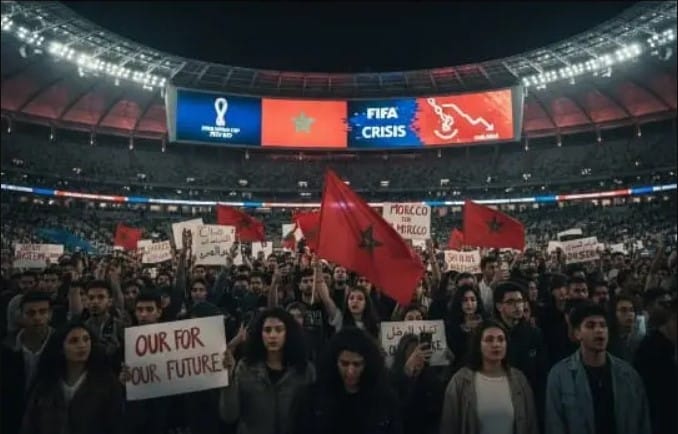
Introduction: A Nation in the Spotlight
Morocco has long celebrated its selection to co-host the 2030 FIFA World Cup alongside Spain and Portugal. For many, this was a national triumph: global recognition, billions in potential investment, and a chance to showcase Morocco’s growing infrastructure and “stability.”
But as 2025 draws to a turbulent close, a new question looms: can Morocco hold onto this dream amid political unrest, corruption scandals, and growing youth-led protests? For the first time, international observers and sports bodies are quietly asking whether the kingdom’s domestic crises might undermine its role as a World Cup host.
Domestic Unrest: A Crisis at Home
Over the past months, Morocco has been shaken by mass protests, led largely by Generation Z. Rising unemployment, skyrocketing living costs, collapsing healthcare, and a failing education system have fueled unprecedented anger.
What began as localized demonstrations over hospital shortages has escalated into nationwide protests demanding accountability and reform. Social media hashtags such as #MoroccoProtests and #GenZRevolt trend daily, exposing police crackdowns and systemic failures to a global audience.
For a country hoping to present itself as a reliable World Cup host, these images are disastrous. FIFA is acutely sensitive to political instability and reputational risks, particularly after controversies in Russia and Qatar.
Corruption Allegations and Governance Concerns
Beyond protests, Morocco faces growing scrutiny over corruption and financial mismanagement.
Billions are being funneled into stadium renovations, transport infrastructure, and luxury tourism projects, while public hospitals lack basic supplies and schools remain overcrowded. Critics argue that World Cup preparations are being prioritized at the expense of essential services.
International watchdogs, including Transparency International, have repeatedly flagged Morocco’s governance challenges. If corruption scandals directly linked to World Cup projects emerge, FIFA may face pressure to reconsider its choice—or at least impose stricter oversight.
The Image Problem: Global Media Attention
In the lead-up to every major tournament, host nations are placed under a microscope. For Morocco, the timing could not be worse.
- Western media outlets already highlight the contrast between “gleaming stadiums” and “poverty-stricken communities.”
- Human rights organizations warn of repression against protesters and activists.
- International investors worry about instability impacting large-scale projects tied to the World Cup.
If the protests escalate or police violence becomes a recurring headline, Morocco’s image as a “safe and stable” destination will be undermined. FIFA, keen to avoid reputational damage, cannot ignore these optics.
Could FIFA Actually Remove Morocco?
While the outright removal of Morocco as a co-host remains unlikely, it is no longer unthinkable.
FIFA has precedent:
- Colombia was stripped of the 1986 World Cup due to political instability and economic challenges.
- Other nations have faced relocation threats when unable to meet hosting commitments.
Should Morocco’s crisis deepen—through mass unrest, political paralysis, or corruption scandals tied directly to infrastructure projects—FIFA could be forced to scale back Morocco’s role or reassign key matches to Spain and Portugal.
Gen Z’s Counter-Narrative
Ironically, Morocco’s young protesters argue that the World Cup could have been a unifying national project—an opportunity to inspire, create jobs, and modernize the country. Instead, they see it as a symbol of mismanagement: billions spent on stadiums while everyday citizens struggle for survival.
On TikTok and Twitter, memes circulate contrasting glossy FIFA promotional videos with footage of broken hospitals and student protests. For Gen Z, the World Cup has become not a source of pride, but a reminder of government failure.
The Road Ahead: What Morocco Must Do
To avoid losing face internationally—and to keep its World Cup dream alive—Morocco’s leadership must act urgently:
- Address Core Grievances: Invest in healthcare, education, and youth employment, not just stadiums.
- Transparency in Spending: Open the books on World Cup projects to rebuild public trust.
- Respect Human Rights: Stop repression of protesters and allow peaceful expression.
- Engage Gen Z: Include young voices in national dialogue, turning dissent into participation.
Without these steps, Morocco risks not only domestic instability but also international humiliation if its hosting role comes under review.
Conclusion: The World is Watching
The 2030 World Cup was supposed to cement Morocco’s reputation as a rising star on the global stage. Instead, the kingdom finds itself under unprecedented scrutiny.
For Morocco’s rulers, the message is clear: the world’s patience—and FIFA’s tolerance—is limited. If corruption, unrest, and repression continue, the cost may be far greater than domestic dissent. It could be the loss of the nation’s most prized opportunity: the right to welcome the world in 2030.
The question is no longer whether Morocco can build stadiums. It’s whether Morocco can build trust, stability, and hope—before it’s too late.
Also :
Morocco’s Generation Z Revolt: Unmasking a Nation in Crisis
Will Morocco Prioritize Its Own People Before Impressing Its World Cup Guests?
Stadiums or Survival? Morocco’s Costly World Cup Gamble on the Backs of Its People