Introduction: The Youthquake of 2025
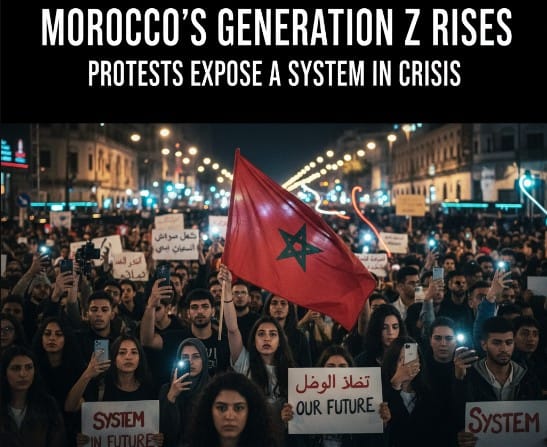
In late September 2025, Morocco’s streets witnessed an eruption that the country’s rulers had long feared but consistently ignored. From the bustling boulevards of Casablanca to the narrow alleys of Fez, thousands of young Moroccans—primarily members of Generation Z—marched against a system they describe as corrupt, elitist, and indifferent to their struggles.
These protests, though sparked by immediate crises in healthcare and education, reflect a much deeper malaise. They are the visible cracks in a fragile political and economic architecture that has failed to provide dignity, jobs, and hope for the nation’s youngest generation.
Unlike previous movements, this uprising is digitally native, globally connected, and uncompromising. Gen Z in Morocco is not content with vague promises of “reform” or half-measures. They demand structural change, accountability, and a future worth staying for.
A Broken Social Contract
Economic Fragility and Joblessness
At the heart of Morocco’s crisis lies a social contract that no longer works. For decades, the implicit bargain was clear: citizens would accept limited political freedoms in exchange for economic stability and gradual modernization. But that contract has collapsed.
Unemployment among Moroccan youth remains devastatingly high. Official figures place youth unemployment at nearly 37% in 2025, though independent studies suggest the number may be even higher when factoring in underemployment and informal work. University graduates spend years chasing precarious contracts, often in jobs unrelated to their studies.
For a young Moroccan with a degree in engineering, teaching, or law, the options are stark: accept informal, low-paying work, attempt migration at all costs, or join the growing chorus of dissent.
Rising Cost of Living
Adding fuel to the fire is a relentless rise in the cost of living. Rent in cities like Rabat and Casablanca has skyrocketed, while wages stagnate. Essential goods—bread, cooking oil, fuel—have seen sharp price increases, eating away at household budgets. For Gen Z, many of whom are forced to live with their parents well into adulthood, economic independence feels like a mirage.
The state continues to tout “mega-projects” such as new stadiums, luxury resorts, and high-speed train expansions. But for ordinary citizens struggling to pay rent or access basic medical care, such projects symbolize misplaced priorities and systemic neglect.
Healthcare and Education: The Breaking Point
Healthcare in Ruins
The trigger for the September 2025 protests came from Morocco’s collapsing healthcare system. Stories of preventable deaths, shortages of basic medical supplies, and overwhelmed hospitals dominated social media feeds. One viral case involved a young woman who died after being denied emergency care due to lack of hospital capacity. For a generation already on edge, this tragedy became the spark that ignited mass demonstrations.
Despite billions in state revenues, public hospitals remain underfunded, understaffed, and unable to meet basic standards. Wealthier citizens rely on private clinics, while the poor are left to navigate a broken system. For Gen Z, this disparity epitomizes systemic injustice.
An Education System in Decline
Parallel to healthcare woes is the collapse of Morocco’s education system. Overcrowded classrooms, underpaid teachers, and outdated curricula have left students frustrated and unprepared for the labor market.
Graduates often discover their degrees hold little value in a stagnant economy. The disconnect between academic training and professional opportunities has produced what many describe as a “lost generation”—highly educated, but unemployed and disillusioned.
The Digital Dimension: Gen Z’s Weapon of Choice
What sets the 2025 protests apart from earlier waves of dissent is the central role of digital platforms. Morocco’s Gen Z is the first fully connected generation: fluent in TikTok, Instagram, and encrypted messaging apps like WhatsApp and Telegram.
Social media has transformed into both a mobilizing tool and a battlefield. Hashtags such as #GenZMorocco, #YouthForDignity, and #Morocco2025Protests trend daily, amplifying stories of injustice and circulating real-time videos of police crackdowns.
Where state-controlled television once shaped narratives, Gen Z’s smartphones now bypass censorship, exposing corruption and brutality to both domestic and international audiences.
This digital fluency also globalizes the struggle. Moroccan youth see themselves reflected in global movements—from climate protests in Europe to pro-democracy campaigns in Asia. Their fight is no longer isolated; it is part of a broader generational demand for accountability worldwide.
State Response: Denial and Repression
Heavy-Handed Policing
Instead of addressing grievances, the Moroccan state has responded with a familiar playbook: silence, repression, and cosmetic promises. Riot police were deployed in major cities, dispersing crowds with tear gas and batons. Human rights organizations report dozens of arbitrary arrests, with activists and citizen journalists targeted in particular.
By criminalizing dissent, the state risks deepening mistrust and radicalizing a generation that already feels abandoned.
Empty Reform Promises
Government officials insist they are investing in reforms, pointing to digitalization projects, renewable energy investments, and tourism initiatives. Yet these efforts, while significant on paper, rarely translate into tangible improvements in the lives of ordinary citizens.
For Gen Z, talk of “Vision 2030” or “national strategies” is meaningless when hospitals lack beds, schools lack resources, and job markets lack opportunities.
Migration Dreams and Brain Drain
The ultimate expression of disillusionment among Moroccan youth is their growing desire to leave. Migration surveys show a dramatic increase in the number of young people considering emigration to Europe, Canada, and the Gulf.
Doctors, engineers, and IT specialists are among the first to go, fueling a brain drain that weakens Morocco’s development potential. For those unable to migrate legally, dangerous sea crossings remain a tragic option. The exodus of talent and ambition represents a damning indictment of a system incapable of nurturing its own citizens.
A Global Dimension: Why Morocco’s Crisis Matters
Morocco has long been portrayed internationally as a beacon of “stability” in North Africa—a strategic ally for Europe and the United States, a hub for renewable energy, and a tourist-friendly kingdom.
But beneath the polished image lies a reality of widening inequality, systemic corruption, and an alienated youth. If ignored, the ongoing crisis risks destabilizing not only Morocco but also the wider Maghreb and Mediterranean region.
For Europe, mass migration waves could intensify. For investors, the erosion of social cohesion raises questions about long-term stability. And for policymakers, the contradiction between supporting Morocco as a “stable ally” and turning a blind eye to repression is increasingly untenable.
Conclusion: A Generation’s Ultimatum
Morocco’s Generation Z is standing at a historic crossroads. Their protests are not simply about wages or schools—they are about dignity, justice, and the right to a future.
The Moroccan state faces an ultimatum: embrace genuine reform, fight corruption, and invest in essential services, or risk losing an entire generation to despair, migration, or permanent opposition.
For too long, the system has relied on promises without delivery, and repression without resolution. But this time is different. The youth are louder, more connected, and more determined than ever before.
The world is watching. And so is Morocco’s Gen Z, phones in hand, unwilling to be silenced.
🔑 Key Takeaway for Global Readers
Morocco’s crisis is not just a national story—it is a generational one, echoing across continents where young people demand accountability from outdated systems. Whether Morocco’s leaders choose dialogue or repression will determine not only the fate of their nation but also the legacy they leave in the eyes of the world.
Also :
Morocco’s Crisis and the World Cup Question: Could Turmoil Cost the Kingdom 2030?
Will Morocco Prioritize Its Own People Before Impressing Its World Cup Guests?
Stadiums or Survival? Morocco’s Costly World Cup Gamble on the Backs of Its People