Introduction
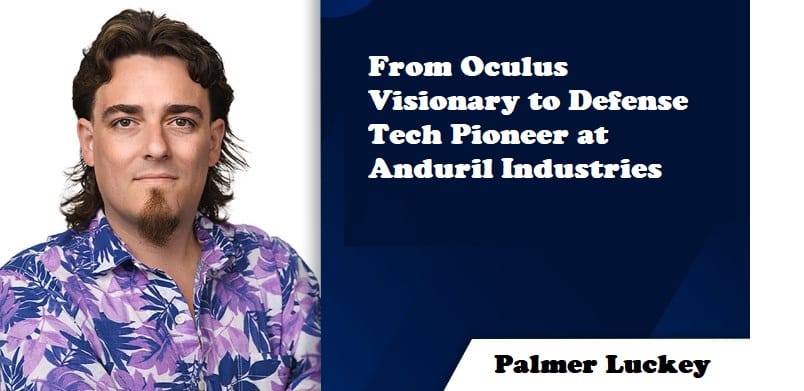
Palmer Luckey has lived one of the most fascinating arcs in modern tech. At just 19, he founded Oculus VR, a startup that brought virtual reality back to life and sold to Facebook in 2014 for $2 billion. A few years later, after a political controversy and a quiet exit from Meta, Luckey reemerged in an entirely new field: defense technology.
Today, he leads Anduril Industries, a company that uses AI, autonomy, and advanced hardware to reshape how militaries secure borders, detect threats, and make decisions in the field.
From VR Hobbyist to Silicon Valley Star
Before Oculus became a household name, Palmer Luckey was a teenage tinkerer obsessed with immersive technology. He built dozens of headset prototypes in his parents’ garage and shared his progress on VR forums.
In 2012, Luckey launched a Kickstarter campaign for the Oculus Rift, which quickly went viral. The project reignited global interest in VR and attracted attention from investors — and eventually, from Mark Zuckerberg, who acquired Oculus for $2 billion in 2014.
This deal made Luckey a multimillionaire overnight and positioned Oculus as a cornerstone of Facebook’s future “metaverse” ambitions.
The Political Storm and His Exit from Meta
In 2016, Luckey found himself at the center of controversy when reports surfaced about his donation to a pro-Trump group, sparking internal backlash within Facebook.
Despite issuing a public apology, the incident damaged his reputation in Silicon Valley’s progressive circles. By 2017, Luckey had quietly left Facebook, with many observers noting that the controversy likely influenced the decision.
That moment marked a turning point — one that would push him in a completely different direction.
The Birth of Anduril Industries
Later in 2017, Palmer Luckey founded Anduril Industries, named after the sword from The Lord of the Rings. His mission: to rebuild America’s defense technology infrastructure through modern tools like AI, computer vision, and autonomous drones.
Anduril’s first products — including autonomous surveillance towers and counter-drone systems — were designed to support border security and military reconnaissance.
The company’s growth has been explosive. Within a few years, Anduril secured multi-million-dollar defense contracts and became one of the most valuable private defense startups in the U.S.
Anduril’s Breakthrough: The EagleEye System
In 2025, Anduril unveiled EagleEye, an AI-powered mixed-reality helmet system that overlays battlefield data for soldiers. The device integrates augmented reality, real-time analytics, and machine learning — blending Luckey’s early VR expertise with advanced defense applications.
Interestingly, EagleEye reunites Luckey with some of his former Oculus colleagues and even incorporates technology from Meta’s AR display division.
The result: a wearable system that brings a video-game-like interface to the battlefield — raising both excitement and ethical questions about human-machine collaboration in warfare.
The Ethics and Controversy of Defense Tech
Luckey’s pivot to defense has drawn mixed reactions. Supporters argue that Anduril’s tools modernize national defense and reduce risk to soldiers. Critics, however, warn of the dangers of privatizing warfare technology and deploying AI in lethal decision-making.
Despite the ethical debate, Anduril’s success has positioned Luckey as one of the most influential figures in military innovation — and possibly the Elon Musk of defense tech.
Palmer Luckey’s Vision for the Future
Beyond contracts and controversy, Luckey has become a vocal advocate for U.S. reindustrialization and technological independence. He frequently warns about reliance on foreign supply chains, especially in electronics and AI components.
His long-term vision extends beyond defense: he aims to make Anduril a technology powerhouse that combines autonomy, robotics, and real-world data to safeguard both soldiers and civilians.
Leadership Lessons from Palmer Luckey
Luckey’s career offers several lessons for entrepreneurs and innovators:
- Reinvention is possible. Failure or controversy can lead to greater success if you pivot strategically.
- Cross-industry thinking matters. Luckey applied VR expertise to defense — an unexpected yet transformative leap.
- Courage to innovate in taboo spaces. He entered an industry most Silicon Valley founders avoid — and succeeded.
Conclusion
Palmer Luckey’s story is more than a tale of VR and defense; it’s a blueprint for resilience, adaptability, and visionary leadership. From Oculus to Anduril, he continues to push boundaries — proving that innovation can thrive even in the most unconventional spaces.