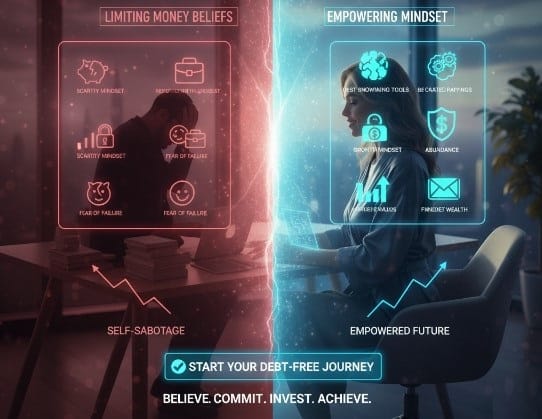
Introduction — Why Money Is More About Mindset Than Math
Most people believe wealth is built on hard numbers: income, investments, and savings rates. But in reality, your financial success in 2025 depends just as much on your beliefs, habits, and emotions about money as it does on your paycheck.
From childhood lessons to cultural influences, the psychology of money shapes how we save, spend, and invest. If your beliefs around money are outdated, rooted in fear, or based on scarcity, you may sabotage your financial growth — even if you earn well.
In this guide, we’ll explore how money beliefs form, why they matter in 2025’s digital-first economy, and how to rewire them to build wealth that lasts.
The Hidden Power of Money Beliefs 💭
Your money beliefs act like a financial operating system. Some people run on abundance and opportunity, while others run on fear and survival.
- If you believe “money is scarce,” you may hoard cash but avoid investing.
- If you believe “money is freedom,” you’ll likely take calculated risks to grow.
- If you believe “I’m bad with money,” you’ll subconsciously overspend or avoid budgets.
👉 Case Example: A 2024 survey showed that 48% of Gen Z adults admitted their biggest barrier to investing wasn’t lack of money — it was fear of losing money, rooted in family beliefs about financial insecurity.
Why Money Psychology Matters More in 2025
The financial world in 2025 is faster and more complex:
- AI-powered investing tools give people unprecedented access to markets.
- Crypto, tokenized assets, and micro-investments are mainstream.
- Global inflation cycles have forced people to rethink saving and spending habits.
In this environment, outdated money beliefs (like “only the rich can invest”) can hold you back more than ever. Success now requires not just financial literacy, but emotional literacy.
Step 1: Identify Your Current Money Story 📝
Your beliefs about money usually stem from:
- Childhood messages (“Money doesn’t grow on trees”).
- Cultural norms (shame around debt, pride in ownership).
- Past financial trauma (job loss, failed investment).
Action Exercise: Write down 3 core money beliefs you grew up with. Then ask: Are they helping me, or holding me back in 2025?
Step 2: Rewire Limiting Beliefs Into Empowering Ones 🔄
Changing your money psychology doesn’t mean ignoring reality — it means reframing it.
- Limiting belief: “I’ll never get out of debt.”
- Empowering belief: “Debt is temporary, and I can create a plan to crush it.”
- Limiting belief: “Investing is too risky for me.”
- Empowering belief: “Smart, diversified investing lowers risk and builds freedom.”
- Limiting belief: “I don’t deserve wealth.”
- Empowering belief: “Wealth is a tool to improve my life and others’.”
👉 Mini Story: Ahmed, a 32-year-old teacher, carried a belief that “teachers don’t make money.” After reframing his mindset and starting a side hustle in 2024, he doubled his income in a year.
Step 3: Use Psychology Hacks to Align Money With Behavior 🧠
Practical hacks to make your beliefs fuel your actions:
- Name your accounts emotionally (“Future Freedom Fund” instead of “Savings”).
- Automate abundance by scheduling automatic investments monthly.
- Visualize success — create a financial vision board or digital dashboard.
- Practice gratitude with money — review not just expenses but what those purchases gave you (comfort, knowledge, connection).
Step 4: Build Wealth That Lasts 🌍
In 2025, wealth is no longer about chasing quick wins — it’s about sustainable systems. When your psychology is aligned, you’ll naturally:
- Stick to budgets.
- Invest with patience.
- Resist financial fads.
- Balance enjoying today with building for tomorrow.
Remember: wealth is a habit loop — beliefs shape actions, actions shape results, results reinforce beliefs.
Conclusion — Upgrade Your Money Mindset for 2025 ✨
Numbers matter, but mindset matters more. By understanding and upgrading your money beliefs, you unlock the freedom to make smarter choices, reduce stress, and build lasting wealth in 2025 and beyond.
🔑 Interactive Question: What is one money belief you grew up with — and how will you reframe it in 2025 to build a healthier financial future?