Introduction
Do you often feel like there’s never enough — money, time, opportunities, or success?
Or do you believe there’s always more to create, share, and experience?
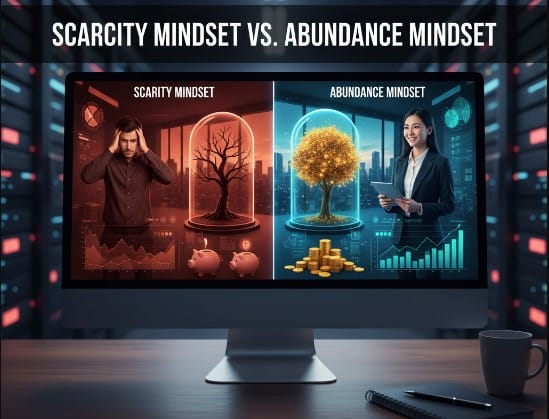
That difference defines your mindset — specifically, whether you live from scarcity or abundance.
Your mindset shapes every choice you make — from how you earn and spend money to how you build relationships, take risks, and grow.
In this article, we’ll explore the core differences between scarcity and abundance mindsets, how each affects your finances and life satisfaction, and how to shift from fear and limitation to trust and expansion.
1. What Is a Scarcity Mindset?
A scarcity mindset is the belief that resources are limited — that there isn’t enough success, money, or opportunity to go around.
People with this mindset often live in fear of loss, comparison, or inadequacy.
Common Beliefs of a Scarcity Mindset:
- “If someone else wins, I lose.”
- “There’s never enough money to go around.”
- “I need to hold onto what I have — opportunities are rare.”
- “I can’t take risks; I might lose everything.”
Example:
A freelancer sees another creator land a big client and instantly feels threatened instead of inspired.
That reaction isn’t jealousy — it’s scarcity thinking.
The Problem:
Scarcity thinking shrinks your creativity, increases anxiety, and blocks new opportunities.
When you believe there’s “not enough,” your mind focuses on protecting instead of expanding.
2. What Is an Abundance Mindset?
An abundance mindset is the belief that opportunities, money, and success are expansive and renewable — not limited or scarce.
It’s not about blind optimism. It’s about trusting that you can create more, learn more, and attract more by focusing on growth, gratitude, and value creation.
Common Beliefs of an Abundance Mindset:
- “There’s enough success for everyone.”
- “Money flows through value and creativity.”
- “I can learn, adapt, and grow with every experience.”
- “Giving and sharing attract even more opportunities.”
Example:
A content creator shares insights freely online, trusting that generosity builds authority and attracts better clients.
That’s abundance in action.
3. How Scarcity and Abundance Mindsets Affect Finances
| Aspect | Scarcity Mindset | Abundance Mindset |
|---|---|---|
| Spending | Fear-based: hoarding or impulsive splurging | Conscious: invests in growth and joy |
| Saving | Feels restrictive, fueled by fear | Feels empowering, fueled by purpose |
| Earning | “There are no good opportunities.” | “I can create new streams of income.” |
| Investing | Avoids risk out of fear | Takes calculated risks and learns from experience |
| Giving | Holds back, fears loss | Gives freely, trusts in return flow |
An abundant thinker doesn’t ignore financial limits — they simply believe limits can shift with creativity and growth.
4. The Psychology Behind Scarcity Thinking
Scarcity often develops from early experiences of lack, fear, or comparison.
When we grow up around financial stress, competition, or instability, the brain associates money with danger or loss.
Example:
Someone raised hearing “we can’t afford that” repeatedly may internalize “money is hard to get.”
Even when earning more as an adult, they still feel insecure.
Actionable Tip:
Reprogram scarcity by practicing gratitude.
Each morning, list three things you already have enough of — time, clients, skills, health, or relationships.
Gratitude shifts your focus from what’s missing to what’s present.
5. How to Shift from Scarcity to Abundance
1️⃣ Awareness: Catch Scarcity Thoughts in Real Time
Notice when you think, “I can’t afford this,” or “there’s not enough.”
Pause and reframe: “How can I make this possible?”
Questions create possibility — statements close it.
2️⃣ Celebrate Others’ Success
Instead of comparing, use others’ wins as proof that success is possible.
Say: “If they did it, I can too — there’s space for me.”
3️⃣ Invest in Growth, Not Fear
Scarcity hoards; abundance invests.
Whether it’s a course, tool, or collaboration — invest in your skills and expansion, not just safety.
4️⃣ Visualize Expansion
Regularly picture money and opportunity flowing through you, not to you.
This shifts your role from “collector” to “creator.”
5️⃣ Give and Collaborate
Sharing time, ideas, or knowledge signals to your subconscious: “I have enough.”
Generosity is one of the fastest ways to rewire for abundance.
6. Building an Abundance Mindset in Daily Life
Actionable Daily Practices:
- Practice gratitude journaling each morning.
- Replace comparison with curiosity (“What can I learn from them?”).
- Surround yourself with growth-minded people.
- Focus on creating, not competing — build, write, share.
- Take small, consistent actions that prove to yourself that growth is possible.
Over time, abundance becomes not a mindset — but a default setting.
7. Abundance Mindset and the Future of Work
In the digital age, abundance thinkers thrive.
Why? Because technology, AI, and online opportunities have removed traditional scarcity barriers.
There are infinite clients, audiences, and creative avenues for those who see and act on them.
In 2025 and beyond, the most successful freelancers and entrepreneurs will be those who approach money and opportunity from creation, not competition.
Conclusion
Scarcity says: “There’s not enough.”
Abundance says: “There’s always more to learn, create, and share.”
Your financial success isn’t limited by resources — it’s expanded by your mindset.
The moment you choose abundance, you begin to attract opportunity, confidence, and peace.
🔑 Interactive Question:
What’s one area of your life where you’re ready to replace scarcity with abundance thinking?
CTA:
Start shifting your focus today — practice gratitude, celebrate others’ success, and take one small action that aligns with abundance. The more you trust in “enough,” the more life expands.