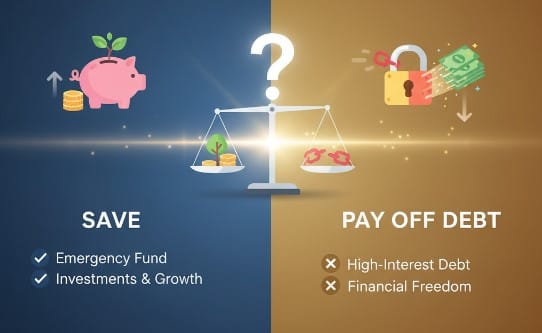
It’s one of the most common financial dilemmas: Should you prioritize saving money or paying off debt first? The answer isn’t always simple—it depends on your personal situation, financial goals, and even your psychology around money.
In this article, we’ll dive into the pros and cons of each approach, look at real-world case studies, and give you practical strategies to help you make the best decision for your financial journey.
Why This Question Matters
Balancing savings and debt repayment is critical for long-term financial health. Choose wrongly—or ignore one side—and you risk being unprepared for emergencies or stuck in a never-ending cycle of high-interest payments.
The Case for Paying Off Debt First 🧾
Debt can feel like a heavy chain. Especially with high-interest rates, delaying repayment often costs you more in the long run.
Pros of Paying Off Debt First
- Save on Interest – Credit card and loan interest can eat up hundreds or thousands yearly.
- Peace of Mind – Being debt-free reduces stress and creates a sense of freedom.
- Higher ROI – Paying off a 20% APR credit card is like earning a guaranteed 20% return.
Cons of Paying Off Debt First
- You might neglect savings and end up borrowing again during an emergency.
- Can delay long-term goals like investing or buying a home.
The Case for Saving First 💰
On the flip side, saving provides security and flexibility. Without a cushion, even small emergencies can derail progress.
Pros of Saving First
- Emergency Fund Protection – Keeps you from relying on credit cards in a crisis.
- Financial Confidence – A savings cushion reduces anxiety about “what ifs.”
- Future Investments – Savings can be redirected into investing, growing wealth over time.
Cons of Saving First
- High-interest debt keeps compounding, making it harder to escape later.
- You may build savings at the expense of tackling your biggest financial burden.
Case Study: Debt vs. Savings
Case 1 – Debt First Approach
Emma, a 27-year-old graphic designer, had $10,000 in credit card debt at 22% interest. She focused aggressively on paying off her debt, putting almost every extra dollar toward repayment. She became debt-free in two years but had very little in savings. A medical emergency forced her to borrow again temporarily.
Case 2 – Balanced Approach
Marcus, a 35-year-old teacher, had $5,000 in credit card debt and no emergency savings. He decided to split his extra income: 70% toward debt, 30% toward savings. Within 18 months, he cleared his debt and built a $2,000 emergency fund—leaving him more financially secure long-term.
The Balanced Strategy ⚖️
For most people, a hybrid approach is the smartest choice. Here’s how to structure it:
Step 1: Build a Starter Emergency Fund
- Aim for $1,000–$2,000 in quick-access savings.
- This prevents falling back into debt when unexpected expenses arise.
Step 2: Tackle High-Interest Debt Aggressively
- Focus on credit cards, payday loans, and other high-interest balances.
- Use the Debt Avalanche Method (highest interest first) or Debt Snowball Method (smallest balance first).
Step 3: Save While Paying Debt
- Once you’ve reduced the high-interest debt, allocate part of your income toward both debt repayment and savings growth.
Step 4: Long-Term Balance
- After clearing consumer debt, boost your emergency fund to 3–6 months of living expenses and start investing for the future.
Practical Tips to Find Your Answer
- Run the Numbers – Compare interest rates vs. savings account yields. If debt interest is higher than savings returns, prioritize debt.
- Know Yourself – Some people feel motivated seeing savings grow, while others thrive by eliminating debt.
- Automate Both – Even if you prioritize one, automate a small percentage for the other to stay balanced.
- Review Regularly – As your financial situation evolves, adjust your strategy every 6–12 months.
Conclusion
The debate of “Should you save or pay off debt first?” doesn’t have a one-size-fits-all answer. If you have high-interest debt, paying it down should usually be the priority—but never at the expense of leaving yourself completely vulnerable.
The best path often lies in a balanced strategy: build a small emergency fund, aggressively tackle high-interest debt, and gradually grow savings along the way.
🔑 Interactive Question for Readers:
Which approach do you prefer—saving first, paying debt first, or balancing both? Share your story in the comments!