Introduction
As blockchain technology continues to evolve, two of the most popular ways to earn passive income in the crypto world are mining and staking.
Both methods play a critical role in keeping blockchain networks secure and functional, while also rewarding participants for contributing their resources.
But what’s the difference between them, and how can you get started? This guide breaks down everything you need to know about mining and staking, including their pros, cons, and potential for profit in 2025.
1. What Is Cryptocurrency Mining?
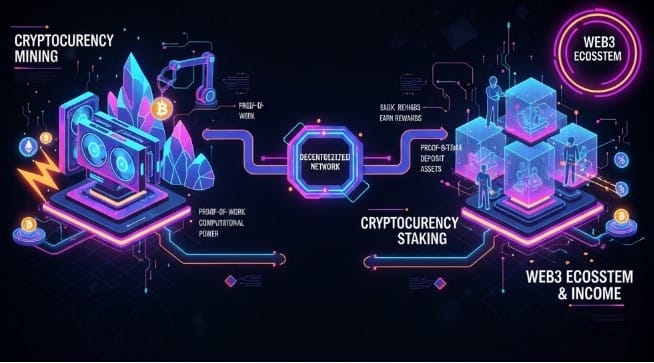
Cryptocurrency mining is the process of validating and recording transactions on a blockchain through computational power.
Miners use specialized hardware to solve complex mathematical puzzles, securing the network and creating new coins as rewards.
How It Works:
- Every time a transaction occurs on the blockchain, it needs verification.
- Miners compete to solve the mathematical problem linked to that transaction.
- The first miner to solve it adds a new block to the chain and receives a block reward (e.g., Bitcoin).
This system is known as Proof of Work (PoW).
2. The Essentials for Crypto Mining
Mining requires some technical setup and investment.
a. Hardware
- ASICs (Application-Specific Integrated Circuits): High-power machines built for mining specific coins (e.g., Bitcoin).
- GPUs (Graphics Processing Units): Used for coins like Ethereum Classic or Ravencoin.
b. Mining Software
Popular programs include:
- CGMiner
- BFGMiner
- NiceHash
c. Power and Cooling
Mining rigs consume significant electricity. Efficient cooling systems and renewable energy sources can help lower costs.
d. Mining Pools
Joining a mining pool allows miners to combine computing power and share rewards, increasing the chance of steady income.
3. Advantages and Disadvantages of Mining
✅ Advantages
- Generates new coins as rewards.
- Strengthens and secures the blockchain network.
- Potential for long-term profit if coin value increases.
❌ Disadvantages
- High energy consumption and electricity costs.
- Expensive hardware that becomes outdated quickly.
- Increasing difficulty and competition make solo mining less profitable.
4. What Is Cryptocurrency Staking?
While mining relies on computing power, staking depends on holding and locking tokens in a blockchain wallet to support the network.
This mechanism, known as Proof of Stake (PoS), selects validators to confirm transactions based on the number of tokens they stake, not their computational power.
How It Works:
- You stake (lock) a certain amount of tokens in your wallet.
- The network randomly selects stakers to validate new transactions.
- Validators receive staking rewards (new tokens or transaction fees) as compensation.
5. The Essentials for Crypto Staking
Getting started with staking is much easier than mining.
a. Choose a PoS Coin
Popular staking coins in 2025 include:
- Ethereum (ETH)
- Cardano (ADA)
- Solana (SOL)
- Polkadot (DOT)
- Avalanche (AVAX)
b. Use a Staking Platform or Wallet
You can stake through:
- Exchange platforms: Binance, Coinbase, Kraken
- Wallets: MetaMask, Trust Wallet, Ledger Live
- DeFi protocols: Lido, Rocket Pool
c. Earn Rewards
Rewards vary by network, typically ranging from 4% to 15% annually, depending on token supply and staking duration.
6. Advantages and Disadvantages of Staking
✅ Advantages
- Energy-efficient and eco-friendly.
- Generates passive income without hardware costs.
- Easier entry point for beginners.
- Encourages long-term holding and stability.
❌ Disadvantages
- Locked tokens can’t be sold immediately (illiquidity risk).
- Rewards may fluctuate based on network performance.
- Some platforms carry security risks if not decentralized.
7. Mining vs. Staking: Key Differences
| Feature | Mining | Staking |
|---|---|---|
| Mechanism | Proof of Work | Proof of Stake |
| Resources Needed | Hardware & electricity | Tokens (locked) |
| Energy Consumption | High | Minimal |
| Technical Complexity | High | Low |
| Profit Potential | Variable (depends on hardware & market) | Steady (depends on staking rate & token price) |
| Examples | Bitcoin, Litecoin | Ethereum, Cardano |
In short, mining rewards computational effort, while staking rewards ownership and participation.
8. The Future of Mining and Staking
As environmental concerns and energy regulations grow, staking is becoming the dominant consensus model for new blockchain projects.
However, mining still plays a vital role, especially for Bitcoin, which remains the largest and most secure PoW network.
In 2025, hybrid models like Proof of Stake + Proof of Work and Delegated Proof of Stake (DPoS) are emerging to combine efficiency with decentralization.
9. How to Choose the Right Path
Your choice depends on your goals and resources:
- If you have access to cheap electricity and hardware, mining may offer higher returns.
- If you prefer a simpler, eco-friendly method, staking is ideal for earning steady passive income.
Many investors diversify — mining with one asset and staking another to balance risk and reward.
Conclusion
Both mining and staking are essential components of the cryptocurrency ecosystem, enabling decentralization, transparency, and trust in blockchain networks.
Whether you decide to build a mining rig or stake your tokens in a DeFi protocol, you’re not just earning income — you’re contributing to the future of digital finance.
In the end, understanding the basics of mining and staking empowers you to make smarter, more sustainable crypto investment decisions in the Web3 era.