Introduction: More Than Just Silicon
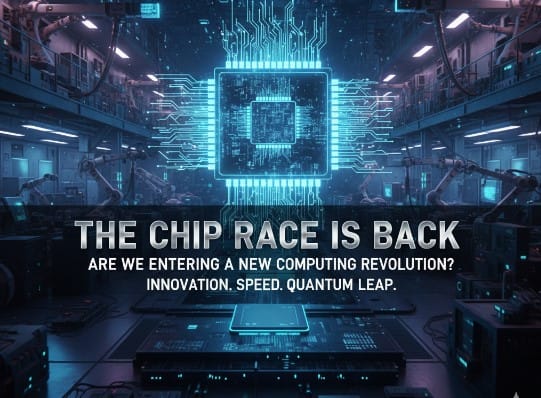
Not since the early days of Intel and AMD have we seen such fierce competition in the semiconductor world. But in 2025, the chip race is officially back — and this time, it’s not just about faster processors for personal computers.
From AI acceleration to quantum breakthroughs, chips are shaping the future of everything from healthcare to space exploration. The question is: are we standing on the edge of a new computing revolution?
Why Chips Are the Heart of Modern Innovation
Every piece of technology we touch — smartphones, laptops, self-driving cars, even refrigerators — runs on chips. They’re the invisible engines driving progress.
- AI models? Need specialized GPUs and AI accelerators.
- Cloud computing? Runs on high-performance server CPUs.
- Autonomous systems? Depend on energy-efficient, real-time processors.
👉 Example: The rise of generative AI wouldn’t have been possible without NVIDIA’s GPUs, designed for parallel computation.
The New Chip Race: Who’s Competing?
1. The Big Players
- NVIDIA: Leading the AI acceleration space.
- AMD & Intel: Pushing CPUs and GPUs into high-performance computing.
- Apple: Redefining mobile and desktop chips with its M-series silicon.
2. The Rising Challengers
- ARM-based designs are powering everything from cloud servers to smartphones with energy efficiency.
- RISC-V, an open-source architecture, is gaining momentum as an alternative to proprietary designs.
3. The Global Angle
The chip race is also geopolitical:
- The U.S., China, and Europe are investing billions in domestic chip manufacturing.
- Supply chain disruptions during the pandemic highlighted how critical chips are to national security.
Key Trends Driving the Revolution
AI-Specific Chips 🤖
AI workloads need specialized hardware. Expect more AI-only processors optimized for training and inference.
Energy Efficiency 🌱
Chips that deliver more power with less energy are vital for sustainable computing.
Edge Computing ⚡
As devices process data locally (instead of in distant data centers), chips are being designed for low-latency, on-device AI.
Quantum & Neuromorphic Computing 🔮
While still experimental, these chips mimic brain-like computation or quantum mechanics — promising leaps in areas like cryptography and drug discovery.
How This Impacts Everyday Life
This chip revolution isn’t just for tech giants:
- Healthcare: Faster drug simulations, AI diagnostics.
- Finance: Real-time fraud detection powered by specialized processors.
- Entertainment: Hyper-realistic gaming and AR/VR.
- Smart Homes: Energy-efficient chips running everything from thermostats to appliances.
👉 Case study: A medical research lab using custom AI accelerators cut cancer detection analysis time from days to hours.
Opportunities and Challenges
Opportunities
- 🚀 Faster innovation across industries.
- 🌍 More accessible AI and computing power.
- 💡 Democratization through open-source designs like RISC-V.
Challenges
- 🔒 Supply chain vulnerability.
- 💸 Rising costs of chip development and fabs.
- ⚖️ Balancing performance with environmental impact.
Conclusion: A Revolution in the Making
The chip race isn’t just back — it’s accelerating faster than ever. Unlike past decades, this isn’t just about faster personal computers. It’s about reshaping entire industries, economies, and even global power structures.
Whether through AI accelerators, quantum processors, or open-source hardware, one thing is clear: we’re entering a new computing revolution — and the winners will define the future of technology.
🔑 Do you think AI chips or quantum processors will dominate the next decade of computing? Share your prediction below!
✅ Light CTA: Want to stay ahead in the tech race? Subscribe to our Future Tech Insights Newsletter for weekly updates on AI, chips, and the next big computing trends.