Introduction
If you’ve spent any time learning about cryptocurrencies, you’ve likely come across two common terms: coins and tokens.
At first glance, they might seem interchangeable — both represent digital assets that hold value. But in the blockchain world, they serve very different purposes and are built on different layers of technology.
In this article, we’ll explain the difference between coins and tokens, how they’re created, and why understanding this distinction matters whether you’re investing, trading, or building on blockchain networks.
1. What Are Coins in Cryptocurrency?
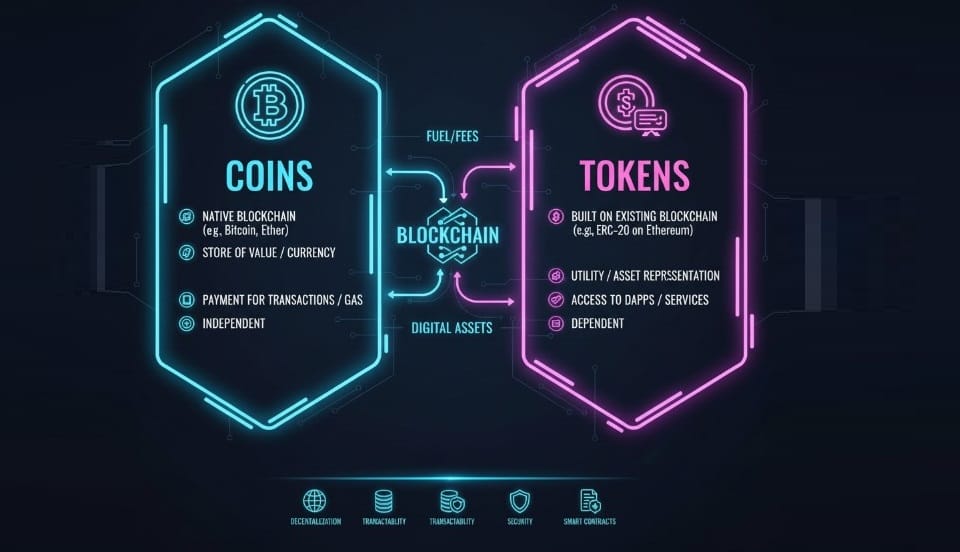
A coin is a digital currency that operates on its own blockchain.
Coins are native to the network they belong to — meaning they are the primary currency used to pay for transactions, secure the network, or store value.
Examples of Coins
- Bitcoin (BTC) → native to the Bitcoin blockchain
- Ether (ETH) → native to the Ethereum blockchain
- BNB → native to the BNB Smart Chain
- ADA (Cardano) → native to the Cardano blockchain
Functions of Coins
- Store of Value: Just like gold or cash (e.g., Bitcoin as “digital gold”).
- Medium of Exchange: Used for payments, trading, or transfers.
- Network Security: Coins are staked or mined to validate transactions.
- Transaction Fees: Pay for gas or transaction costs within the network.
Coins are the backbone of blockchain networks. They have their own infrastructure, nodes, and consensus mechanisms.
2. What Are Tokens in Cryptocurrency?
Unlike coins, tokens are digital assets that operate on an existing blockchain rather than having their own.
Tokens rely on smart contracts — programmable code that defines how they are created, transferred, and used.
Examples of Tokens
- USDT (Tether) → built on Ethereum, Tron, and others
- UNI (Uniswap) → built on the Ethereum blockchain
- MATIC (Polygon) → originally ERC-20, now has its own chain
- LINK (Chainlink) → operates on Ethereum
Tokens exist because developers can leverage the security and infrastructure of established blockchains (like Ethereum) instead of building new ones from scratch.
3. The Main Types of Tokens
Tokens serve different purposes depending on their role within an ecosystem. Here are the most common types:
🪙 1. Utility Tokens
These provide access to a product or service within a blockchain-based platform.
- Example: BNB is used to pay fees on Binance and access benefits.
- Example: UNI is used to govern and participate in Uniswap’s ecosystem.
💰 2. Security Tokens
These represent ownership in a real-world asset — like company shares or real estate — and are subject to financial regulations.
- Example: Securitize tokens that give investors equity rights.
🎮 3. Governance Tokens
Used for voting and decision-making in decentralized projects (DAOs).
- Example: AAVE and COMP holders can vote on platform changes.
💵 4. Stablecoins
Tokens designed to maintain a stable value, usually pegged to fiat currencies like the U.S. dollar.
- Examples: USDT, USDC, DAI
4. Technical Difference: Blockchain vs Smart Contract Layer
Here’s a simple way to visualize it:
| Feature | Coins | Tokens |
|---|---|---|
| Blockchain Ownership | Has its own blockchain | Built on another blockchain |
| Example | Bitcoin, Ethereum, Solana | USDT, Chainlink, Shiba Inu |
| Created Through | Mining or Staking | Smart Contracts |
| Use Case | Payments, network fees, store of value | Access to apps, governance, rewards |
| Dependency | Independent | Dependent on another blockchain |
| Transaction Fee Paid In | Native coin | Host blockchain’s coin (e.g., ETH) |
For instance, when you send USDT (Tether) on Ethereum, you still pay ETH as the transaction fee because the token runs on Ethereum’s infrastructure.
5. Why the Difference Matters
Understanding the difference between coins and tokens helps you:
- Avoid confusion when analyzing crypto projects.
- Identify scams that misuse these terms.
- Choose the right investment based on risk and utility.
- Understand gas fees and how blockchain transactions work.
Many beginner investors mistakenly assume all digital assets are “coins,” but this technical distinction affects how you store, trade, and interact with them.
6. Examples from the Real World
Bitcoin (BTC):
A coin that exists purely as digital money — no smart contracts, no platform tokens, just peer-to-peer currency.
Ethereum (ETH):
A coin and a platform for tokens. ETH powers transactions, while thousands of ERC-20 tokens use its network.
Uniswap (UNI):
A token built on Ethereum that lets users vote on governance proposals for the Uniswap decentralized exchange.
7. The Future of Coins and Tokens
As blockchain ecosystems mature, the line between coins and tokens continues to blur.
Projects are moving from token-based models (built on other blockchains) to independent coin-based ecosystems with their own blockchains — improving scalability and governance.
At the same time, cross-chain technology and multi-chain tokens (like USDT) show that interoperability is the future of decentralized finance.
By 2025, expect more hybrid systems where tokens can operate seamlessly across multiple networks without needing to switch wallets or pay multiple fees.
Conclusion
Coins and tokens are both essential to the crypto economy, but they serve different purposes.
- Coins are the fuel of blockchains — providing value and security.
- Tokens are the tools of innovation — powering decentralized applications and ecosystems.
Understanding how they differ is the first step toward becoming a confident crypto investor or builder.
In short: All coins are cryptocurrencies, but not all cryptocurrencies are coins — some are tokens.