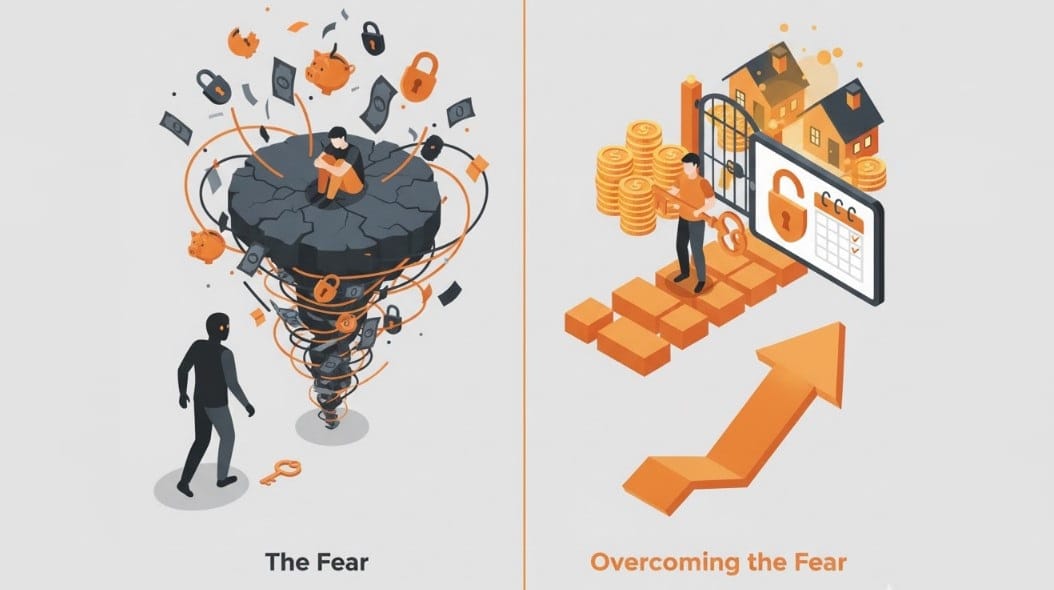
Money is never just about numbers. It’s about safety, security, and the belief that we’ll be cared for — both by ourselves and by others.
Yet for many people, money triggers deep fears of loss and abandonment. The worry that support will disappear. That we’ll be left to fend for ourselves. That financial stability — or love — could vanish overnight.
This is called the fear of financial abandonment, and it’s far more common than most realize.
It quietly influences how we spend, save, love, and trust, often without us even noticing.
1. What Is Financial Abandonment?
Financial abandonment isn’t just about being left without money — it’s the emotional experience of feeling unsafe, unsupported, or unseen in financial matters.
It can show up as:
- A partner who stops contributing financially
- Parents who withheld financial support or used money to control
- Sudden job loss or betrayal that shattered your sense of stability
The result? A lingering fear that financial security can disappear at any moment.
It’s not about greed — it’s about survival.
When your nervous system equates money with safety, any instability feels like emotional abandonment.
2. The Psychology Behind Financial Abandonment
Psychologists link financial abandonment fears to attachment theory — the idea that our earliest relationships teach us what to expect from others.
If love or security felt conditional growing up (“We can’t afford that,” “Don’t ask for too much,” “Money is tight, behave”), you may unconsciously link love and safety to financial conditions.
This creates two core beliefs:
- “If I lose financial stability, I’ll lose love.”
- “I must control money to stay safe.”
Both beliefs can lead to anxiety, over-control, or dependency in adult relationships.
3. How This Fear Shows Up in Daily Life
The fear of financial abandonment can subtly shape nearly every financial decision.
Here are common ways it manifests:
| Behavior | Underlying Emotion |
|---|---|
| Hoarding money or refusing to spend | Fear of being left with nothing |
| Overgiving financially | Trying to “buy” safety or love |
| Avoiding joint accounts | Distrust rooted in past financial betrayal |
| Overspending when anxious | Seeking control or relief from fear |
| Staying in unhealthy jobs or relationships | Fear of financial insecurity or being alone |
| Constantly checking bank accounts | Hypervigilance against potential loss |
In essence, this fear turns money from a tool of freedom into a symbol of emotional safety.
4. When Love and Money Intersect
Money and relationships often trigger one another.
If you’ve ever felt anxious about splitting bills, lending money, or asking for financial help — you’re not just dealing with numbers, but with trust wounds.
The fear of financial abandonment may make you:
- Avoid vulnerable money conversations
- Feel threatened by a partner’s financial independence
- Use money to prove worth or loyalty
- Equate financial generosity with emotional intimacy
But these behaviors often lead to resentment, imbalance, and emotional exhaustion.
Healing means learning that love and financial security are not the same currency.
5. The Cultural Layer: Scarcity and Survival
Beyond personal history, society reinforces this fear.
Messages like “You’re on your own,” “Don’t depend on anyone,” and “Financial independence is power” can make financial interdependence feel like weakness.
Yet true financial security often comes from connection, not isolation.
Even the most independent person needs emotional and social support. The myth of total self-sufficiency only deepens financial anxiety.
6. How Financial Abandonment Affects Decision-Making
When you fear financial loss, your brain shifts into survival mode, limiting your ability to make rational long-term decisions.
You might:
- Overprioritize short-term safety (hoarding cash, avoiding risks)
- Undervalue self-investment (education, health, creativity)
- Self-sabotage opportunities out of fear of change
These patterns keep you “safe” in the short term but trapped in fear-based financial loops over time.
7. Recognizing the Emotional Patterns
To break free from this cycle, awareness is key. Ask yourself:
- Do I equate financial security with love or worth?
- Do I fear being financially dependent — or financially alone?
- When I feel insecure, do I spend or save impulsively?
- Do I avoid financial discussions to prevent conflict or rejection?
Answering these honestly can uncover the root of your money anxiety — and start your healing process.
8. Healing the Fear of Financial Abandonment
Overcoming this fear isn’t about fixing your bank balance — it’s about rebuilding emotional safety around money.
Here’s how:
1. Reconnect Safety to Self, Not Money
Remind yourself: You are the source of safety.
Money is a resource, not a reflection of worth.
2. Create a Secure Financial Base
Emergency savings, debt planning, and clear budgeting create emotional breathing room.
3. Communicate Financially and Emotionally
Talk openly with partners or family about your money fears. Vulnerability builds trust.
4. Work on Self-Worth
Financial confidence grows when self-worth isn’t tied to external support.
5. Seek Guidance, Not Control
A financial therapist or planner can help separate emotional fear from practical decision-making.
Healing begins when you no longer need to control money to feel secure.
9. Building Emotional and Financial Interdependence
The healthiest form of financial relationship is interdependence — not dependence, not isolation.
That means:
- You can share resources without losing autonomy
- You can trust without feeling trapped
- You can receive help without shame
- You can give support without fear of being used
True financial safety is built on mutual trust and emotional transparency.
10. Redefining Financial Security
Financial security isn’t just about having enough — it’s about feeling enough.
It’s the confidence that, even if circumstances change, you have the resilience, skills, and support to rebuild.
When you heal the fear of financial abandonment, you move from anxiety to agency — from survival to stability.
You stop chasing external guarantees and start building inner financial trust.
Conclusion
The fear of financial abandonment is not weakness — it’s a survival response rooted in experiences of instability, scarcity, or betrayal.
But you are no longer that person waiting for safety to arrive.
You have the power to create it.
Money will always fluctuate.
But emotional safety — once rebuilt — stays.
Heal your fear of financial abandonment, and you’ll find that security doesn’t come from what you hold — but from how deeply you trust yourself to handle whatever comes next.