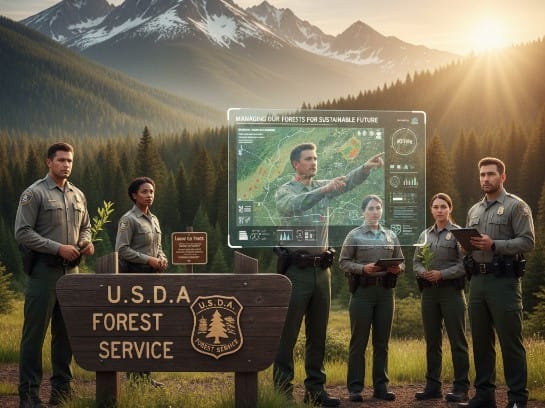
Introduction: A Technological Shift in Forest Management
In 2024–2025, a notable development emerged: the USDA Forest Service has begun deeper collaboration with Google (and Google Cloud / AI technologies) to modernize how it collects, processes, and analyzes forest data. TechTrend+1
Google + USDA Forest Service → Data → AI/ML → Forest Insights → Policy & Action
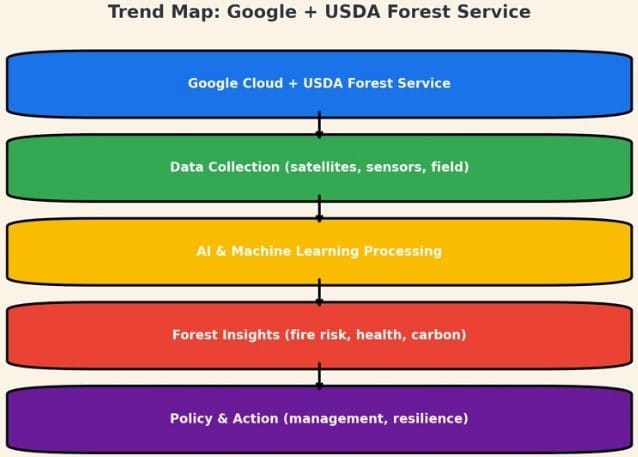
This is more than a tech partnership. It signals a broader shift in how federal agencies manage natural resources — using big data, machine learning, remote sensing, cloud platforms, and predictive modeling.
In this article, we’ll examine:
- What this trend is
- Why it matters
- The challenges and risks
- What it suggests about future forest stewardship
- How stakeholders (scientists, NGOs, the public) should respond
What’s Going On: Google + USFS Cooperation
Here are a few concrete instances that illustrate this trend:
1. Google Cloud & AI/ML Support for the Forest Service
In late 2024, TechTrend was awarded the USDA STRATUS task order to lead the Forest Service’s adoption of Google Cloud infrastructure, especially for AI/ML workloads. TechTrend
The idea is to provide scalable, secure computing power, data infrastructure, and machine-learning support to help manage Forest Service research, modeling, and operations.
2. Remote Sensing, Large-Scale Data, and Google Earth Engine (GEE)
Researchers from USDA Forest Service stations (Pacific Northwest, Rocky Mountain) collaborated with Google to customize GEE for forest attribute mapping. USFS Research & Development
By leveraging GEE’s cloud computing and satellite data, they sped up processing for spatial forest maps and improved modeling workflows.
3. Increased Use of Spatial & Temporal Models
The Forest Inventory & Analysis (FIA) program, a core data arm of USFS, is exploring spatial-temporal modeling to infer forest changes over time — a methodological upgrade from older design-based methods. arXiv
These models require high computational capacity, data fusion, and integration across large datasets — exactly where cloud + AI systems excel.
Why This Trend Matters: The Stakes & Opportunities
This partnership is more than a geeky upgrade. It has real-world implications:
A. More Responsive & Predictive Forest Management
With better computational tools, the Forest Service can anticipate challenges like drought, disease outbreaks, wildfire risk, and tree mortality earlier — shifting from reactive to proactive management.
B. Improved Data Quality & Transparency
Modern data systems allow more consistent collection, integration (satellite, field, sensor), and public access to forest health data. This strengthens scientific credibility, public trust, and stakeholder collaboration.
C. Cost & Efficiency Gains
Legacy systems can be expensive to maintain and slow to update. Adopting cloud infrastructures means economies of scale, flexibility, and reduced duplication across branches.
D. Enabling Climate Adaptation Strategies
Climate change is stressing forest ecosystems globally. Tools powered by AI can help design adaptive silviculture, assisted migration, or carbon accounting — critical strategies in the coming decades.
Challenges, Risks & Cautionary Factors
As with any trend, there are pitfalls to watch:
- Data Bias & Model Overconfidence: Models can systematically misrepresent under-sampled regions or rare events.
- Equity & Access: Small agencies, tribal nations, or rural research stations may lack resources or connectivity to use cloud systems.
- Vendor Lock-In: Heavy reliance on Google’s infrastructure could limit flexibility or raise costs in the long run.
- Privacy, Security & Governance: Sensitive ecological, land ownership, or proprietary data require strong governance, encryption, and oversight.
- Technical Staff & Capacity: The Forest Service must hire or train staff able to operate these systems — loss of institutional knowledge becomes a liability.
Additionally, external pressures — such as budget cuts, staffing shortages, or shifting policy priorities — can threaten continuity. For example, a 2025 GAO report flagged that workforce downsizing and staffing gaps are delaying progress in communication, mapping, and wildfire response efforts. Government Executive
What This Suggests for the Future (2025–2030)
Here’s where this trend might evolve:
| Domain | Likely Direction | Impact |
|---|---|---|
| Forest Monitoring | Real-time sensor networks + satellite integration | Near-term condition tracking (moisture, insect outbreaks) |
| Predictive Analytics | Models forecasting fire, disease, mortality | Preventive intervention becomes feasible |
| Public Access & Visualization | Interactive dashboards & mobile apps for citizens, researchers | Greater transparency and civic engagement |
| Climate Adaptation | Tools to evaluate alternate species, drought-resistant genotypes | Informed assisted migration and forest resilience |
| Decentralization | Edge computing in remote stations | Local nodes that sync with central cloud for efficiency |
In short: forest management is becoming data-driven, anticipatory, and collaborative.
What Stakeholders Should Do Now
If you’re a researcher, nonprofit, land manager, or concerned citizen, here are some steps you can take:
- Advocate for open data — push for public access to cloud-hosted forest datasets.
- Build partnerships — universities, NGOs, field stations can co-invest in capacity.
- Learn or train in cloud/AI skills — expertise is in demand in this transformation.
- Monitor policy & budget changes — these can enable or disable tech progress.
- Participate in pilot programs — testing new tools with USFS collaboration provides early access and influence.
Conclusion: A New Chapter for Forest Stewardship
The Google-USDA Forest Service trend isn’t just about tech for tech’s sake — it’s a strategic rethinking of how we manage forests in an era of climate complexity. If done wisely, it could usher in more predictive, responsive, and resilient forest systems that better serve ecosystems, communities, and the planet.
🔑 Interactive Question: In your view — what’s the single most transformative way AI + cloud computing could help manage forests better (e.g. wildfire forecasting, carbon mapping, species adaptation)?