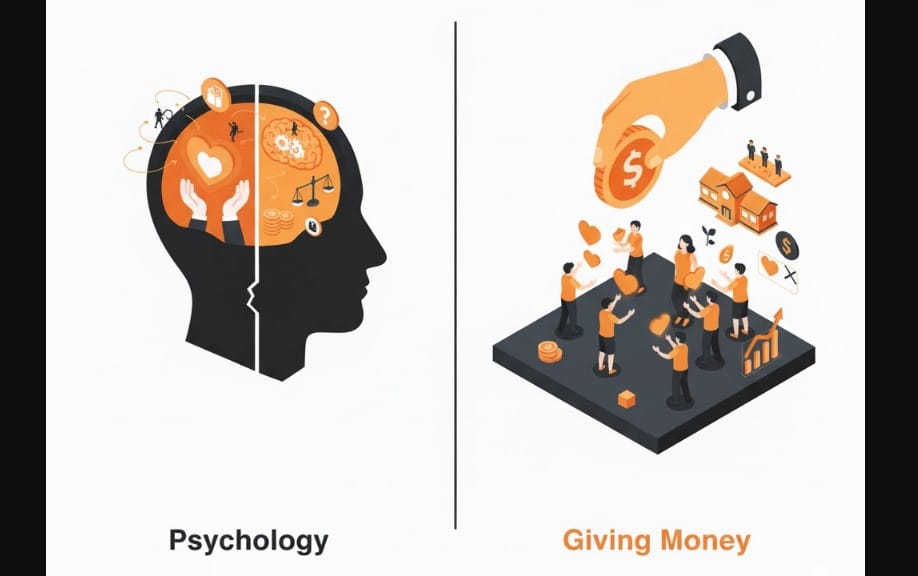
Money is more than numbers in a bank account — it’s an emotional language that reveals how we see the world, ourselves, and others.
While most conversations about money revolve around earning, saving, and investing, few explore the emotional and psychological impact of giving.
But here’s the truth:
How you give is just as important as how you earn.
Understanding the psychology of giving money helps you create not only financial abundance — but also emotional freedom and purpose.
1. Giving and the Human Brain
Modern neuroscience has revealed that acts of generosity activate the brain’s reward center — the same area triggered by food or pleasure.
When you give, your brain releases dopamine and oxytocin, creating what scientists call the “helper’s high.”
This isn’t just feel-good science — it explains why giving reduces stress, strengthens relationships, and even boosts long-term happiness.
In short:
Giving money activates the same psychological reward mechanisms as receiving it — but with deeper emotional returns.
2. The Emotional Layers Behind Generosity
Giving money isn’t purely logical — it’s emotional.
Here are the key emotional drivers behind why people give:
- Empathy: The ability to feel someone else’s need as your own.
- Gratitude: A recognition of abundance that inspires sharing.
- Identity: Giving helps define who we are — generous, compassionate, or purpose-driven.
- Legacy: A desire to leave a meaningful impact on others and the world.
When giving aligns with your emotional values, it transforms from a transaction into an act of alignment — a reflection of your true self.
3. Scarcity vs. Abundance: The Mindset Divide
The way you feel about giving reveals your money mindset.
| Scarcity Mindset | Abundance Mindset |
|---|---|
| “If I give, I’ll have less.” | “The more I give, the more value I create.” |
| Driven by fear of loss. | Driven by trust and purpose. |
| Hoards money for control. | Circulates money for growth. |
| Measures success by accumulation. | Measures success by contribution. |
Generosity doesn’t reduce wealth — it redefines it.
People with an abundance mindset see money as energy: the more it flows, the more it grows.
4. Giving as Financial Therapy
Giving can be a form of financial healing — especially for those who associate money with guilt, control, or fear.
When you give intentionally, you rewrite your emotional narrative around money.
For example:
- If you fear never having enough, give a small, regular amount — it teaches your brain that you’re already safe.
- If money feels transactional, give anonymously — it reconnects you with pure generosity.
- If wealth feels isolating, support a cause that connects you with others.
Giving becomes therapy through trust — a reminder that money is a tool, not a master.
5. How to Give Intentionally and Sustainably
Not all giving is equal.
True generosity balances emotion with structure.
1. Define Your Giving Purpose
Ask yourself:
“What kind of impact do I want my money to have?”
Whether it’s education, environment, or local community, having clarity ensures your giving aligns with your values.
2. Set a Giving Budget
Treat generosity like an investment — allocate a specific percentage of your income.
Even 1–5% builds a habit of intentional abundance.
3. Track Emotional ROI
Notice how giving affects your mood, motivation, and sense of connection.
Emotional returns are the ultimate dividends.
4. Give Beyond Money
Generosity isn’t limited to cash. Time, knowledge, and attention are equally powerful currencies.
6. The Paradox of Generosity
The paradox is simple yet profound:
The more you give, the richer you feel.
Studies show that consistent givers report higher levels of happiness and life satisfaction, regardless of income.
Giving fosters trust, community, and emotional security — the foundations of long-term wealth.
It reminds us that money isn’t just for spending or saving — it’s for circulating value.
7. The Future of Financial Generosity
In the digital age, giving has evolved beyond traditional charity.
Now, micro-donations, crowdfunding, and creator support platforms (like Patreon or Buy Me a Coffee) have democratized generosity.
People no longer give only to institutions — they give to ideas, art, and authenticity.
This shift marks a new era of purpose-driven wealth where money follows meaning.
Conclusion
The psychology of giving money teaches one universal truth:
Wealth isn’t measured by what you keep — but by what you’re willing to release.
Generosity expands both emotional and financial capacity.
It creates a cycle where giving fuels gratitude, and gratitude fuels growth.
In mastering the art of giving, you don’t just build wealth — you build well-being.