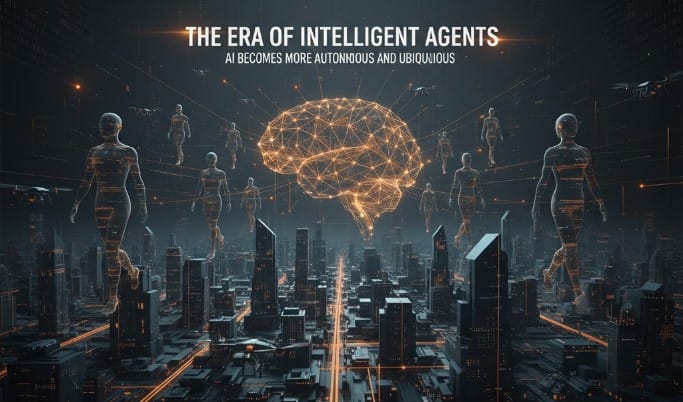
Introduction: The Rise of Intelligent Agents
Artificial Intelligence (AI) has evolved beyond traditional software. The new frontier is intelligent agents — AI systems capable of autonomous decision-making, learning, and problem-solving.
In 2025, these agents are no longer confined to labs or research papers. They are ubiquitous, appearing in business, healthcare, finance, entertainment, and daily life.
This article explores:
- What intelligent agents are
- How they function autonomously
- Their impact on industries and society
- Key opportunities and challenges
1. What Are Intelligent Agents?
Intelligent agents are AI systems designed to perceive their environment, make decisions, and act autonomously to achieve specific goals.
Key Features:
- Autonomy: Operates without constant human guidance.
- Learning Capability: Improves performance over time through data and feedback.
- Goal-Oriented Behavior: Pursues objectives efficiently.
- Interactivity: Can interact with humans, other agents, or systems.
Examples in 2025:
- AI-powered personal assistants managing tasks and schedules
- Autonomous financial trading bots optimizing portfolios
- Industrial AI agents monitoring and adjusting factory operations
2. The Shift Toward Autonomy in AI
Earlier AI systems were tool-based, performing tasks strictly under human supervision. Intelligent agents represent a paradigm shift:
- Self-Learning: They can analyze new data and adapt strategies.
- Proactive Behavior: Predicting needs and taking action before humans intervene.
- Multi-Agent Systems: Collaborating with other AI agents for complex problem-solving.
💡 Example:
A warehouse management AI not only tracks inventory but autonomously reorders stock, reroutes shipments, and predicts demand surges.
3. Intelligent Agents in Everyday Life
Intelligent agents are becoming ubiquitous:
- Personal Productivity: AI agents organize emails, schedule meetings, and suggest priorities.
- Smart Homes: Autonomous agents control lighting, climate, security, and energy use efficiently.
- Healthcare: AI agents monitor patients, suggest treatments, and predict medical risks.
- Transportation: Autonomous vehicles, traffic management AI, and ride-sharing agents.
These agents are increasingly anticipating human needs, making everyday life smoother and more efficient.
4. Transforming Industries
Intelligent agents are revolutionizing multiple sectors:
| Industry | Application |
|---|---|
| Finance | AI agents manage portfolios, detect fraud, and automate trading. |
| Healthcare | Predictive diagnostics, personalized treatment planning, and robotic surgery support. |
| Manufacturing | Autonomous production lines, predictive maintenance, and quality control. |
| Retail & E-commerce | AI agents optimize inventory, personalize recommendations, and manage customer service. |
| Energy & Utilities | Smart grids, energy optimization, and predictive maintenance of infrastructure. |
💡 Impact: Companies using intelligent agents report higher efficiency, lower operational costs, and faster decision-making.
5. Opportunities of Intelligent Agents
- Increased Productivity: Agents handle repetitive tasks, freeing humans for strategic work.
- Data-Driven Decisions: Agents analyze vast datasets to make informed choices.
- Personalization: Tailor services, products, and experiences in real-time.
- Global Collaboration: Agents can operate 24/7 across geographies, enhancing productivity.
6. Challenges and Considerations
While intelligent agents offer transformative potential, they also raise challenges:
- Ethics & Bias: Agents may perpetuate bias if trained on flawed data.
- Security Risks: Autonomous AI could be exploited for cyberattacks.
- Job Displacement: Certain roles may become automated, requiring workforce reskilling.
- Transparency: Decisions made by AI agents can be opaque, raising accountability concerns.
Pro Tip: Implement governance frameworks, continuous monitoring, and human-in-the-loop systems to mitigate risks.
7. The Future of Intelligent Agents
Looking ahead, intelligent agents will:
- Integrate more deeply with IoT devices, creating fully connected environments.
- Collaborate with humans in hybrid work systems, enhancing rather than replacing roles.
- Evolve into generalist AI agents, capable of handling multiple tasks across domains.
- Drive new business models, such as autonomous service delivery and AI-managed enterprises.
💡 Trend: The next decade may see personal AI agents as ubiquitous as smartphones today.
Conclusion: Embracing the Era of Autonomous AI
The era of intelligent agents marks a new chapter in technology and human productivity. Autonomous AI systems are no longer optional—they are becoming integral to business, healthcare, and everyday life.
For individuals and organizations, the key takeaway is clear: understand, adopt, and ethically integrate intelligent agents to stay competitive in 2025 and beyond.
The future isn’t just AI-assisted — it’s AI-autonomous and ubiquitous.
Bonus Tip
Start exploring intelligent agents today by experimenting with:
- AI personal assistants like ChatGPT or Claude
- Automation platforms like Zapier and Make
- AI-powered analytics tools in your industry
Early adoption and familiarity with intelligent agents will give you a strategic advantage in the coming years.