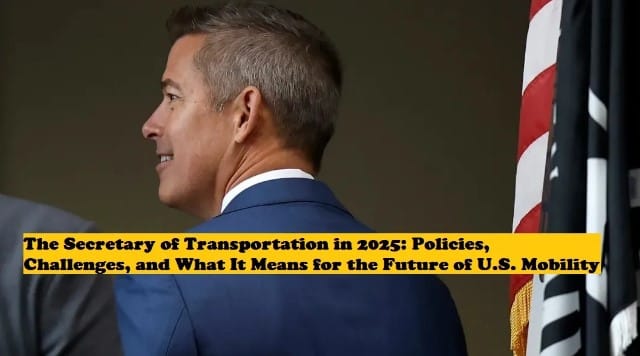
Introduction: Why Transportation Leadership Matters 🚦✈️🚛
Every U.S. administration leaves its mark on how Americans move — by road, rail, air, or sea. With trillions of dollars tied to infrastructure, energy, and logistics, the Secretary of Transportation plays a role that shapes both the economy and everyday life.
In January 2025, Sean Duffy was confirmed as U.S. Secretary of Transportation under President Donald Trump’s administration. His appointment sparked debates about priorities, regulatory changes, and the future of mobility in the U.S. Let’s break down what this leadership shift means for businesses, workers, and citizens.
Who Is Sean Duffy? 📌
Before stepping into the role of Secretary of Transportation:
- Sean Duffy was a Republican congressman from Wisconsin (2011–2019).
- He later became a TV commentator, gaining national recognition.
- Known for his strong ties to conservative policies, he was tapped to lead the Department of Transportation (DOT) in Trump’s second administration.
His background leans more political than technical — raising questions about how he will navigate the complex world of federal transportation policy.
Key Policies and Priorities Under Duffy
1. Infrastructure and Highways 🛣️
Duffy has emphasized highway expansion and modernization, aligning with Trump’s “America First” infrastructure plan.
- Support for traditional road-building projects.
- Less focus on rail or green alternatives compared to previous administrations.
- Potential rollback of environmental reviews to speed up construction.
👉 Example: The administration announced plans to redirect funds away from California’s high-speed rail project back into road-building initiatives.
2. Commercial Driver Regulations 🚚
In September 2025, the DOT announced restrictions on commercial driver’s licenses for non-U.S. citizens.
- Supporters argue it prioritizes jobs for American workers.
- Critics warn it could worsen the ongoing truck driver shortage.
This policy highlights the tension between domestic labor protection and the realities of a global workforce.
3. Aviation and International Policy ✈️
The U.S., under Duffy’s leadership, recently opposed Russia’s entry into the UN aviation council.
- This move underscores geopolitical tensions spilling into aviation governance.
- It also reflects a harder U.S. stance on international collaboration in transport.
4. Shifts in Grants and Local Mobility 🚲
The DOT has begun pulling grants for trails, cycling, and walkability projects, labeling them “hostile to cars.”
- Car-centric policies may dominate the next four years.
- Urban planners and sustainability advocates are concerned about the decline in federal support for alternative mobility.
Case Study: The High-Speed Rail Controversy 🚄
California’s high-speed rail project — once hailed as a flagship for sustainable transit — faced repeated delays and budget overruns. In 2025, Duffy’s DOT announced it would reclaim $2.4 billion in federal funds from the project.
While road advocates applauded the move, it also signaled a shift away from high-tech, green transit solutions and back to traditional highway expansion.
Opportunities and Threats for Businesses
Opportunities ✅
- Construction firms in road and highway development could benefit from fast-tracked projects.
- Aviation companies may see stronger government backing on security issues.
- Domestic trucking firms may gain from stricter CDL regulations.
Threats ⚠️
- Renewable energy and green transit companies could see reduced federal support.
- Cities pushing for bike- and pedestrian-friendly infrastructure may lose funding.
- Global trade and logistics companies could face more restrictions in international transport cooperation.
What This Means for Everyday Americans 🚦
- Drivers: More roads and highways may ease congestion in some areas.
- Urban residents: Fewer federal funds for public transit and walkability may shift burdens to local governments.
- Consumers: Trucking policy could impact shipping costs and delivery times.
Conclusion: The Road Ahead for U.S. Transportation 🌟
Sean Duffy’s leadership as Secretary of Transportation marks a pivot back toward car- and highway-focused policies, with less emphasis on climate-conscious or alternative mobility solutions.
For businesses, it means aligning with traditional infrastructure priorities. For citizens, it could shape how communities grow, commute, and connect for years to come.
🔑 Do you think the U.S. should focus on highways and traditional infrastructure, or double down on high-speed rail and green mobility?
✅ Light CTA
👉 Want more insights into how government policies affect business, innovation, and infrastructure? Subscribe to our Policy & Markets Newsletter and stay ahead of the trends shaping tomorrow’s economy.