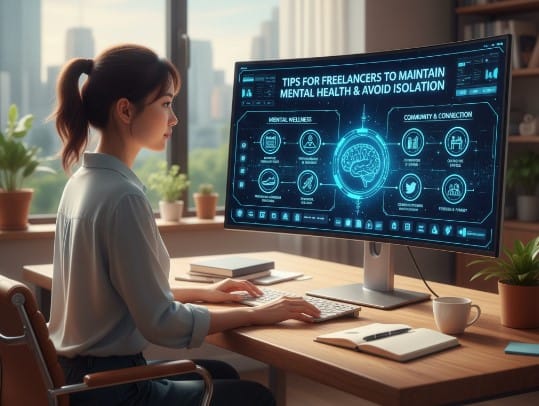
Introduction
Freelancing gives you freedom — but it can also quietly drain your emotional energy.
Many freelancers and digital creators enjoy working on their own terms but underestimate the psychological toll of isolation, uncertainty, and pressure to perform. Without a team or social structure, it’s easy to slip into loneliness, anxiety, or burnout.
This article explores practical, science-backed strategies to protect your mental health, stay connected, and thrive as a freelancer in 2025 and beyond.
1. Acknowledge That Freelancing Is Both Freedom and Responsibility
Working for yourself is empowering — but it’s not effortless. The first step to protecting your mental health is acknowledging that freedom comes with emotional management.
Example:
A designer loves working from home but notices that without coworkers or structure, days blur together and motivation drops.
Actionable Tip:
- Create clear boundaries between work and rest.
- Keep a consistent wake-up, work, and shutdown routine.
- Celebrate both small and big wins — acknowledgment fuels momentum.
2. Design a Social Routine — Even When You Work Alone
Isolation doesn’t come from being alone — it comes from lacking meaningful connection.
Example:
A writer who spends all day online might feel drained, not because of work, but because digital engagement lacks genuine emotional contact.
Actionable Tip:
- Join co-working spaces, online communities, or mastermind groups.
- Schedule weekly check-ins with fellow freelancers.
- Use virtual coffee chats (Zoom or Discord) to replace office banter.
Building a support network of people who understand your journey can dramatically improve mental resilience.
3. Prioritize Mental Health Like a Client Project
Freelancers often give 100% to clients but 0% to themselves. Mental health maintenance is a professional investment, not a luxury.
Actionable Tip:
- Schedule mental health breaks — walks, journaling, therapy sessions, or meditation.
- Use apps like Calm, Headspace, or Notion Journals for mindfulness tracking.
- Protect “no-work zones” during weekends to recover emotionally.
4. Manage Uncertainty Through Financial and Emotional Stability
One of freelancing’s biggest stressors is inconsistent income. Financial anxiety directly impacts mental well-being.
Actionable Tip:
- Build a 3–6 month financial safety net.
- Diversify income streams (e.g., affiliate marketing, digital products).
- Use finance tools like YNAB or Notion Budget Tracker to visualize stability.
Peace of mind comes not from constant earnings — but from structured financial awareness.
5. Set Boundaries with Clients and Technology
Constant connectivity blurs boundaries and accelerates burnout.
Example:
A developer who checks client messages at midnight feels constantly “on call,” unable to rest.
Actionable Tip:
- Establish office hours and communicate them clearly.
- Turn off notifications outside those hours.
- Use tools like Slack status, autoresponders, or task schedulers to manage communication gracefully.
Remember: saying “no” to chaos is saying “yes” to longevity.
6. Move Your Body and Change Your Environment
Freelancers often underestimate how physical movement impacts emotional balance. Long hours at a desk isolate both body and mind.
Actionable Tip:
- Take stretch breaks every 60–90 minutes.
- Incorporate short workouts, walks, or yoga sessions.
- Work occasionally from cafes, libraries, or co-working hubs to refresh your energy.
Movement creates clarity — and clarity prevents emotional fatigue.
7. Build a Purpose Beyond Productivity
Freelancers sometimes tie self-worth to output — but life is bigger than deadlines.
Actionable Tip:
- Engage in hobbies unrelated to work — music, gardening, or volunteering.
- Practice gratitude daily: list 3 small things you appreciate outside of income.
- Redefine “success” as balance, not just achievement.
When your purpose expands beyond work, freelancing becomes sustainable — not exhausting.
8. Seek Support When Needed
Mental health is not a solo project. Therapy, coaching, or peer mentoring are signs of strength, not weakness.
Actionable Tip:
- Use platforms like BetterHelp, Talkspace, or local counseling networks.
- Join freelancer-focused mental health communities (e.g., Leapers, Indie Hackers).
You don’t need to struggle alone — connection is medicine.
Conclusion
Freelancing can be both fulfilling and isolating — but balance is possible.
By creating structure, nurturing connections, managing uncertainty, and caring for your mental health like your business, you can enjoy the freedom of freelancing without sacrificing well-being.
You’re your most valuable asset — protect it with intention.
🔑 Interactive Question:
What’s one change you’ll make this week to protect your mental health as a freelancer?