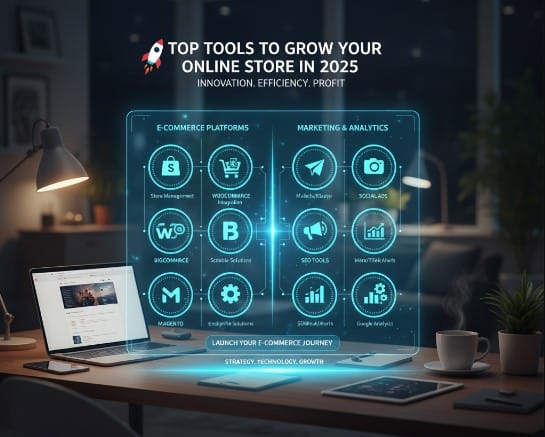
Introduction: Why the Right Tools Make All the Difference
Running an online store in 2025 isn’t just about having great products—it’s about using the right tools. Imagine launching a promotion, only to lose sales because your checkout is clunky, or your email gets marked as spam, or you can’t analyze what’s actually driving conversions.
The difference between stores that drift and stores that scale lies in tooling. The right software stack can automate tedious tasks, reduce friction, improve customer experience, and free you to focus on growth. Below are the tools you should consider integrating this year to stay ahead.
H2: What to Look for in Growth Tools
Before diving in, here are criteria to help you choose wisely:
- Usability: Easy to set up and maintain.
- Scalability: Handles growth in traffic, orders, and customer data.
- Integration: Works well with your platform (Shopify, WooCommerce, etc.) and other apps.
- Value vs Cost: Will the tool’s ROI justify its monthly fee?
- Support & Community: Good documentation and responsive support.
With those in mind, let’s explore the top tools by category.
H2: Essential Tools for Marketing & Traffic
H3: AI-Powered Content & SEO Tools
- Surfer SEO or MarketMuse – for optimizing blog & product page content to rank in search engines.
- ChatGPT / Claude / Jasper – to generate product descriptions, content ideas, email drafts, or social content. Remember to edit for brand voice.
H3: Social Media & Short-Form Video Tools
- InVideo or Pika Labs – for creating sleek, engaging product videos or promotional snippets.
- Tools like Later or Planoly – for visually planning your Instagram feed or Reels. Bulk scheduling = consistent branding.
H3: Email Marketing & SMS Providers
- Klaviyo or Omnisend – deep e-commerce integrations, automation sequences, and segmentation.
- Postscript – for SMS marketing if you’re doing 2-factor or mobile promos. Great for flash sales.
H2: Conversion Optimization & UX Tools
H3: A/B Testing & Heat Mapping
- Hotjar or FullStory – to see where users drop off, what they click, and where confusion arises.
- Google Optimize / VWO / Optimizely – test headlines, product page layouts, CTA buttons.
H3: Cart Abandonment & Checkout Optimizer
- Use CartFlows or Shopify Scripts / Plus Apps to customize checkout flows and reduce friction.
- Tools like Rejoiner or Jilt for email reminders to recover abandoned carts.
H3: Live Chat & Chatbots
- Tidio, Drift, or Chatfuel – to answer customer queries in real time. A small chatbot that handles FAQs can help reduce support load and improve conversion.
H2: Analytics, Reporting & Scaling Tools
H3: Analytics Platforms
- Google Analytics 4 – must-use for behavior tracking, conversion paths, and attribution.
- Mixpanel or Amplitude for deeper event-level tracking, especially if you have a SaaS component or membership side.
H3: Dashboard & Reporting Automation
- DashThis, Databox, or Glew.io – to pull together data from orders, ad spend, emails, etc., into a single dashboard. Helps you quickly see what’s working (and what’s not).
H3: Inventory, Fulfillment & Ops Tools
- ShipStation, ShipBob, or Selro for managing shipping and fulfillment across channels.
- Skubana or Orderbot – for automating purchase orders, tracking stock, and multi-warehouse management if you scale.
H2: Case Study: How Tool Stack Transformed a Store
Meet “FitGear Co.”, an online store selling fitness apparel and gear. At the start of 2024:
- Their email segmentation was basic; customers dropped off post-purchase.
- Cart abandonment was at ~75%.
- Their product descriptions were generic, not optimized for SEO.
They gradually adopted:
- Klaviyo → built post-purchase drip flows and segmented win-back campaigns.
- Hotjar + Google Optimize → tested different product page layouts, moved customer reviews higher up.
- Surfer SEO → rewrote top 20 product descriptions; traffic to product pages increased by 45%.
- Cart abandonment emails + SMS via Jilt/Postscript → reduced abandoned cart losses by 30%.
Result by mid-2025: Revenue up 60%, CAC (customer acquisition cost) dropped 20%, and repeat purchase rate up from 18% to 35%.
H2: Practical Action Plan: How to Integrate These Tools
- Audit your current stack – list tools you use vs what you need. Identify gaps.
- Pick one small win – maybe optimizing product pages or improving your email flow.
- Test over 30 days – implement one tool or change, measure results.
- Scale the wins – once something works, expand it. Use tools in combination (e.g. SEO + email + UX).
- Re-evaluate quarterly – remove tools that cost more than value they deliver.
Conclusion: Your Toolset Determines Your Growth
In 2025, it’s not enough to have a nice website and some products. The stores that grow fastest are those that build a smart toolkit — tools that automate, analyze, optimize, and enhance customer experience.
Pick tools that align with your current stage, invest in one or two upgrades at a time, and always track impact. Do that, and your growth will accelerate without burning you out.
🔑 Question for you: What’s the one tool (or type of tool) you feel is missing from your online store right now — and what would you try first to fill that gap?
CTA 💌
Want a curated checklist of 10 tools every serious online store should test in 2025? Subscribe to our newsletter and get it free — tracker included so you can compare before & after results.