🚀 Introduction: The AI Revolution Evolving
Artificial Intelligence has become a core part of modern life — from predictive text to smart recommendations. But not all AI is created equal.
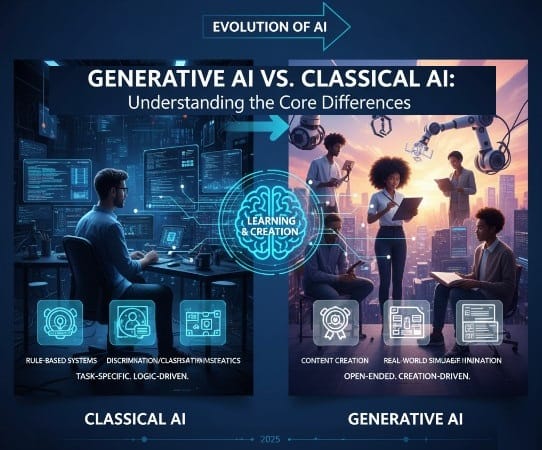
Two terms often discussed in 2025 are classical AI and generative AI. While classical AI focuses on analyzing data and making predictions, generative AI creates new content — text, images, music, and more — expanding the boundaries of human creativity.
Understanding the difference is crucial for creators, businesses, and professionals who want to leverage AI for maximum impact.
💡 H2: What Is Classical AI?
Classical AI, sometimes called narrow or rule-based AI, focuses on:
- Data analysis and predictions: e.g., forecasting stock trends or predicting customer behavior.
- Automation of repetitive tasks: e.g., sorting emails, detecting spam.
- Problem-solving using predefined rules: e.g., chess engines or early expert systems.
Classical AI does not create new content — it recognizes patterns, classifies data, and makes decisions based on rules or learned patterns.
Example:
Netflix recommending shows based on your watch history is classical AI in action. It predicts what you might like but doesn’t generate new shows.
🧠 H2: What Is Generative AI?
Generative AI goes one step further. It’s designed to create entirely new content by learning from existing data.
Key characteristics:
- Content creation: Generates text, images, music, video, or even code.
- Learning patterns: Uses large datasets to understand structure, style, and context.
- Innovation-friendly: Can produce variations or new ideas humans might not have considered.
Example:
- ChatGPT writing a blog post or story based on a few prompts.
- MidJourney generating a digital illustration of a futuristic city.
Generative AI creates instead of just predicting, making it a transformative tool for creators, marketers, and educators.
⚖️ H2: Key Differences Between Classical and Generative AI
| Feature | Classical AI | Generative AI |
|---|---|---|
| Purpose | Analyze & predict | Create & generate |
| Data Use | Learn patterns | Learn patterns + generate new data |
| Output | Predictions, classifications | Text, images, music, code |
| Creativity | None (rule-based) | High (new content creation) |
| Examples | Spam filters, recommendation engines | ChatGPT, DALL·E, MidJourney |
🚀 H2: Why Generative AI Matters in 2025
Generative AI is reshaping industries:
- Content Creation: Bloggers, marketers, and educators generate high-quality content faster.
- Design & Creativity: Artists and designers can rapidly prototype and explore ideas.
- Automation: Businesses can generate reports, emails, and personalized campaigns automatically.
- Education: Personalized learning content can be created dynamically for students.
Action Tip: Start small — experiment with ChatGPT or MidJourney to understand how generative AI can enhance your workflow.
🌱 H2: Human + AI: The Perfect Collaboration
Generative AI is powerful, but human guidance is key. AI provides speed, scalability, and inspiration, while humans provide intuition, context, and emotional resonance.
Example:
- A blogger uses ChatGPT to draft articles but edits them to include personal stories and voice.
- A designer creates AI-generated visuals but refines them for brand style and storytelling.
This collaboration multiplies creativity rather than replacing it.
🔮 Conclusion: Embrace Generative AI Today
Generative AI is not just another tech trend — it’s a paradigm shift. By understanding how it differs from classical AI and learning to integrate it into workflows, creators and businesses can unlock new opportunities and revenue streams.
🔑 Question for You:
How could you use generative AI in your workflow this week — for content, design, or automation?
CTA:
Share this article with your network and start experimenting with generative AI tools today. Your next big idea might just be one prompt away!