Introduction
Every fan has an opinion. Every coach has a philosophy. But when it comes to measuring player performance, data doesn’t lie — it reveals.
From football fields to basketball courts, analytics has revolutionized how we understand what makes a player truly valuable. No longer are goals or points the sole indicators of greatness; today, performance analysis blends data science, AI, and situational context to uncover the full story behind every action.
So, what metrics actually matter? In this guide, we’ll break down the key quantitative and qualitative indicators that define player performance — across different sports — and how to interpret them like a pro.
1. The Evolution of Player Analytics
Before the rise of sports analytics, evaluation relied heavily on traditional stats — goals, assists, rebounds, or win–loss records.
While these are useful, they don’t always capture the player’s true impact. For instance, a midfielder with zero goals might still be the engine behind a team’s success due to positioning, passing efficiency, and defensive work rate.
The modern approach to performance focuses on contextual metrics — combining data and decision-making to assess contribution beyond surface-level numbers.
2. Core Quantitative Metrics
⚽ 1. Efficiency Metrics
Efficiency tells us how effectively a player converts opportunities into results.
- Shooting Accuracy / Conversion Rate: Measures how often shots lead to goals.
- Passing Accuracy: Indicates ball control and decision quality.
- Possession Retention Rate: Tracks how well a player maintains control under pressure.
Example:
In soccer, Kevin De Bruyne’s value isn’t just assists — it’s his expected assists (xA), which measures the likelihood that a pass results in a goal-scoring chance.
🏀 2. Advanced Impact Metrics
These go beyond simple output to show how a player influences the game overall.
- Plus-Minus (±): How the team performs when the player is on the field.
- Player Efficiency Rating (PER): A basketball metric that summarizes a player’s per-minute productivity.
- Expected Goals (xG) / Expected Points (xP): Predictive metrics based on shot quality and probability.
Example:
A striker with low goal totals but high xG may be underperforming due to luck — not skill.
🏈 3. Physical and Fitness Data
Modern technology allows tracking of a player’s physiological and biomechanical performance, including:
- Distance covered per match
- Top sprint speed
- Heart rate recovery
- Load management metrics (GPS-based tracking)
Actionable Tip:
For coaches, tracking load and recovery data prevents burnout and injuries — ensuring long-term consistency rather than short-term peaks.
3. Contextual and Qualitative Metrics
🧠 1. Decision-Making and Game IQ
Numbers alone don’t measure how a player makes choices under pressure.
Cognitive metrics, such as reaction time, pass timing, and situational awareness, matter deeply in evaluating intelligence on the field.
Example:
An NBA point guard with fewer assists but higher “assist potential” — passes leading to shot opportunities — shows strong decision-making, even if teammates miss.
🧍♂️ 2. Positioning and Off-Ball Movement
Elite performers understand space as much as they understand the ball.
- Heatmaps: Visualize areas of influence and involvement.
- Off-ball runs / Defensive coverage zones: Reveal contribution beyond possession.
Example:
In soccer, N’Golo Kanté’s impact isn’t just tackles — it’s his positional intelligence, disrupting plays before they develop.
💬 3. Team Dynamics and Chemistry
Great players elevate others. Metrics like team cohesion scores, passing networks, and on-field communication analysis (AI-driven voice + movement mapping) are becoming essential to evaluate synergy.
4. The Role of AI and Predictive Analytics
AI tools now go beyond tracking — they predict future performance.
Machine learning models can forecast injury risk, fatigue levels, and even expected performance trends based on current training loads and match data.
Example:
Top European clubs use predictive models that analyze micro-movements to prevent hamstring injuries before they occur — a blend of data science and human intuition.
Actionable Tip:
Integrate AI dashboards (like STATSports or Wyscout) to visualize player data holistically. Don’t just track — interpret trends over time.
5. Metrics That Don’t Show Up on the Stat Sheet
Some of the most valuable contributions remain intangible:
- Leadership under pressure
- Communication and adaptability
- Mental resilience
- Emotional stability after setbacks
Sports psychology now recognizes these as performance multipliers.
A player with strong mindset metrics often outperforms technically stronger athletes in high-stakes moments.
6. Building a Balanced Performance Analysis Framework
To get the full picture, combine:
- Quantitative Metrics → Objective data (stats, speed, accuracy)
- Qualitative Metrics → Context and observation (decision-making, leadership)
- Predictive Insights → AI-driven forecasts for performance and injury risk
Actionable Tip:
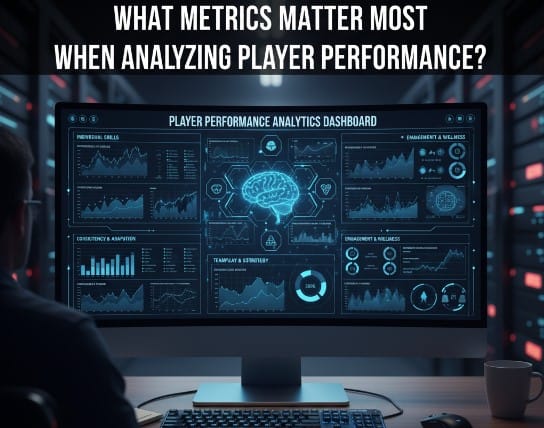
Create a Player Performance Dashboard that blends these three. For example:
- 40% Physical and Technical Metrics
- 30% Tactical and Cognitive Metrics
- 30% Psychological and Predictive Metrics
This balanced model provides both analytical depth and human understanding.
Conclusion
Performance analysis has evolved from counting goals to understanding contribution.
In the era of AI-driven analytics, the best teams and players aren’t just defined by numbers — but by how those numbers fit into a larger story of consistency, decision-making, and teamwork.
True performance isn’t just what happens on the field — it’s the sum of data, mindset, and strategy off it.
🔑 Interactive Question:
Which metric do you think best captures a player’s true impact — efficiency, intelligence, or consistency?
CTA:
Ready to analyze performance like a pro? Start by tracking both numbers and behaviors — because true success is found where data meets human insight.