🌐 Introduction: Untangling the Web3 Revolution
The internet is evolving — again.
We’ve moved from Web1 (static pages) to Web2 (social media & apps), and now we’re entering Web3, the new digital frontier powered by blockchain technology.
But many people still ask:
👉 What’s the difference between Web3, NFTs, and crypto?
👉 Are they connected or completely separate things?
Let’s break it down clearly — no tech jargon, just simple explanations that anyone can understand.
🔹 1. What Is Web3? (The Next Internet Evolution)
Web3 is the next generation of the internet built on blockchain technology — meaning it’s decentralized, user-controlled, and permissionless.
Unlike today’s Web2 platforms (like Facebook, Google, and Amazon) that own your data, Web3 aims to give ownership and control back to users.
🔍 Key Features of Web3:
- Decentralization: No single company controls the network.
- Blockchain-based: Data is stored on public, transparent ledgers.
- User ownership: People own their digital assets and identities.
- Smart contracts: Automated code that executes transactions without intermediaries.
Example:
Instead of posting videos on YouTube (where Google earns ad revenue), in a Web3 video platform like LBRY or Theta, you own your content and get paid directly by viewers using tokens.
💰 2. What Is Cryptocurrency (Crypto)?
Cryptocurrency, or crypto, is digital money that exists only on the blockchain.
It’s the financial layer of Web3 — powering transactions, apps, and decentralized ecosystems.
🔍 Key Features of Crypto:
- Digital and borderless: Works worldwide without banks.
- Secure: Protected by encryption and blockchain consensus.
- Fast & cheap: Send money in seconds with minimal fees.
- Transparent: Every transaction is public on the blockchain.
Examples of Popular Cryptocurrencies:
- Bitcoin (BTC): Digital gold; mainly a store of value.
- Ethereum (ETH): Powers decentralized apps (dApps).
- Solana (SOL): Fast blockchain for apps and NFTs.
How It’s Used:
- Buying and selling products or services.
- Paying fees (gas) on blockchain networks.
- Earning passive income through staking or lending.
🖼️ 3. What Are NFTs (Non-Fungible Tokens)?
NFTs, or Non-Fungible Tokens, are unique digital assets that represent ownership of something — like artwork, music, videos, game items, or even real estate.
They’re “non-fungible” because unlike Bitcoin (where each coin is equal), every NFT is one-of-a-kind.
🔍 Key Features of NFTs:
- Proof of ownership: Stored on the blockchain.
- Authenticity: Can’t be faked or copied.
- Royalties: Artists earn automatically when NFTs are resold.
- Utility: Can unlock access to exclusive content or experiences.
Examples:
- A digital artist sells artwork on OpenSea using NFTs.
- A gaming company sells rare characters as NFTs that players can trade.
- Musicians issue NFT albums that give fans VIP concert access.
🔗 4. How Web3, Crypto, and NFTs Work Together
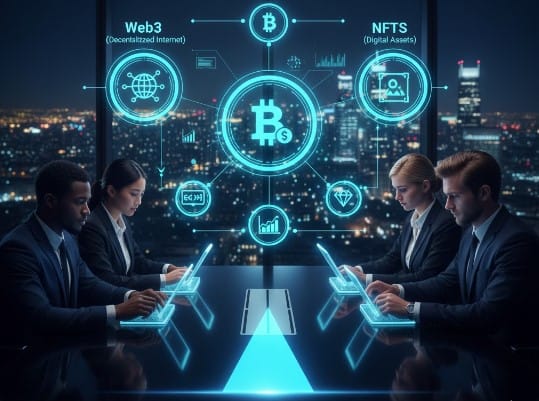
You can think of Web3 as the world, crypto as the currency, and NFTs as the assets that exist inside that world.
| Concept | Description | Example |
|---|---|---|
| Web3 | The decentralized internet | A blockchain-based social media platform |
| Crypto | The digital money used in Web3 | Paying creators using Ethereum |
| NFTs | Unique digital items or proof of ownership | Buying a digital artwork or collectible |
Example in Action:
A Web3 game runs on Ethereum. Players earn crypto tokens (ETH or game tokens) and trade NFTs representing weapons, characters, or land.
The game economy is self-sustained, owned by players — not a company.
⚙️ 5. Why These Technologies Matter in 2025
We’re moving toward a digital economy where users own what they create and earn directly from it — not through middlemen.
🌟 Impact on Industries:
- Art: NFTs let creators sell directly to fans.
- Finance: DeFi (Decentralized Finance) replaces traditional banks.
- Gaming: Players can truly own in-game assets.
- Social Media: Platforms reward engagement with crypto tokens.
Pro Tip:
The smartest businesses in 2025 are learning to integrate Web3 wallets, token-based memberships, and NFT marketing into their strategies.
🧠 6. Common Myths About Web3, NFTs, and Crypto
| Myth | Reality |
|---|---|
| “NFTs are just overpriced pictures.” | Many NFTs now represent access, memberships, or digital identity. |
| “Crypto is only for speculation.” | It powers real-world transactions, from online stores to global payments. |
| “Web3 is too technical.” | New user-friendly platforms make it easier than ever to join Web3 without coding. |
🚀 7. Getting Started with Web3 Today
If you’re curious but don’t know where to begin, start small:
Step-by-Step:
- Create a crypto wallet – MetaMask or Coinbase Wallet.
- Buy a small amount of crypto – e.g., $20 of Ethereum.
- Explore Web3 apps – Try platforms like Lens Protocol, OpenSea, or Uniswap.
- Learn & stay updated – Follow newsletters like Bankless, Decrypt, or CoinDesk.
Pro Tip:
Never invest more than you can afford to lose. Learn before you leap.
🏁 Conclusion: The Future Is Decentralized
Web3, NFTs, and crypto aren’t just trends — they’re building blocks of a new, open internet.
An internet where you own your data, your money, and your creations.
Whether you’re an artist, developer, or entrepreneur, now is the time to explore these technologies — because the future of digital ownership has already begun.
💡 Call to Action (CTA)
Ready to dive deeper?
Check out our guides on:
- [How to Get Started with NFTs in 2025]
- [Top AI Tools for Finance & Crypto Investors]
- [The Rise of Web3 E-commerce Platforms]